Porisma

Original question & working

Recover the unknown function by undoing a logarithm · source reference

[2018/DHS/Prelim/I/5] · Question pp. 5 · Working pp. 22, 23

Open the interactive lesson

The working and teaching notes are included in the interactive lesson.

View source review notes
Full original question, working & notes

Printed question

Functions f:x↦1+2x−1 f:x\mapsto1+\frac2{x-1}, x∈Rx\in\mathbb R, x<1 x<1; g:x↦ln⁡xg:x\mapsto\ln x, x∈Rx\in\mathbb R, 0<x<10<x<1.

(i) Explain why composite gfgf does not exist. [1]

(ii) Find an expression for fg(x) fg(x). Hence or otherwise find (fg)−1(0)(fg)^{-1}(0). [4]

(iii) Find h(x) h(x) for each case: (a) gh(x)=xgh(x)=x, [1] (b) hg(x)=x2+1 hg(x)=x^2+1. [2]

[2018/DHS/Prelim/I/5]

Printed working

(i) Rf=(−∞,1)⊈Dg=(0,1) R_f=(-\infty, 1)\nsubseteq D_g=(0, 1). Thus gfgf does not exist.

(ii) fg(x)=f(ln⁡x)=1+2/(ln⁡x−1)=(ln⁡x+1)/(ln⁡x−1) fg(x)=f(\ln x)=1+2/(\ln x-1)=(\ln x+1)/(\ln x-1), 0<x<10<x<1.

Method1: let x=(fg)−1(0) x=(fg)^{-1}(0). Then fg(x)=0 fg(x)=0 ⇒ (ln⁡x+1)/(ln⁡x−1)=0(\ln x+1)/(\ln x-1)=0 ⇒ ln⁡x+1=0\ln x+1=0 ⇒ ln⁡x=−1\ln x=-1 ⇒ x=e−1 x=e^{-1}. Thus (fg)−1(0)=e−1(fg)^{-1}(0)=e^{-1}.

Method2 (find inverse directly): y=(ln⁡x+1)/(ln⁡x−1) y=(\ln x+1)/(\ln x-1) ⇒ yln⁡x−y=ln⁡x+1 y\ln x-y=\ln x+1 ⇒ ln⁡x(y−1)=y+1\ln x(y-1)=y+1 ⇒ ln⁡x=(y+1)/(y−1)\ln x=(y+1)/(y-1) ⇒ x=e(y+1)/(y−1) x=e^{(y+1)/(y-1)}.

(fg)−1(x)=e(x+1)/(x−1)(fg)^{-1}(x)=e^{(x+1)/(x-1)} for −1<x<1-1<x<1, so (fg)−1(0)=e(0+1)/(0−1)=e−1(fg)^{-1}(0)=e^{(0+1)/(0-1)}=e^{-1}.

(iii)(a) gh(x)=x⇒h(x)=g−1(x)=exgh(x)=x\Rightarrow h(x)=g^{-1}(x)=e^x, x<0 x<0.

(iii)(b) Method1: hg(x)=x2+1 hg(x)=x^2+1 ⇒ hg(g−1(x))=(g−1(x))2+1 hg(g^{-1}(x))=(g^{-1}(x))^2+1 ⇒ h(x)=(ex)2+1=e2x+1 h(x)=(e^x)^2+1=e^{2x}+1.

Method2: h(g(x))=x2+1 h(g(x))=x^2+1 ⇒ h(ln⁡x)=(eln⁡x)2+1 h(\ln x)=(e^{\ln x})^2+1 ⇒ h(x)=(ex)2+1=e2x+1 h(x)=(e^x)^2+1=e^{2x}+1, on x<0 x<0.

Teacher notes

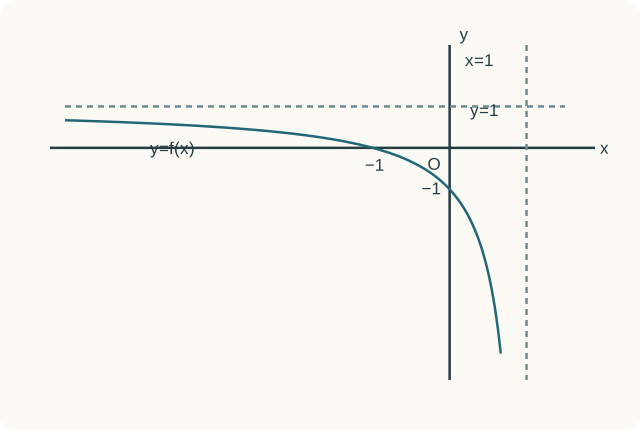
The source graph shows y=f(x) y=f(x), cuts (−1,0)(-1, 0) and (0,−1)(0, -1), with asymptotes y=1 y=1, x=1 x=1. No separate sidebar text is printed for this group; both inverse and missing-function methods are retained above.

Answer key

(i) Rf⊈DgR_f\nsubseteq D_g, does not exist. (ii) e−1 e^{-1}. (iii)(a) exe^x. (iii)(b) e2x+1 e^{2x}+1.

Native diagrams

Restricted rational curve with −1 intercepts and asymptotes x=1, y=1.