Original question & working
Compose through a restricted range, then use symmetry for area · source reference
[2010/TJC/Prelim/II/3] · Question pp. 6 · Working pp. 23, 24
Open the interactive lessonThe working and teaching notes are included in the interactive lesson.
Source discrepancy: the question uses ℝ₀⁺ but the solution uses x>0. The inclusion of 2a in the inverse domain awaits clarification.
Full original question, working & notes
Printed question
(a) Functions for , ; for , .
Determine if is one-one, justifying your answer. [1]
Only one of and exists. Give a definition (including domain) of the composite that exists, and explain why the other does not exist. Find the range of the composite that exists. [6]
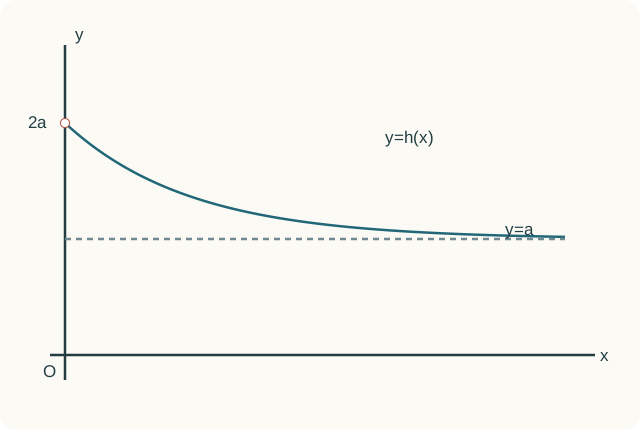
(b) , , where is positive. Find and its domain. [3]
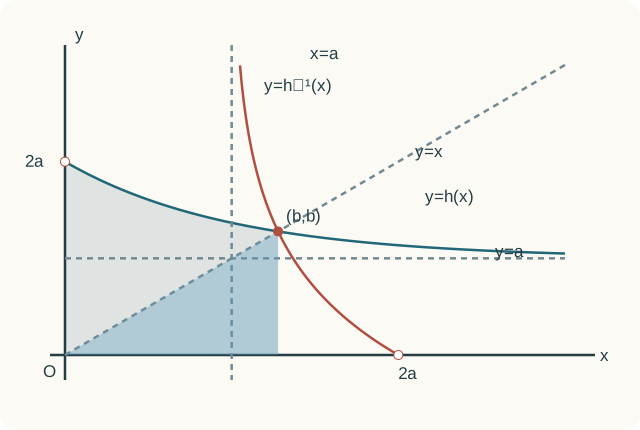
Given that and intersect where , and , find the area bounded by and the axes in terms of . [2]
[2010/TJC/Prelim/II/3]
Printed working
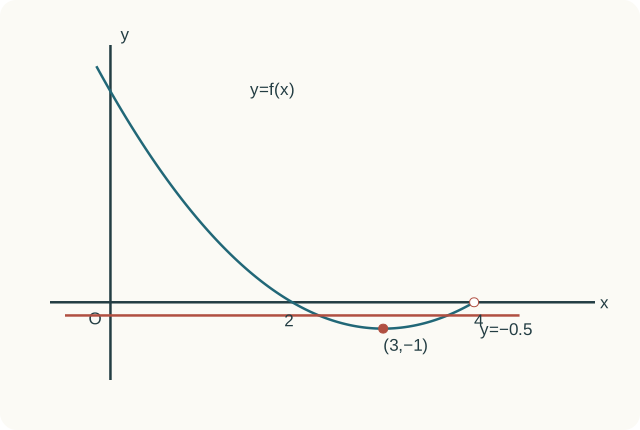
(a) Horizontal line cuts the graph of twice ⇒ is not one-one.
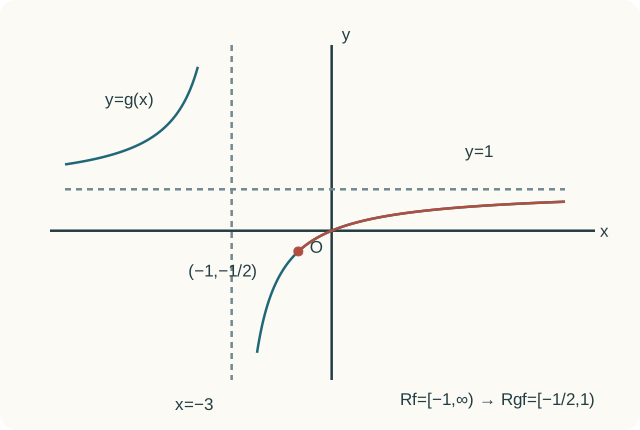
, . Since , does not exist.
, . Since , exists.
Definition for , .
The source flow diagram prints , then immediately concludes . The intermediate is a source typo: , and correct range is .
(b) The solution uses : let ⇒ ⇒ . Thus , under that interpretation.
Endpoint qualification
The question prints , normally including0, while solution explicitly uses and open endpoint . If0 is included, inverse domain is and . Both interpretations retain the same area formula.
Area bounded by and axes
Teacher notes
The horizontal-line test must include the whole printed domain .
Use symmetry about for inverse-curve areas; subtract the triangle with base and height from before doubling. Figure has point , open endpoint , and asymptotes , .
Answer key
(a) No; ; , ; . (b) inverse ; printed domain ; area .
Native diagrams