Porisma

Original question & working

A non-invertible function can have an invertible composite · source reference

[2011/RI/Promo/13] · Question pp. 6 · Working pp. 25, 26

Open the interactive lesson

The working and teaching notes are included in the interactive lesson.

View source review notes
Full original question, working & notes

Printed question

f:x↦(x−7)(x+1) f:x\mapsto(x-7)(x+1), x>0 x>0.

(a) Use an algebraic method to find exact solution of f(x)<(x2−7x)/(2−x) f(x)<(x^2-7x)/(2-x). [5]

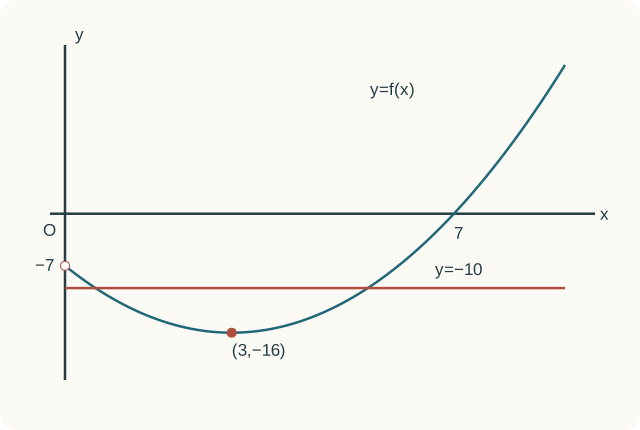
(b)(i) Determine if f−1 f^{-1} exists. [2]

Given gg is one-one with domain (0,∞)(0, \infty) and range (4,∞)(4, \infty):

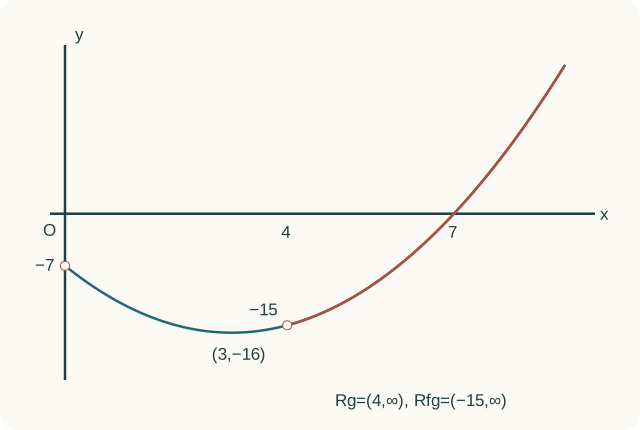
(ii) Find range of fgfg. [2]

(iii) A function hh is one-one if for any α,β∈Dh\alpha, \beta\in D_h , h(α)=h(β) h(\alpha)=h(\beta) implies α=β\alpha=\beta . Show that fgfg is one-one. [2]

(iv) If g(x)=4exg(x)=4e^x for x>0 x>0, find exact (fg)−1(20)(fg)^{-1}(20). [4]

[2011/RI/Promo/13]

Printed working

(a)

(x−7)(x+1)<x2−7x2−x⇒(x−7)(x+1+xx−2)<0,(x-7)(x+1)<\frac{x^2-7x}{2-x}\Rightarrow(x-7)\left(x+1+\frac x{x-2}\right)<0, (x−7)(x2−2)x−2<0⇒(x−7)(x−2)(x+2)x−2<0.\frac{(x-7)(x^2-2)}{x-2}<0\Rightarrow\frac{(x-7)(x-\sqrt2)(x+\sqrt2)}{x-2}<0.

Since x>0 x>0, x+2>0 x+\sqrt2>0. This reduces to (x−7)(x−2)/(x−2)<0(x-7)(x-\sqrt2)/(x-2)<0 ⇒ (x−2)(x−7)(x−2)<0(x-2)(x-7)(x-\sqrt2)<0, x≠2 x\ne2 (multiply by positive (x−2)2(x-2)^2).

The source sign sketch has open roots 2,2,7\sqrt2, 2, 7, negative to the left of 2\sqrt2 and between 2 and 7. Given x>0 x>0, solution 0<x<20<x<\sqrt2 or 2<x<72<x<7.

(b)(i) Horizontal line y=−10 y=-10 cuts ff twice ⇒ff not one-one ⇒f−1 f^{-1} does not exist. Graph has open (0,−7)(0, -7) and vertex (3,−16)(3, -16).

(ii) Dg=(0,∞) D_g=(0, \infty), Rg=(4,∞) R_g=(4, \infty); flow Dg→gRg→fRfg=(−15,∞) D_g\xrightarrow g R_g\xrightarrow f R_{fg}=(-15, \infty). Thus range (−15,∞)(-15, \infty).

(iii) Dfg=Dg=(0,∞) D_{fg}=D_g=(0, \infty). Suppose fg(α)=fg(β) fg(\alpha)=fg(\beta) for α,β>0\alpha, \beta>0: f[g(α)]=f[g(β)] f[g(\alpha)]=f[g(\beta)]. Since Rg=(4,∞) R_g=(4, \infty), both inner values lie in (4,∞)(4, \infty). From graph ff is one-one restricted to (4,∞)(4, \infty) ⇒g(α)=g(β) g(\alpha)=g(\beta). Since gg is one-one, α=β\alpha=\beta . Hence fgfg is one-one (shown).

(iv) Let (fg)−1(20)=x(fg)^{-1}(20)=x . Then f(g(x))=20 f(g(x))=20 ⇒[g(x)]2−6g(x)−7=20[g(x)]^2-6g(x)-7=20 ⇒[g(x)]2−6g(x)−27=0[g(x)]^2-6g(x)-27=0 ⇒[g(x)−9][g(x)+3]=0[g(x)-9][g(x)+3]=0.

g(x)=9 g(x)=9, since g(x)>4 g(x)>4 makes g(x)+3>0 g(x)+3>0. Therefore 4ex=9⇒x=ln⁡(9/4)4e^x=9\Rightarrow x=\ln(9/4).

Teacher notes

g(α),g(β)∈Dfg(\alpha), g(\beta)\in D_f in the injectivity argument.

Expand fg(x)=(g(x)−7)(g(x)+1)=[g(x)]2−6g(x)−7 fg(x)=(g(x)-7)(g(x)+1)=[g(x)]^2-6g(x)-7 before solving inverse-value equation.

Answer key

(a) 0<x<20<x<\sqrt2 or 2<x<72<x<7. (b)(i) No. (ii) Rfg=(−15,∞) R_{fg}=(-15, \infty). The short key labels ln⁡(9/4)\ln(9/4) “(iii)” although it answers(iv); printed numbering retained here.

Native diagrams
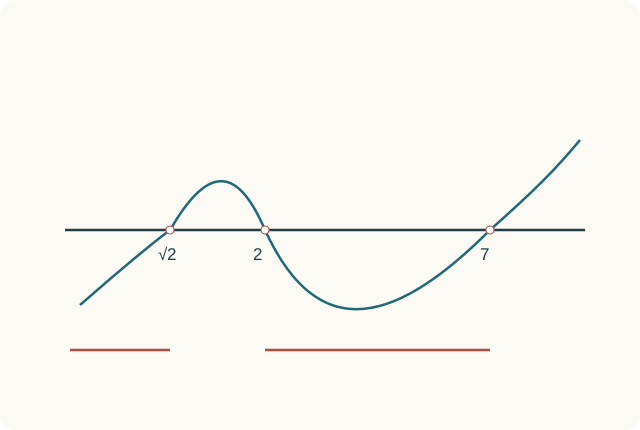
Cubic sign sketch, open roots√2, 2, 7 and highlighted negative intervals. Parabola with vertex(3, −16), open(0, −7), root7 and y=−10 line. f restricted to input Rg=(4, ∞), outputRfg=(−15, ∞), open endpoints and source vertex.