Original question & working
Composition conditions and a hidden constant case · source reference
[2019/TJC/Promo/9] · Question pp. 7 · Working pp. 27, 28
Open the interactive lessonThe working and teaching notes are included in the interactive lesson.
Source qualification: solution PDF p.28 assumes ab≠1 in part (ii). Under that part’s literal wording, a constant-map family also works. Part (iii) requires an inverse, which rules out constant maps; if that assumption is intended throughout, the printed part (ii) answer applies.
Full original question, working & notes
Printed question
Functions , , ; , , , where are constants.
(i) Sketch , giving coordinates of turning points and equations of asymptotes. Write down the range of . [3]
(ii) Find the value of and range of such that both and exist. [4]
(iii) Find . Given for all real , , find in terms of . [3]
[2019/TJC/Promo/9]
Printed working
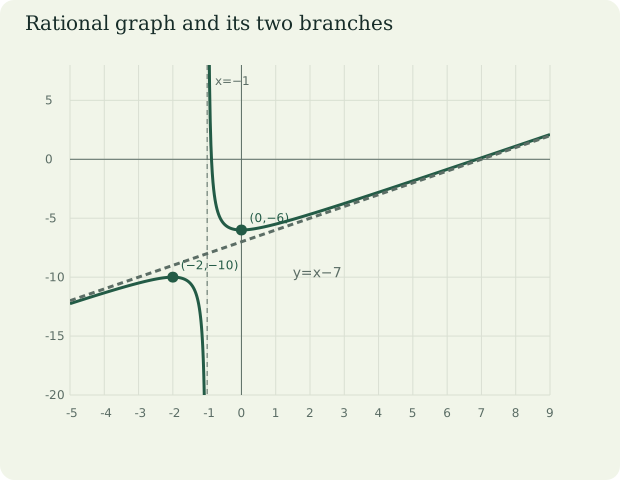
(i) . Native source graph has turning points and , vertical asymptote , oblique . Range .
(ii) Printed nonconstant argument:
, . For to exist, , i. e., hence .
, . For to exist, ⇒ ⇒.
Constant-family qualification
The displayed range requires . Literal (ii) also permits : then on its punctured domain, . Both composites exist for , since and is outside . Part (iii) requires an inverse and therefore excludes constant . If that premise applies throughout, the printed nonconstant answer is the intended answer.
(iii) Let ⇒ ⇒ ⇒, , provided .
Given , . By comparison, . With the determinant is nonzero(), so the inverse exists and domains agree.
The short key sketch labels oblique line“”, whereas the detailed working labels ; the latter is consistent with . Both printed labels are recorded, and native correct curve uses .
Teacher notes
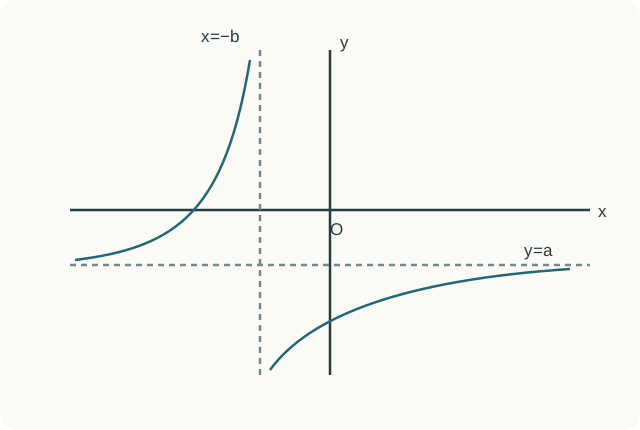
No separate teacher sidebar is printed. The rational graph for illustrates nonconstant case with asymptotes , ; the constant case has a removable hole at instead of a vertical asymptote.
Answer key
(i) , turning points and asymptotes in the native figure. Shortkey oblique label“” is corrected separately above. (ii) Printed , , constant-family qualification above. (iii) .
Native diagrams