Original question & working
Nested derivatives and increasing intervals · source reference
2009/DHS/Prelim/I/4 · Question pp. 1 · Working pp. 1
Open the interactive lessonThe working and teaching notes are included in the interactive lesson.
Do not omit the derivative of g. A squared denominator is positive only where nonzero.
Full original question, working & notes
Printed question
(a) Suppose the following facts are known about the function and its derivative: , . If , find the value of . [3]
(b) Find, by differentiation, the range of values of for which the function increases as increases. [3]
[2009/DHS/Prelim/I/4]
Printed working
(a) .
Thus (3 s.f.).
(b) .
Function is increasing .
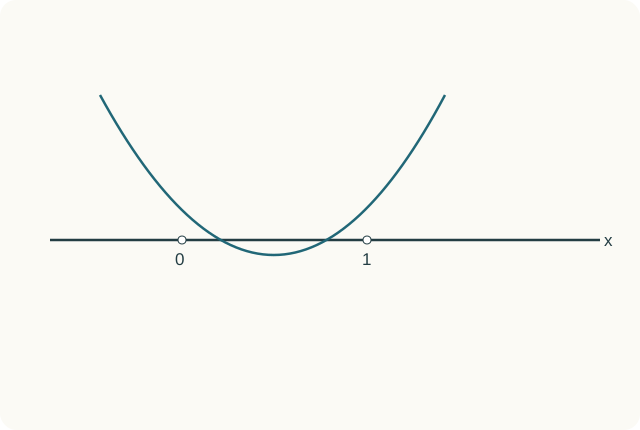
Therefore , since for all real . The numerator parabola has zeros and is positive outside those zeros, so or .
Teacher notes
Apply Chain Rule: let and .
Differentiate from “outside to inside”: layer ① is , layer ② is the exponential , layer ③ is . Differentiate ① first, then ② → ③.
Apply quotient rule in (b).
Answer key
(a) (3 s.f.). (b) or .
Native diagrams