Original question & working
Turn a curve sketch into its gradient graph · source reference
modified 2010/RVHS/Prelim/II/1 · Question pp. 1 · Working pp. 3
Open the interactive lessonThe working and teaching notes are included in the interactive lesson.
Roots of f need not be roots of its derivative.
Full original question, working & notes
Printed question
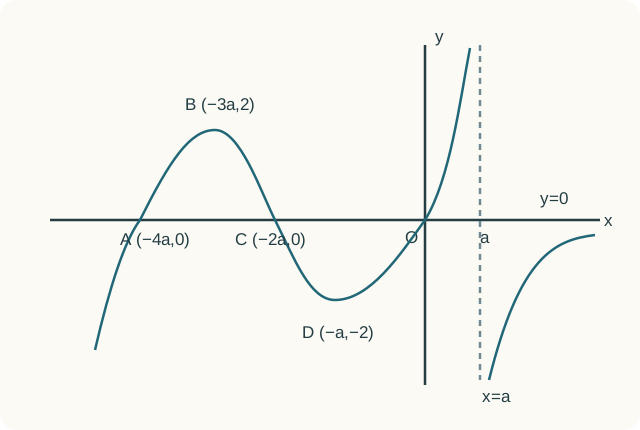
The diagram shows the graph of . The curve passes through the origin , the points and . The points and are stationary points and the lines and are asymptotes of the curve.
Sketch the graph of , indicating clearly the points corresponding to , , and , and the asymptotes, where applicable. [2]
[modified 2010/RVHS/Prelim/II/1]
Printed working
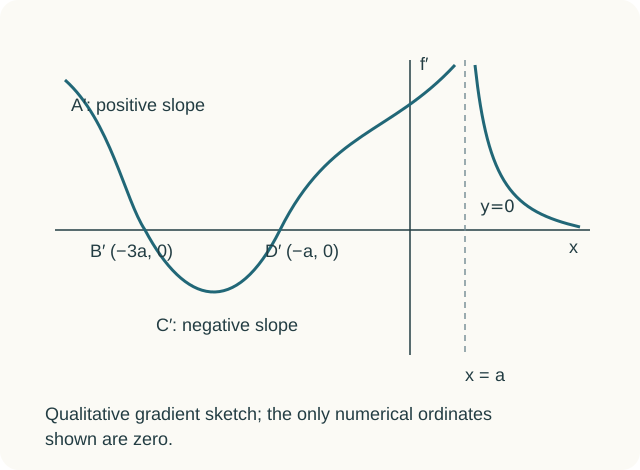
The printed solution is the native derivative sketch below: and are its intercepts, with asymptotes and . At the abscissae of and , the derivative is respectively positive and negative; numeric ordinates are not supplied.
Teacher notes
-
Asymptotes: asymptotes , of curve remain as asymptotes of curve in the supplied sketch.
-
Stationary points of curve become -intercepts of curve since at .
-
Map out the graph by tracing the gradient of curve as increases.
Note: curve decreases (i.e. curve to ) / increases ⇒ gradient / ⇒ curve lies below / above the -axis.
Qualification: the asymptote rule describes this particular source sketch, not every differentiable function with a horizontal asymptote.
Answer key
Same derivative sketch as the detailed solution.
Native diagrams