Original question & working
Recover a rational curve from its asymptotes · source reference
2008/NJC/Prelim/I/11(i) · Question pp. 2 · Working pp. 5, 6
Open the interactive lessonThe working and teaching notes are included in the interactive lesson.
No stationary points alone gives c≥−1; the stated vertical asymptote excludes equality.
Full original question, working & notes
Printed question
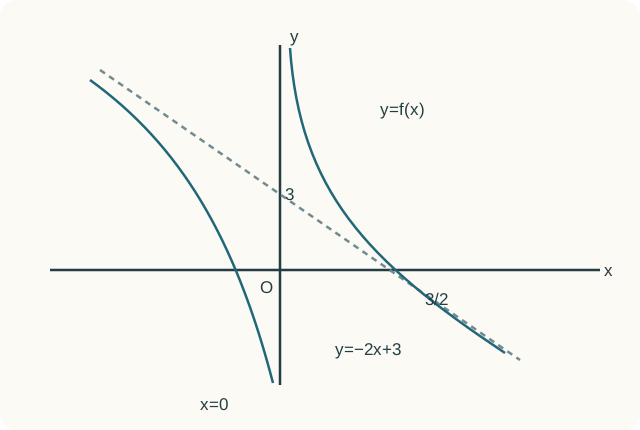
The diagram above shows the graph of the function where , . The oblique asymptote intersects the axes at and . Find the values of .
By considering , show that . [5]
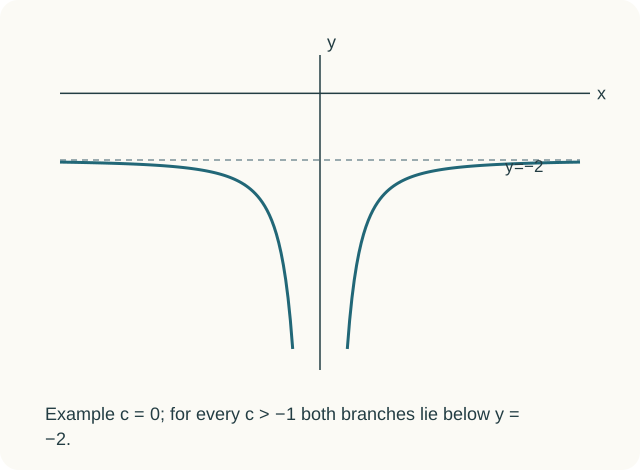
Sketch, on a separate diagram, the graph of . [3]
[2008/NJC/Prelim/I/11(i)]
Printed working
From the diagram vertical asymptote is . Thus .
Gradient of oblique asymptote . Equation of oblique asymptote: .
Comparing coefficients, , , .
From graph, has no stationary points. So has no real solutions ⇒ has no real solutions ⇒ ⇒ .
The source argument also uses the visible vertical asymptote: would remove it, so equality is excluded. The native derivative sketch is below.
Teacher notes
To find a vertical asymptote put denominator : (provided the numerator does not cancel that pole).
Alternative no-real-solutions test: . Since for real , for no real solutions .
OR: . For no real solutions the discriminant .
-
Asymptotes: vertical asymptote remains. Oblique asymptote of becomes asymptote of .
-
Map out the curve by tracing the gradient of as increases. Note: is strictly decreasing ⇒ for all in its domain ⇒ the curve lies below the -axis.
Answer key
, , ; native derivative sketch has both branches below .
Native diagrams