Original question & working
Increasing and concave down from a derivative sketch · source reference
2009/HCI/Prelim/I/3 · Question pp. 3 · Working pp. 6
Open the interactive lessonThe working and teaching notes are included in the interactive lesson.
A derivative zero alone does not establish a maximum or minimum.
Full original question, working & notes
Printed question
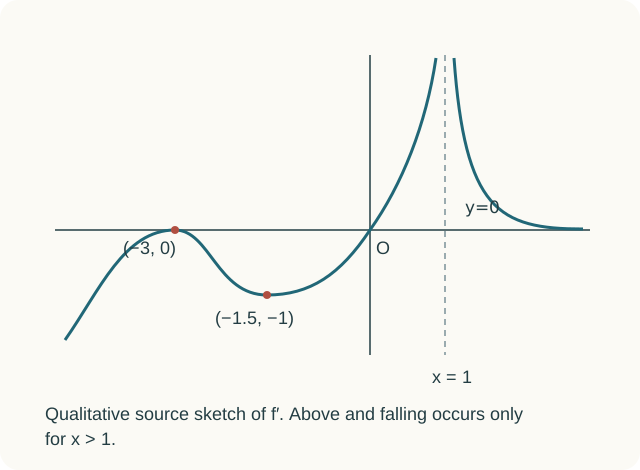
The diagram below shows the graph of . The curve passes through the origin and has turning points at and . The -axis and are the two asymptotes of the curve.
(i) Find the range of values of for which the graph of is strictly increasing and concave downwards. [1]
(ii) State the -coordinates of all the stationary points of the graph of and determine the nature of each point. [2]
[2009/HCI/Prelim/I/3]
Printed working
(i) concave downwards ⇒ , so the gradient of is negative. strictly increasing ⇒ , so the curve is above the -axis. Thus .
(ii) Stationary points: .
| negative (falling ) | (horizontal) | positive (rising ) |
Minimum point at .
| negative (falling ) | (horizontal) | negative (falling ) |
Stationary point of inflexion at . The drawn gradient has a local maximum there, so its slope changes from positive to negative.
Answer key
(i) . (ii) Stationary points : minimum at and stationary point of inflexion at .
Native diagrams