Original question & working
A vertical tangent forms a square · source reference
2012/NYJC/Prelim/I/3 · Question pp. 1 · Working pp. 1
Open the interactive lessonThe working and teaching notes are included in the interactive lesson.
An undefined slope is not automatically a vertical tangent at every singularity. Here the nonzero implicit gradient verifies it.
Full original question, working & notes
Printed question
The equation of a curve is given by . Find in terms of and , simplifying your answer. [2]
The curve meets the line at point . Find (i) the coordinates of [2] and (ii) the equation of the tangent at . [2]
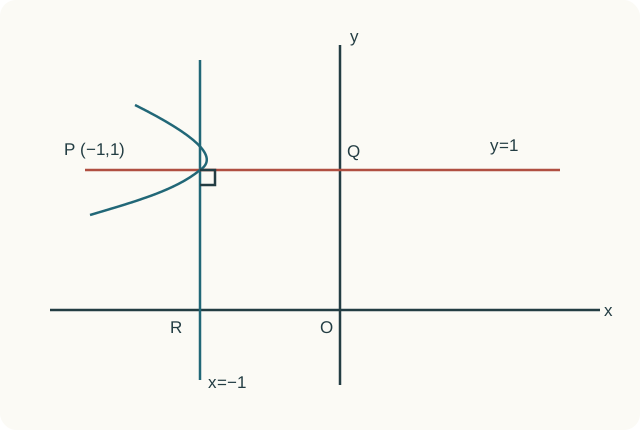
The tangent to the curve at cuts the -axis at and the normal to the curve at cuts the -axis at . If denotes the origin, use the results above to give a geometrical description of the quadrilateral . [1]
[2012/NYJC/Prelim/I/3]
Printed working
. Differentiating with respect to :
(i) Curve meets when , so , , . Thus .
(ii) At , is undefined. Thus tangent at is . The normal is ; and , giving the square .
Teacher notes
Group all terms with on one side of the equation, then take out the common factor .
Since is undefined here (the numerator is nonzero), its gradient is infinite, so the tangent at is a vertical line.
Answer key
; (i) ; (ii) ; is a square.
Native diagrams