Porisma

Original question & working

All ellipse normals through a fixed point · source reference

2023/MI/Prelim/II/4 · Question pp. 1 · Working pp. 3, 4, 5

Open the interactive lesson

The working and teaching notes are included in the interactive lesson.

Dividing by b would lose the two horizontal normals.

View source review notes
Full original question, working & notes

Printed question

MI Prelim 9758/2023/02/Q4. The curve CC has equation 2x2+y2=202x^2+y^2=20.

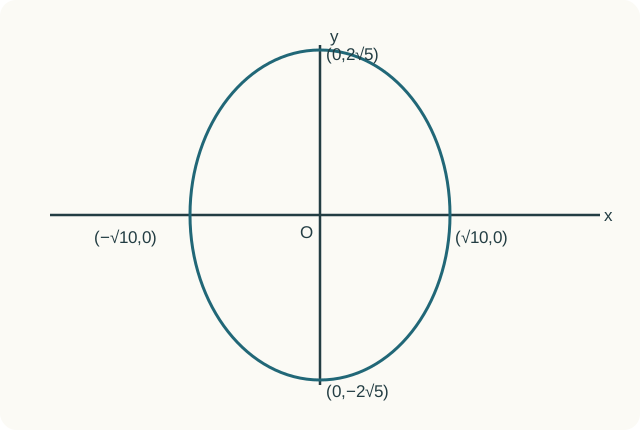
(i) Sketch curve CC, giving the exact coordinates of any points where the curve meets the axes. [2]

(ii) Show that dydx=−2xy\frac{dy}{dx}=-\frac{2x}{y}. [1]

(iii) It is given that point P(a,b)P(a,b) is on CC. The normal to CC at PP passes through the point (1,0)(1,0). Find the possible coordinates of PP. [5]

[2023/MI/Prelim/II/4]

Printed working

(i) 2x2+y2=20⇒x210+y220=1⇒x2(10)2+y2(20)2=1⇒x2(10)2+y2(25)2=12x^2+y^2=20\Rightarrow\frac{x^2}{10}+\frac{y^2}{20}=1\Rightarrow\frac{x^2}{(\sqrt{10})^2}+\frac{y^2}{(\sqrt{20})^2}=1\Rightarrow\frac{x^2}{(\sqrt{10})^2}+\frac{y^2}{(2\sqrt5)^2}=1.

The ellipse has intercepts (±10,0)(\pm\sqrt{10},0) and (0,±25)(0,\pm2\sqrt5).

(ii) 4x+2ydydx=0⇒2ydydx=−4x⇒dydx=−4x2y=−2xy4x+2y\frac{dy}{dx}=0\Rightarrow2y\frac{dy}{dx}=-4x\Rightarrow\frac{dy}{dx}=-\frac{4x}{2y}=-\frac{2x}{y} (shown).

(iii) Method 1. Normal gradient =y/(2x)=y/(2x), at (a,b)(a,b) it is b/(2a)b/(2a). Since the normal passes through (1,0)(1,0),

b2a=b−0a−1⇒ab−b=2ab⇒ab+b=0⇒b(a+1)=0.\frac b{2a}=\frac{b-0}{a-1}\Rightarrow ab-b=2ab\Rightarrow ab+b=0\Rightarrow b(a+1)=0.

So b=0b=0 or a=−1a=-1. If b=0b=0, 2a2+02=202a^2+0^2=20, a=±10a=\pm\sqrt{10}. If a=−1a=-1, 2(−1)2+b2=202(-1)^2+b^2=20, b2=18b^2=18, b=±18=±32b=\pm\sqrt{18}=\pm3\sqrt2.

Points: (10,0)(\sqrt{10},0), (−10,0)(-\sqrt{10},0), (−1,−32)(-1,-3\sqrt2), (−1,32)(-1,3\sqrt2).

Method 2. Normal equation y−b=b2a(x−a)y-b=\frac b{2a}(x-a) ⇒ y=b2ax−b2+b=b2ax+b2y=\frac b{2a}x-\frac b2+b=\frac b{2a}x+\frac b2.

Substitute (1,0)(1,0): 0=b2a(1)+b2⇒0=b+ab⇒b(1+a)=00=\frac b{2a}(1)+\frac b2\Rightarrow0=b+ab\Rightarrow b(1+a)=0. Again b=0b=0 or a=−1a=-1, and the same substitutions yield the same four points.

For completeness, the excluded case a=0a=0 has vertical normal x=0x=0, which cannot pass through (1,0)(1,0); the horizontal normals at b=0b=0 do pass through it.

Teacher notes

Since the coefficients of x2x^2 and y2y^2 have the same sign and different magnitudes, CC is an ellipse. Put the equation of CC in standard form.

Answer key

(i) Same labelled ellipse. (iii) (10,0)(\sqrt{10},0), (−10,0)(-\sqrt{10},0), (−1,−32)(-1,-3\sqrt2) and (−1,32)(-1,3\sqrt2).

Native diagrams

Ellipse, O, x and y axes, all four exact intercepts.