Porisma

Original question & working

Two tangents to an exponential-logarithmic curve · source reference

2022/HCI/Prelim/I/9 · Question pp. 1 · Working pp. 5, 6

Open the interactive lesson

The working and teaching notes are included in the interactive lesson.

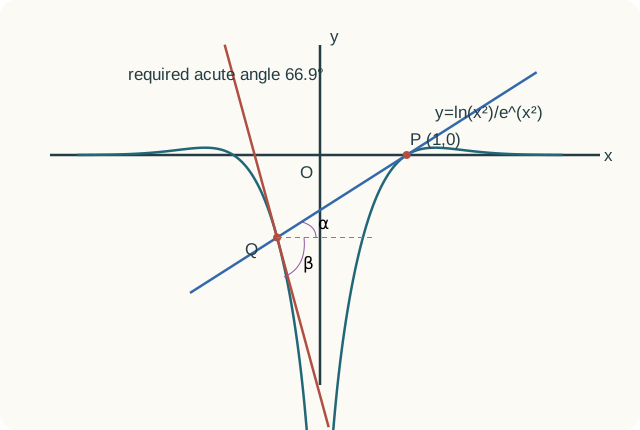
ln(x²) is defined for negative x too; replacing it by 2ln x discards the branch containing Q.

View source review notes
Full original question, working & notes

Printed question

A curve CC is given by the equation ex2y=ln⁡x2e^{x^2}y=\ln x^2, where x≠0x\ne0.

(i) Show that 2xln⁡x2+ex2dydx=2x2x\ln x^2+e^{x^2}\frac{dy}{dx}=\frac2x. [2]

(ii) Find the equation of the tangent to CC at the point PP where x=1x=1. Given that the tangent at PP meets CC again at the point QQ, find the coordinates of QQ, leaving your answer correct to 5 significant figures. [4]

(iii) Determine the acute angle, in degrees, between the tangents to CC at the points PP and QQ. [3]

[2022/HCI/Prelim/I/9]

Printed working

(i) Differentiate both sides of ex2y=ln⁡x2e^{x^2}y=\ln x^2 with respect to xx:

2xex2y+ex2dydx=1x2(2x)⇒2xln⁡x2+ex2dydx=2x2xe^{x^2}y+e^{x^2}\frac{dy}{dx}=\frac1{x^2}(2x)\Rightarrow2x\ln x^2+e^{x^2}\frac{dy}{dx}=\frac2x

(shown), because ex2y=ln⁡x2e^{x^2}y=\ln x^2.

(ii) When x=1x=1, y=ln⁡12/e12=0y=\ln1^2/e^{1^2}=0; dydx=2/1−2(1)ln⁡12e12=2/e\frac{dy}{dx}=\frac{2/1-2(1)\ln1^2}{e^{1^2}}=2/e. Tangent at PP: y=2e(x−1)y=\frac2e(x-1).

At the next intersection, 2e(x−1)=ln⁡x2ex2\frac2e(x-1)=\frac{\ln x^2}{e^{x^2}}. Using GC, the other intersection is Q(−0.49516,−1.1001)Q(-0.49516,-1.1001) (5 s.f.).

(iii) At QQ, ddx[ln⁡(x2)/ex2]∣x=−0.49516=−4.250281\left.\frac{d}{dx}[\ln(x^2)/e^{x^2}]\right|_{x=-0.49516}=-4.250281 (GC); alternatively substitute x=−0.49516x=-0.49516 into (i).

α=tan⁡−1(2/e)=36.344∘\alpha=\tan^{-1}(2/e)=36.344^\circ, β=tan⁡−1(4.250281)=76.760∘\beta=\tan^{-1}(4.250281)=76.760^\circ.

Required acute angle =180∘−36.344∘−76.760∘=66.9∘=180^\circ-36.344^\circ-76.760^\circ=66.9^\circ (1 d.p.).

Teacher notes

Apply product rule on ex2ye^{x^2}y: ddx(ex2y)=yddx(ex2)+ex2dydx\frac d{dx}(e^{x^2}y)=y\frac d{dx}(e^{x^2})+e^{x^2}\frac{dy}{dx}.

Let α\alpha be the acute angle that the tangent at PP makes with the positive xx-axis. tan⁡α=gradient of tangent at P=(dy/dx)P=2/e\tan\alpha=\text{gradient of tangent at }P=(dy/dx)_P=2/e.

Let β\beta be the acute angle that the tangent at QQ makes with the positive xx-axis. tan⁡β=∣gradient at Q∣=∣(dy/dx)Q∣=4.250281\tan\beta=|\text{gradient at }Q|=|(dy/dx)_Q|=4.250281.

Answer key

(ii) y=2e(x−1)y=\frac2e(x-1); Q(−0.49516,−1.1001)Q(-0.49516,-1.1001) (5 s.f.). (iii) 66.9∘66.9^\circ (1 d.p.).

Native diagrams

Even logarithmic-exponential curve, P, Q and both tangents with α, β and required acute angle.