Original question & working
Horizontal and vertical parametric tangents · source reference
modified 2011/SRJC/Prelim/II/3 · Question pp. 2 · Working pp. 7, 8
Open the interactive lessonThe working and teaching notes are included in the interactive lesson.
A tangent can touch at one parameter and intersect again elsewhere; do not infer the second meeting from tangency alone.
Full original question, working & notes
Printed question
A curve is defined by the parametric equations , , .
(i) Find the coordinate of the point(s) where the tangent is parallel to -axis. [3]
(ii) Find the equation of tangent to the curve that is parallel to the -axis. [2]
(iii) Find the exact equation of the tangent to the curve at the point where . [3]
(iv) Hence, determine whether the tangent at point will meet the curve again. [3]
[modified 2011/SRJC/Prelim/II/3]
Printed working
(i) , , so .
Tangent parallel to -axis ⇒ ⇒ ⇒ ⇒ (given interval). Point .
(ii) Tangent parallel to -axis ⇒ undefined ⇒ ⇒ ⇒ . Its coordinate is , so equation is .
(iii) At , , , and .
(iv) Substitute the parametric equations into the tangent:
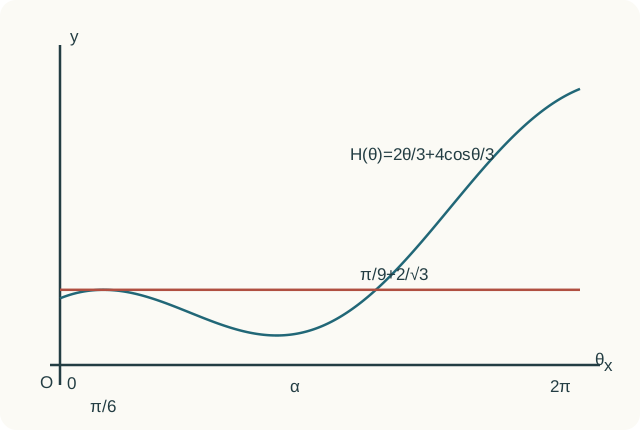
The native intersection sketch has two intersections: and . Thus the tangent intersects again at parameter .
Printed graph label uses while its horizontal axis is ; native graph uses the coherent expression , with the original mixed label recorded here.
Teacher notes
The two callout boxes identify (1) the coordinate of the point where , and (2) the equation of the tangent parallel to the -axis, a vertical line. An coordinate is not a gradient.
Answer key
(i) ; (ii) ; (iii) ; (iv) yes.
Native diagrams