Original question & working
Decreasing curves and the largest tangent intercept · source reference
2011/NYJC/Prelim/I/9 · Question pp. 2 · Working pp. 9, 10
Open the interactive lessonThe working and teaching notes are included in the interactive lesson.
Printed greatest value assumes an unstated domain restriction. Keep the local answer and unrestricted conclusion distinct.
Full original question, working & notes
Printed question
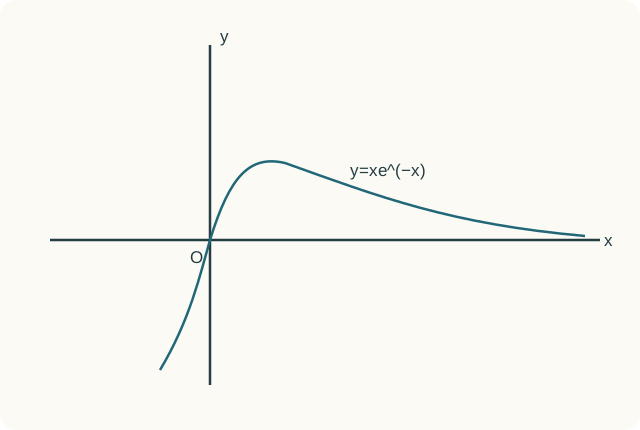
The diagram shows a sketch of the curve .
(i) By differentiation, find the range of values of for which the graph of is decreasing. [3]
(ii) Determine the range of values of for which the graph of is decreasing and concave downwards. [3]
(iii) The tangent to the curve at meets the -axis at . Express in terms of , and find the greatest possible value of . [6]
[2011/NYJC/Prelim/I/9]
Printed working
(i) , . Decreasing ⇒ ⇒ ⇒ since for all real ⇒ .
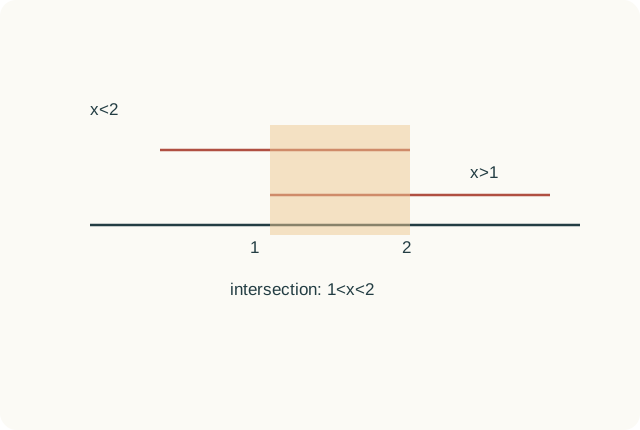
(ii) . Concave downwards ⇒ ⇒ ⇒ . Combining the number-line conditions gives .
(iii) Gradient at is . is on the tangent at :
At maximum/minimum , so or .
| Tangent-height trend | rising | horizontal | falling |
| Tangent-height trend | falling | horizontal | rising |
Printed conclusion: maximum occurs at , greatest possible .
Source-domain qualification
No restriction is printed, and the source sketch includes negative . On all real , as , so there is no greatest value. is a local maximum and is the greatest value on . At the intercept formula follows directly from the tangent, though the displayed secant-gradient rearrangement divides by .
Answer key
(i) ; (ii) ; (iii) printed , qualified above.
Native diagrams