Porisma

Original question & working

Ellipse tangent intercepts and their midpoint · source reference

2023/ACJC/Promo/7 · Question pp. 3 · Working pp. 12, 13

Open the interactive lesson

The working and teaching notes are included in the interactive lesson.

The midpoint locus is not an ordinary ellipse in x,y: reciprocal coordinates satisfy the ellipse identity.

View source review notes
Full original question, working & notes

Printed question

The curve CC has parametric equations x=4cos⁡θx=4\cos\theta, y=3sin⁡θy=3\sin\theta, 0<θ≤π0<\theta\le\pi.

(a) Point QQ lies on CC and is moving along CC, such that its xx coordinate is increasing at the constant rate of 15 units per second. Determine the exact rate of change of θ\theta at the instant when the coordinates of QQ is (2,332)(2,\frac{3\sqrt3}2). [3]

It is given that point PP also lies on CC and has parameter pp where 0<p<π/20<p<\pi/2.

(b) Show that the equation of the tangent to CC at the point PP is given by y=(−34cot⁡p)x+3cosec⁡py=(-\frac34\cot p)x+3\operatorname{cosec}p. [3]

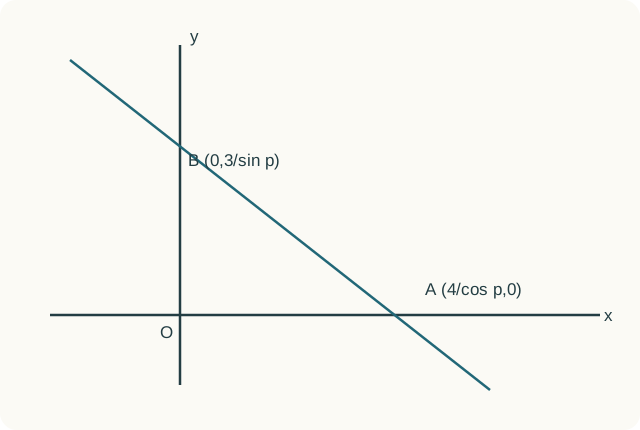
(c) The tangent to the curve at PP meets the xx-axis at the point AA and the yy-axis at the point BB. Find the area of the triangle OABOAB. [2]

(d) Let MM be the mid-point of ABAB. Find a cartesian equation of the curve traced by MM as pp varies. [2]

[2023/ACJC/Promo/7]

Printed working

(a) x=4cos⁡θx=4\cos\theta, dx/dθ=−4sin⁡θdx/d\theta=-4\sin\theta.

dθdt=dθdxdxdt=−14sin⁡θ(15).\frac{d\theta}{dt}=\frac{d\theta}{dx}\frac{dx}{dt}=\frac{-1}{4\sin\theta}(15).

At (2,33/2)(2,3\sqrt3/2), θ=π/3\theta=\pi/3, so dθ/dt=−15/(4sin⁡(π/3))=−53/2=−15/(23)d\theta/dt=-15/(4\sin(\pi/3))=-5\sqrt3/2=-15/(2\sqrt3).

(b) dy/dx=3cos⁡θ−4sin⁡θ=−34cot⁡θdy/dx=\frac{3\cos\theta}{-4\sin\theta}=-\frac34\cot\theta. At P(4cos⁡p,3sin⁡p)P(4\cos p,3\sin p), θ=p\theta=p.

y−3sin⁡p=−34cot⁡p(x−4cos⁡p),y-3\sin p=-\frac34\cot p(x-4\cos p), y=−34cot⁡p x+3sin⁡p+3cos⁡2psin⁡p=−34cot⁡p x+3sin⁡2p+cos⁡2psin⁡p=−34cot⁡p x+3cosec⁡p.y=-\frac34\cot p\,x+3\sin p+3\frac{\cos^2p}{\sin p}=-\frac34\cot p\,x+3\frac{\sin^2p+\cos^2p}{\sin p}=-\frac34\cot p\,x+3\operatorname{cosec}p.

(c) A=(4/cos⁡p,0)A=(4/\cos p,0), B=(0,3/sin⁡p)B=(0,3/\sin p). Area OAB=12(4/cos⁡p)(3/sin⁡p)=12/sin⁡2p=6/(sin⁡pcos⁡p)OAB=\frac12(4/\cos p)(3/\sin p)=12/\sin2p=6/(\sin p\cos p).

(d) M=(2/cos⁡p,3/(2sin⁡p))M=(2/\cos p,3/(2\sin p)). Parametric equations x=2/cos⁡px=2/\cos p, y=3/(2sin⁡p)y=3/(2\sin p). Since sin⁡2p+cos⁡2p=1\sin^2p+\cos^2p=1, Cartesian equation (32y)2+(2x)2=1\left(\frac3{2y}\right)^2+\left(\frac2x\right)^2=1. Given the parameter interval, retain x>2x>2, y>3/2y>3/2.

Teacher notes

Given dx/dtdx/dt, to find dθ/dtd\theta/dt apply chain rule: dθ/dt=(dθ/dx)(dx/dt)d\theta/dt=(d\theta/dx)(dx/dt).

To find the tangent at point PP, where θ=p\theta=p, remember to substitute pp into dy/dxdy/dx.

To obtain a Cartesian equation, eliminate variable pp using the identity relating cos⁡p\cos p and sin⁡p\sin p, namely sin⁡2p+cos⁡2p=1\sin^2p+\cos^2p=1.

Answer key

(a) −53/2-5\sqrt3/2. (b) y=(−3cot⁡p/4)x+3cosec⁡py=(-3\cot p/4)x+3\operatorname{cosec}p. (c) 12/sin⁡2p12/\sin2p. (d) (3/(2y))2+(2/x)2=1(3/(2y))^2+(2/x)^2=1.

Native diagrams

Original tangent-intercept schematic: O, A, B, x and y axes.