Original question & working
A particle switches from a curve to its normal · source reference
2017/SRJC/Prelim/I/10 · Question pp. 3 · Working pp. 14, 15
Open the interactive lessonThe working and teaching notes are included in the interactive lesson.
Do not integrate from t=0 as if the entire path and axis enclosed one positive region; the early curve doubles back in x.
Full original question, working & notes
Printed question
A particle is moving along a curve, , such that its position at time seconds after it is set into motion is given by the parametric equations , .
(i) State the coordinates of the initial position of the article. [1]
(ii) Explain what would happen to the path of the particle after a long time. [1]
At the time of 2 seconds after the particle was set into motion, an external force struck the particle resulting in the particle moving in a straight line along the normal to the path at the point of collision.
(iii) Find an equation for the normal to the curve at the point , leaving your answer correct to 3 decimal places. [3]
After seconds, where , the particle reaches point , which lies on the -axis, and stops moving.
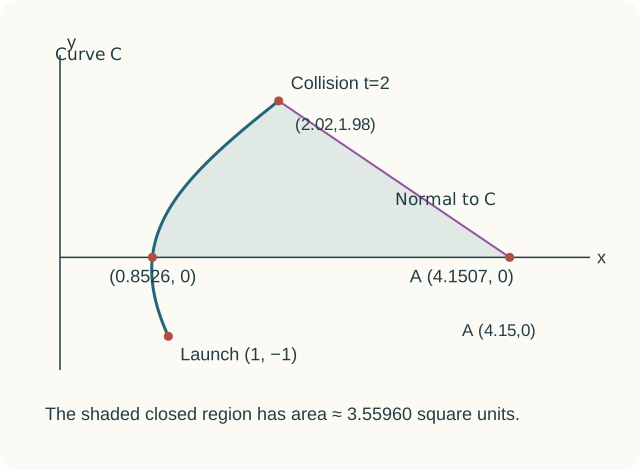
(iv) Find the coordinates of the point . Hence, give a sketch of the path traced by the particle, indicating the coordinates of any axial intercepts. [4]
(v) Find the total area bounded by the path of the particle in the first seconds and the positive -axis. [4]
[2017/SRJC/Prelim/I/10]
Printed working
(i) Original position : , , so .
(ii) As , , so the source writes , : the unforced path approaches because .
(iii) , , so .
At , , ; normal gradient .
(to 3 d.p.).
(iv) At , : , so . The source sketch shows initial , collision , normal segment to , and curved portion crossing the -axis.
(v) On , . GC gives , .
This is the closed region above the positive axis after the curved path crosses it. The initial arc below the axis alone does not enclose a region with that axis. Numerical work should keep unrounded collision/normal values internally.
Teacher notes
“After a long time” means .
Gradient of normal is .
Curve has , . Note: (1) changes to ; (2) remember to change the limits to limits.
Answer key
(i) . (ii) Approaches (unforced extrapolation). (iii) . (iv) and the native path sketch. (v) units.
Native diagrams