Original question & working
Two launch angles for an approaching target · source reference
Not printed in supplied question · Question pp. 4 · Working pp. 16, 17
Open the interactive lessonThe working and teaching notes are included in the interactive lesson.
Use degree mode for this model. The approaching target travels towards the origin, so its distance decreases.
Full original question, working & notes
Printed question
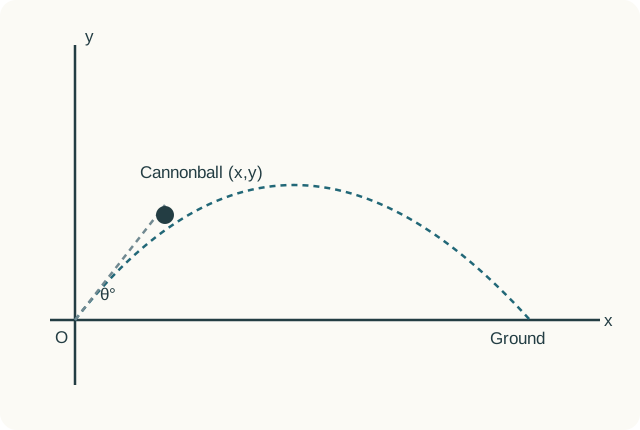
The diagram shows the trajectory of a cannonball fired off from an origin with an initial speed of and at an angle of above the ground. At time seconds, its position can be modelled by , , where m is horizontal distance with respect to and m is vertical distance with respect to ground level.
(i) Find the horizontal distance, m, that a cannonball would have travelled by the time it hits the ground. Leave your answer in terms of and . [4]
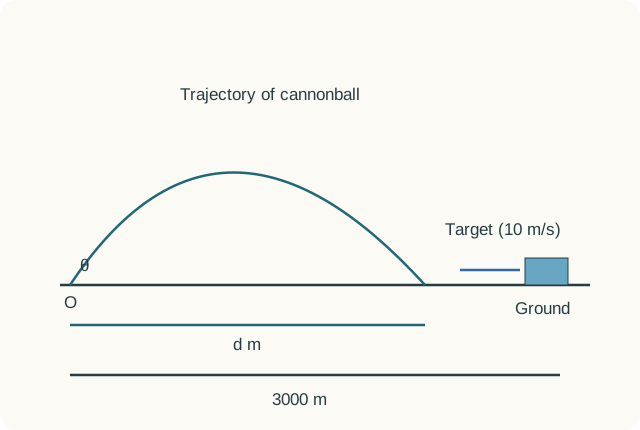
Use to answer the remaining parts. An approaching target is travelling at a constant speed of along the ground. A cannonball is fired towards it when it is 3000 m away. You may assume its height is negligible.
(ii) Show that in order to hit the target, the possible angles at which the cannonball should be fired are and . [2]
(iii) Explain at which angle the cannonball should be fired in order to hit the target earlier. [2]
(iv) Given , find the angle that the tangent to the trajectory makes with the horizontal when . [4]
Printed working
(i) To determine the range consider : .
is rejected as the starting point; otherwise .
At this time , so .
(ii) Time for cannonball to hit ground equals time for target to reach impact:
Given , . GC gives or (1 d.p.; shown).
(iii) Since and for , fire at to hit earlier.
(iv) , . Thus , , .
When , ; .
Let required angle be : (1 d.p.).
Teacher notes
When the cannonball hits ground, .
Time . The same flight time is the target’s travel time over distance .
Answer key
(i) . (iii) . (iv) (1 d.p.). No examination attribution is printed for this group.
Native diagrams