Original question & working
A cylinder inscribed in a cone · source reference
2010/NYJC/Prelim/II/Q2 · Question pp. 6 · Working pp. 20, 21
Open the interactive lessonThe working and teaching notes are included in the interactive lesson.
The surface-area bound is a limiting value for nonzero cylinder height; distinguish a supremum from an attained maximum.
Full original question, working & notes
Printed question
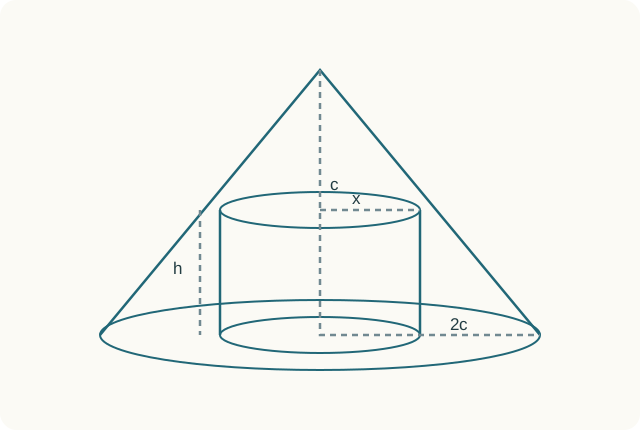
A circular cylinder is inscribed in a right circular cone of base radius and vertical height . One of the circular ends of the cylinder lies on the base of the cone and the other end is in contact with the inner surface of the cone. If the cylinder has base radius , find expressions for the volume and the total surface area of the cylinder in terms of and . If is fixed and varies, find the maximum value of . [8]
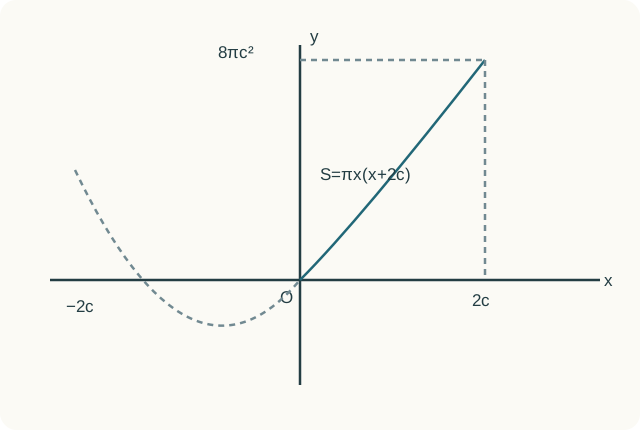
Prove that cannot exceed . [2]
[2010/NYJC/Prelim/II/Q2]
Printed working
Let be the cylinder height. Similar triangles give .
At maximum/minimum, , so or (rejected).
At , , since . Volume is maximum at .
Surface area is strictly increasing for , so largest area corresponds to largest . For a nondegenerate cylinder ,
Thus , so it cannot exceed (shown). If degenerate endpoints are admitted, equality occurs only at , height zero.
Teacher notes
Need to check that is maximum at using a first or second derivative test.
Answer key
, , maximum .
Native diagrams