Porisma

Original question & working

Vertical and horizontal gaps to a parabola · source reference

2017/ACJC/Prelim/I/8 · Question pp. 7 · Working pp. 26, 27, 28

Open the interactive lesson

The working and teaching notes are included in the interactive lesson.

The source line has x=2y+4, not 2y+2; one intermediate printed line contains the latter typo but its final Q is correct.

View source review notes
Full original question, working & notes

Printed question

The curve CC and the line LL have equations y=x2y=x^2 and y=12x−2y=\frac12x-2 respectively.

(i) The point AA on CC and the point BB on LL are such that they have the same xx-coordinate. Find the coordinates of AA and BB that gives the shortest distance ABAB. [3]

(ii) The point PP on CC and the point QQ on LL are such that they have the same yy-coordinate. Find the coordinates of PP and QQ that gives the shortest distance PQPQ. [3]

(iii) Find the exact area of the polygon formed by joining the points found in (i) and (ii). [2]

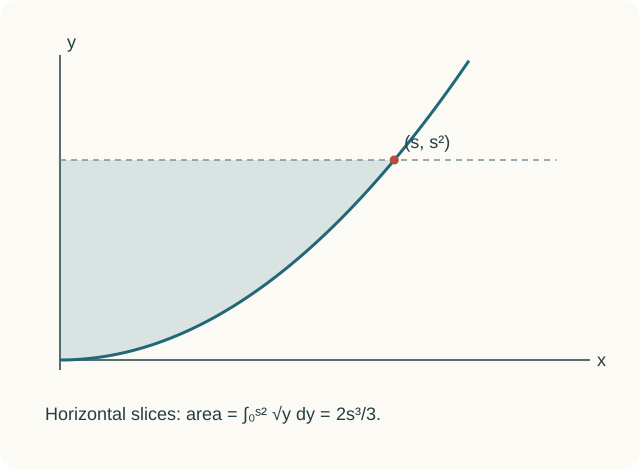
(iv) A variable point on CC with coordinates (s,s2)(s,s^2) starts from origin OO and moves along the curve with ss increasing at a rate of 2 units/s. Find the rate of change of the area bounded by the curve, the yy-axis and the line y=s2y=s^2, at the instant when s=2s=\sqrt2. [4]

[2017/ACJC/Prelim/I/8]

Printed working

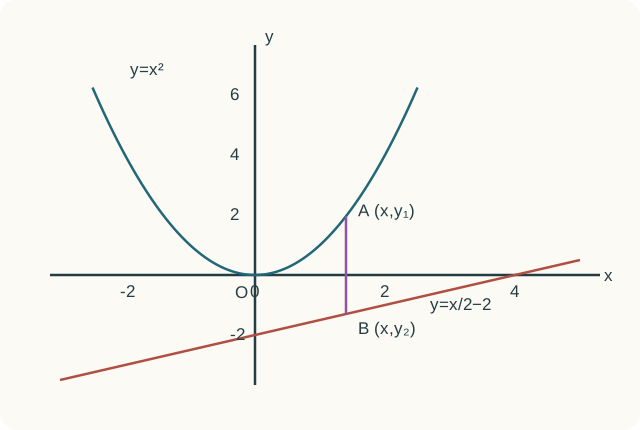
(i) Let VV be ABAB. V=y1−y2=x2−(x/2−2)=x2−x/2+2V=y_1-y_2=x^2-(x/2-2)=x^2-x/2+2, dV/dx=2x−1/2dV/dx=2x-1/2. For maximum/minimum, dV/dx=0⇒x=1/4dV/dx=0\Rightarrow x=1/4. d2V/dx2=2>0d^2V/dx^2=2>0, so minimum there. On CC, y=(1/4)2=1/16y=(1/4)^2=1/16; on LL, y=(1/2)(1/4)−2=−15/8y=(1/2)(1/4)-2=-15/8.

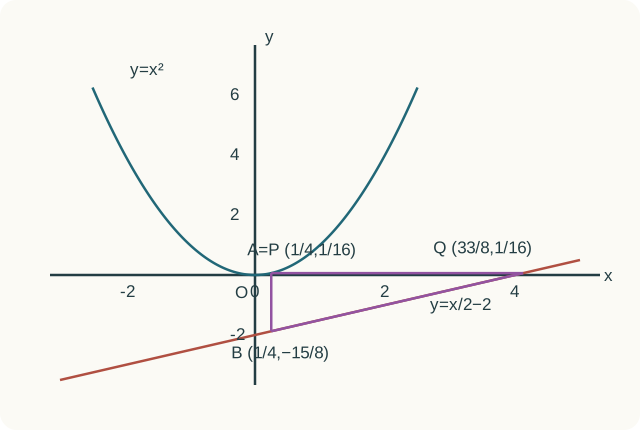
A=(1/4,1/16)A=(1/4,1/16), B=(1/4,−15/8)B=(1/4,-15/8).

Alternative printed solution: A=(x,x2)A=(x,x^2), B=(x,x/2−2)B=(x,x/2-2).

AB=x2−(x/2−2)=(x−1/4)2−1/16+2=(x−1/4)2+31/16.AB=x^2-(x/2-2)=(x-1/4)^2-1/16+2=(x-1/4)^2+31/16.

Thus minimum AB=31/16AB=31/16, attained at x=1/4x=1/4.

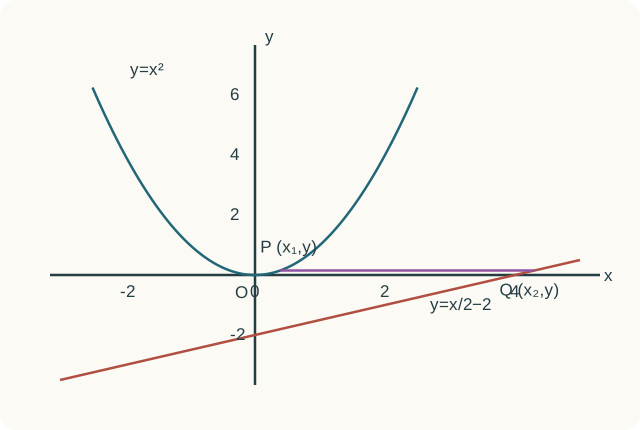
(ii) Let HH be PQPQ. H=x2−x1=2(y+2)−yH=x_2-x_1=2(y+2)-\sqrt y. dH/dy=2−12y−1/2dH/dy=2-\frac12y^{-1/2}. Set zero: 2−12y−1/2=0⇒2=12y−1/2⇒y=4−2=1/162-\frac12y^{-1/2}=0\Rightarrow2=\frac12y^{-1/2}\Rightarrow y=4^{-2}=1/16.

d2Hdy2=14y−3/2;y=1/16⇒H′′=14(1/16)−3/2=16>0.\frac{d^2H}{dy^2}=\frac14y^{-3/2};\quad y=1/16\Rightarrow H''=\frac14(1/16)^{-3/2}=16>0.

Minimum at y=1/16y=1/16. On CC, x=1/16=1/4x=\sqrt{1/16}=1/4; on LL, x=2(1/16+2)=33/8x=2(1/16+2)=33/8. The source main working prints x=2(1/16)+2=33/8x=2(1/16)+2=33/8; this intermediate +2+2 is a typographical error, and must be +4+4. Thus P=(1/4,1/16)P=(1/4,1/16), Q=(33/8,1/16)Q=(33/8,1/16).

Alternative printed solution: P=(y,y)P=(\sqrt y,y), Q=(2y+4,y)Q=(2y+4,y).

PQ=2y+4−y=2(y)2−y+4=2(y−1/4)2−2(1/16)+4=2(y−1/4)2+62/16.PQ=2y+4-\sqrt y=2(\sqrt y)^2-\sqrt y+4=2(\sqrt y-1/4)^2-2(1/16)+4=2(\sqrt y-1/4)^2+62/16.

The source has a typesetting slip in the subtraction, displaying −2(1/16)2-2(1/16)^2 on one line; the correct completed-square constant is −2(1/4)2=−1/8-2(1/4)^2=-1/8, as in the final 62/1662/16. Minimum PQ=62/16PQ=62/16 at y=1/4\sqrt y=1/4, i.e. y=1/16y=1/16.

(iii) AA and PP coincide, so polygon is a triangle. AB=1/16−(−15/8)=31/16AB=1/16-(-15/8)=31/16; PQ=33/8−1/4=31/8PQ=33/8-1/4=31/8.

Area =12×3116×318=961256=\frac12\times\frac{31}{16}\times\frac{31}8=\frac{961}{256} square units.

(iv)

A=∫0s2x dy=∫0s2y dy=[y3/23/2]0s2=23s3.A=\int_0^{s^2}x\,dy=\int_0^{s^2}\sqrt y\,dy=\left[\frac{y^{3/2}}{3/2}\right]_0^{s^2}=\frac23s^3. dAdt=dAdsdsdt=2s2(2)=4s2.\frac{dA}{dt}=\frac{dA}{ds}\frac{ds}{dt}=2s^2(2)=4s^2.

At s=2s=\sqrt2, dA/dt=4(2)2=8dA/dt=4(\sqrt2)^2=8 units2^2/s.

Alternative printed solution: area is rectangle minus area below curve:

A=s×s2−∫0sy dx=s3−∫0sx2 dx=s3−[x33]0s=23s3.A=s\times s^2-\int_0^s y\,dx=s^3-\int_0^s x^2\,dx=s^3-\left[\frac{x^3}3\right]_0^s=\frac23s^3.

Again dA/dt=(dA/ds)(ds/dt)=2s2(2)=4s2dA/dt=(dA/ds)(ds/dt)=2s^2(2)=4s^2, giving 88 units2^2/s at s=2s=\sqrt2.

Teacher notes

Use x1=yx_1=\sqrt y, not −y-\sqrt y, because the shortest distance is wanted: use the nearer branch.

Note that AA and PP are the same point, so the polygon has three distinct vertices and its area is a triangle area.

Answer key

(i) A(1/4,1/16)A(1/4,1/16), B(1/4,−15/8)B(1/4,-15/8). (ii) P(1/4,1/16)P(1/4,1/16), Q(33/8,1/16)Q(33/8,1/16). (iii) 961/256961/256 units2^2. (iv) 88 units2^2/s.

Native diagrams

Parabola y=x² and line y=x/2−2 with vertical A(x,y₁) B(x,y₂), axes and source tick geometry. Same curves with horizontal P(x₁,y) Q(x₂,y). Triangle joining exact A=P, B and Q, all fraction labels. Area bounded by curve, y-axis and y=s², labels 0, s, s² and shaded region.