Porisma

Original question & working

Use the crossing before integrating an absolute value · source reference

2025 TJC H2 Maths (9758) JC2 MSM · original exercise attribution retained on source pages · Question pp. 2 · Working pp. 10

Open the interactive lesson

The working and teaching notes are included in the interactive lesson.

View source review notes
Full original question, working & notes

Printed question

(a) Use u=ex+2u=e^x+2 to find the exact value of ∫0ln⁡2e3xex+2dx\int_0^{\ln2}\frac{e^{3x}}{e^x+2}dx. [4]

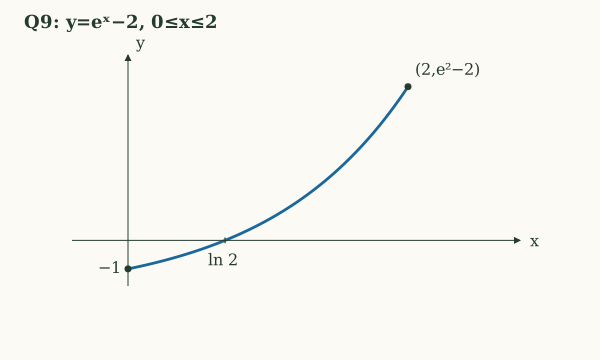
(b) Sketch y=ex−2y=e^x-2 for 0≤x≤20\le x\le2. State the exact xx where it crosses the xx-axis. [2]

Hence find the exact value of ln⁡k\ln k such that

∫02∣ex−2∣dx=∫eek1xln⁡xdx.\int_0^2|e^x-2|dx=\int_e^{e^{\sqrt k}}\frac1{x\ln x}dx.

[5]

[2011/TPJC/Prelim/I/9]

Printed working

(a)

u=ex+2u=e^x+2, du/dx=exdu/dx=e^x; when x=0,u=e0+2=3x=0,u=e^0+2=3; when x=ln⁡2,u=eln⁡2+2=4x=\ln2,u=e^{\ln2}+2=4.

∫0ln⁡2e3xex+2dx=∫34e3xex+21exdu=∫34(u−2)2udu=∫34u2−4u+4udu=∫34(u−4+4/u)du=[u2/2−4u+4ln⁡u]34=4ln⁡(4/3)−12.\int_0^{\ln2}\frac{e^{3x}}{e^x+2}dx=\int_3^4\frac{e^{3x}}{e^x+2}\frac1{e^x}du=\int_3^4\frac{(u-2)^2}{u}du=\int_3^4\frac{u^2-4u+4}{u}du=\int_3^4(u-4+4/u)du=[u^2/2-4u+4\ln u]_3^4=4\ln(4/3)-\frac12.

(b)

y=ex−2y=e^x-2 crosses the xx-axis at x=ln⁡2x=\ln2; endpoints (0,−1)(0,-1) and (2,e2−2)(2,e^2-2).

∫0ln⁡2−(ex−2)dx+∫ln⁡22(ex−2)dx=∫eek1/xln⁡xdx−[ex−2x]0ln⁡2+[ex−2x]ln⁡22=[ln⁡∣ln⁡x∣]eek−(2−2ln⁡2−1)+(e2−4−2+2ln⁡2)=ln⁡k=12ln⁡k.\begin{aligned}\int_0^{\ln2}-(e^x-2)dx+\int_{\ln2}^2(e^x-2)dx&=\int_e^{e^{\sqrt k}}\frac{1/x}{\ln x}dx\\-[e^x-2x]_0^{\ln2}+[e^x-2x]_{\ln2}^2&=[\ln|\ln x|]_e^{e^{\sqrt k}}\\-(2-2\ln2-1)+(e^2-4-2+2\ln2)&=\ln\sqrt k=\frac12\ln k.\end{aligned} ln⁡k=2(e2+4ln⁡2−7).\ln k=2(e^2+4\ln2-7).

Teacher notes

Substitution: ∫f(x)dx=∫f(x)(dx/du)du=∫g(u)(dx/du)du\int f(x)dx=\int f(x)(dx/du)du=\int g(u)(dx/du)du. For a definite integral change limits from x=⋯x=\cdots to u=⋯u=\cdots, here ∫x=0x=ln⁡2f(x)dx=∫u=3u=4g(u)du\int_{x=0}^{x=\ln2}f(x)dx=\int_{u=3}^{u=4}g(u)du. Express the integrand entirely in uu.

Use ∫f′/f=ln⁡∣f∣+c\int f'/f=\ln|f|+c. The modulus sign in ln⁡∣ln⁡x∣\ln|\ln x| is highlighted.

Printed answer key

(a) 4ln⁡(4/3)−1/24\ln(4/3)-1/2; (b) the native exponential graph below, x=ln⁡2x=\ln2; ln⁡k=2(e2+4ln⁡2−7)\ln k=2(e^2+4\ln2-7).

Source diagrams in native form

Native graph y=eˣ−2 on [0,2], labelled −1, ln 2 and (2,e²−2).