Original question & working
Rotate the region between a bell curve and a line · source reference
2025 TJC H2 Maths (9758) JC2 MSM · original exercise attribution retained on source pages · Question pp. 1 · Working pp. 1
Open the interactive lessonThe working and teaching notes are included in the interactive lesson.
View source review notesFull original question, working & notes
Printed question
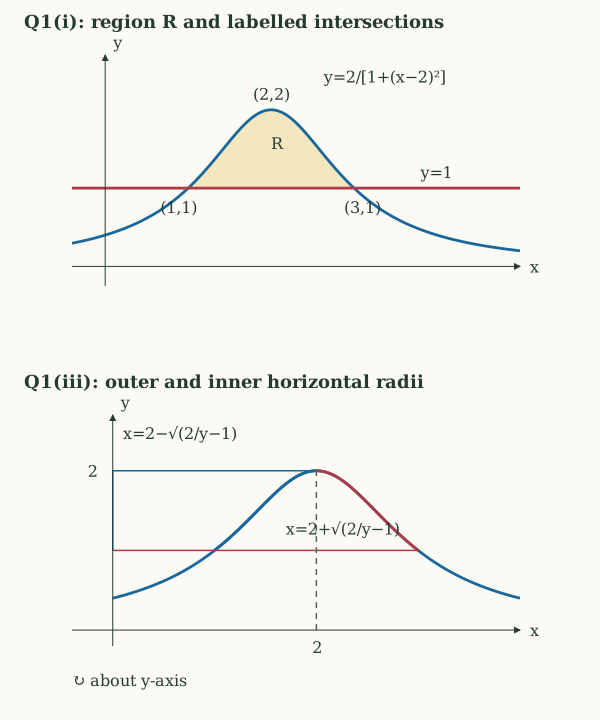
(i) Sketch and on the same diagram, showing clearly the coordinates of the stationary point and intersection points. [2]
(ii) Find the exact area of region R enclosed by the curves and . [3]
(iii) Find the volume generated when R is rotated about the -axis. [4]
[2011/MI/Prelim/II/2]
Printed working
(i)
The stationary point is ; intersections and ; region R lies above and beneath the bell curve.
(ii)
(iii)
Teacher notes
Area R , where is above or intersects for .
Volume (rotation about -axis) . The right branch is the outer radius; the left branch is the inner radius. The original diagram marks the level , centre , horizontal base , and the rotation arrow.
Printed answer key
(i) labelled native graph below; (ii) units; (iii) units.
Source diagrams in native form