Porisma

Original question & working

Change the lower boundary at the intersection · source reference

2025 TJC H2 Maths (9758) JC2 MSM · original exercise attribution retained on source pages · Question pp. 1 · Working pp. 2

Open the interactive lesson

The working and teaching notes are included in the interactive lesson.

Do not use one inner-radius formula across the whole interval. The curves exchange roles at x=1.

View source review notes
Full original question, working & notes

Printed question

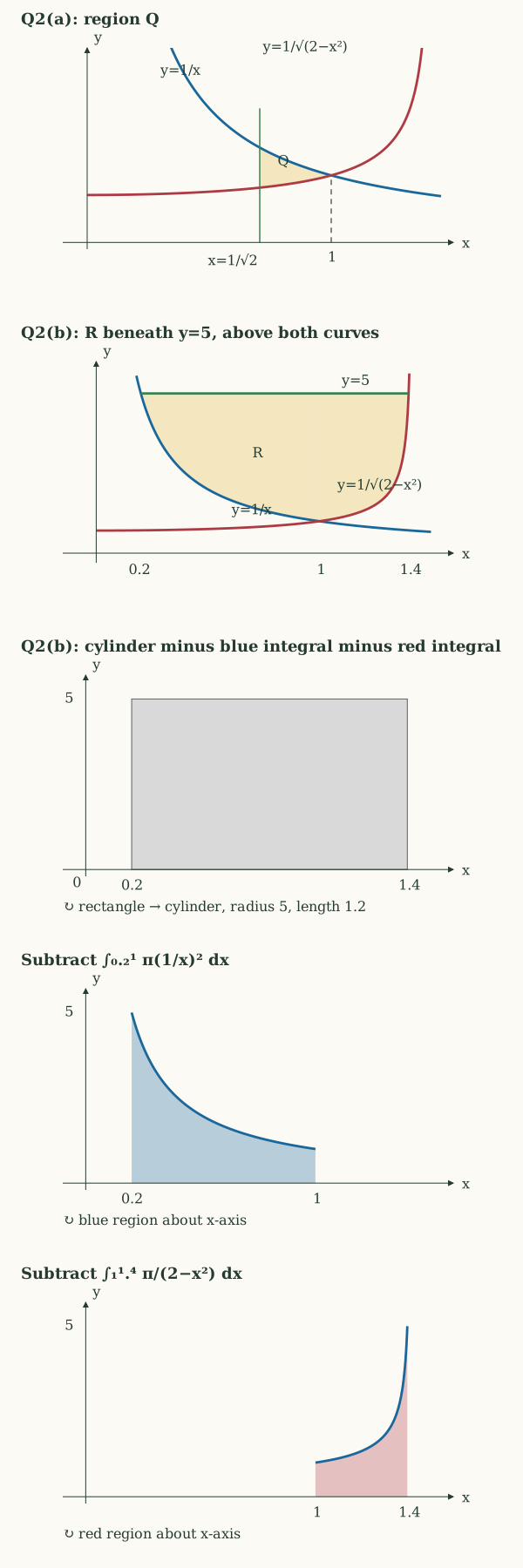
Curve C1C_1: y=1/xy=1/x; curve C2C_2: y=1/2−x2y=1/\sqrt{2-x^2}. Region Q is bounded by x=1/2x=1/\sqrt2 and both curves.

(a) Find the exact area of Q. [3]

(b) The region bounded by y=5y=5 and both curves in the first quadrant is rotated about the xx-axis by 2π2\pi radians. Find the volume of the solid. [3]

[2021/ASRJC/Prelim/I/4]

Printed working

(a)

Let 1/x=1/2−x21/x=1/\sqrt{2-x^2}. Then x2=2−x2x^2=2-x^2, so x=1x=1 since x>0x>0.

Area Q=∫1/211xdx−∫1/2112−x2dx=[ln⁡x−sin⁡−1(x/2)]1/21=(ln⁡1−sin⁡−1(1/2))−(ln⁡(1/2)−sin⁡−1(1/2))=0−π/4−ln⁡(1/2)+π/6=12ln⁡2−π12units2.\begin{aligned}\text{Area Q}&=\int_{1/\sqrt2}^1\frac1x dx-\int_{1/\sqrt2}^1\frac1{\sqrt{2-x^2}}dx\\&=[\ln x-\sin^{-1}(x/\sqrt2)]_{1/\sqrt2}^1\\&=(\ln1-\sin^{-1}(1/\sqrt2))-(\ln(1/\sqrt2)-\sin^{-1}(1/2))\\&=0-\pi/4-\ln(1/\sqrt2)+\pi/6=\frac12\ln2-\frac\pi{12}\quad\text{units}^2.\end{aligned}

Accept ln⁡2−π/12\ln\sqrt2-\pi/12 and −12ln⁡(1/2)−π/12-\frac12\ln(1/2)-\pi/12.

(b)

Let 5=1/x5=1/x and 5=1/2−x25=1/\sqrt{2-x^2}. From GC x=0.2x=0.2 and x=1.4x=1.4 since x>0x>0.

V=volume of cylinder−π∫0.21(1/x)2dx−π∫11.4(1/2−x2)2dx=π(5)2(1.4−0.2)−12.566−3.9158=77.8units3(3 s.f.).\begin{aligned}V&=\text{volume of cylinder}-\pi\int_{0.2}^1(1/x)^2dx-\pi\int_1^{1.4}(1/\sqrt{2-x^2})^2dx\\&=\pi(5)^2(1.4-0.2)-12.566-3.9158\\&=77.8\quad\text{units}^3\quad\text{(3 s.f.)}.\end{aligned}

Teacher notes

Area Q =∫1/21(y1−y2)dx=∫1/21(f(x)−g(x))dx=\int_{1/\sqrt2}^1(y_1-y_2)dx=\int_{1/\sqrt2}^1(f(x)-g(x))dx, with ff above or intersecting gg on [1/2,1][1/\sqrt2,1].

The black rectangular region rotating about the xx-axis is a cylinder of radius 55 units and height (1.4−0.2)(1.4-0.2) units. Subtract the blue region below 1/x1/x on [0.2,1][0.2,1] and red region below 1/2−x21/\sqrt{2-x^2} on [1,1.4][1,1.4]. All three subtraction diagrams and their rotation arrows are retained as native panels.

Printed answer key

(a) 12ln⁡2−π/12\frac12\ln2-\pi/12 units2^2; (b) 77.877.8 units3^3.

Source diagrams in native form

Faithful native source geometry and annotations for question 2.