Porisma

Original question & working

Find the region before selecting radii · source reference

2025 TJC H2 Maths (9758) JC2 MSM · original exercise attribution retained on source pages · Question pp. 1 · Working pp. 3, 4

Open the interactive lesson

The working and teaching notes are included in the interactive lesson.

View source review notes
Full original question, working & notes

Printed question

Curve C: y=3−10/(x2−2x+4)y=3-10/(x^2-2x+4).

(i) Without a calculator, determine its exact stationary point. [2]

(ii) Sketch C, stating clearly any asymptotes. [2]

R is bounded by C, 3y+16x=153y+16x=15 and the yy-axis.

(iii) Find its exact area. [3]

(iv) Find the volume when R is rotated 2π2\pi radians about the yy-axis. [3]

[2021/EJC/Prelim/II/4]

Printed working

(i)

dy/dx=10(2x−2)(x2−2x+4)2.dy/dx=\frac{10(2x-2)}{(x^2-2x+4)^2}.

At a stationary point dy/dx=0dy/dx=0, so x=1x=1, y=3−10/3=−1/3y=3-10/3=-1/3: (1,−1/3)(1,-1/3). Alternatively y=3−10/[(x−1)2+3]y=3-10/[(x-1)^2+3] is symmetric about x=1x=1, hence minimum (1,−1/3)(1,-1/3).

(ii)

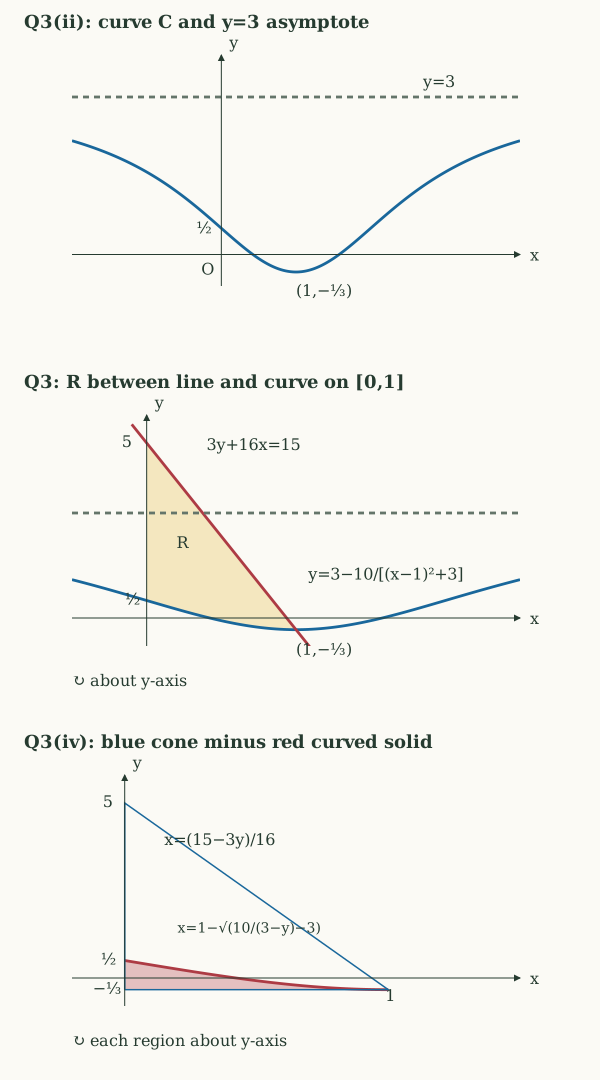
Horizontal asymptote y=3y=3, yy-intercept 1/21/2, origin O and minimum (1,−1/3)(1,-1/3) are labelled in the source graph.

(iii)

Area=∫01[(5−16x/3)−(3−10/(3+(x−1)2))]dx=∫01[2−16x/3+10/(3+(x−1)2)]dx=[2x−8x2/3+(10/3)tan⁡−1((x−1)/3)]01=−2/3+(10/3)(0−(−π/6))=5π33−23=13(5π/3−2)unit2.\begin{aligned}\text{Area}&=\int_0^1[(5-16x/3)-(3-10/(3+(x-1)^2))]dx\\&=\int_0^1[2-16x/3+10/(3+(x-1)^2)]dx\\&=[2x-8x^2/3+(10/\sqrt3)\tan^{-1}((x-1)/\sqrt3)]_0^1\\&=-2/3+(10/\sqrt3)(0-(-\pi/6))\\&=\frac{5\pi}{3\sqrt3}-\frac23=\frac13(5\pi/\sqrt3-2)\quad\text{unit}^2.\end{aligned}

(iv)

y=3−10(x−1)2+3⇒(x−1)2+3=103−y⇒x−1=±10/(3−y)−3.y=3-\frac{10}{(x-1)^2+3}\Rightarrow(x-1)^2+3=\frac{10}{3-y}\Rightarrow x-1=\pm\sqrt{10/(3-y)-3}.

The region is in x<1x<1, so x=1−10/(3−y)−3x=1-\sqrt{10/(3-y)-3}.

V=π∫−1/35(15−3y16)2dy−π∫−1/31/2(1−10/(3−y)−3)2dy≈5.0693=5.07unit3 (3 s.f.).V=\pi\int_{-1/3}^5\left(\frac{15-3y}{16}\right)^2dy-\pi\int_{-1/3}^{1/2}(1-\sqrt{10/(3-y)-3})^2dy\approx5.0693=5.07\quad\text{unit}^3\ (3\text{ s.f.}).

Alternatively, using cone volume 13πr2h\frac13\pi r^2h:

V=13π(1)2[5−(−1/3)]−π∫−1/31/2(1−10/(3−y)−3)2dy=169π−0.16416π≈5.0693=5.07unit3.V=\frac13\pi(1)^2[5-(-1/3)]-\pi\int_{-1/3}^{1/2}(1-\sqrt{10/(3-y)-3})^2dy=\frac{16}9\pi-0.16416\pi\approx5.0693=5.07\quad\text{unit}^3.

Teacher notes

Area R =∫01(y1−y2)dx=∫01(f(x)−g(x))dx=\int_0^1(y_1-y_2)dx=\int_0^1(f(x)-g(x))dx, with upper ff and lower gg on [0,1][0,1].

The blue region rotated about yy-axis is labelled in the sidebar as “volume of cylinder of radius 1 unit and height (5−(−1/3))(5-(-1/3)) units”. As printed, this says cylinder; the working correctly uses a cone. The native subtraction panels retain x=(15−3y)/16x=(15-3y)/16, x=1−10/(3−y)−3x=1-\sqrt{10/(3-y)-3}, 5,1/2,−1/3,15,1/2,-1/3,1 and rotation arrows.

Printed answer key

(i) (1,−1/3)(1,-1/3); (ii) labelled native graph below; (iii) 13(5π/3−2)\frac13(5\pi/\sqrt3-2); (iv) 5.075.07 units3^3.

Source diagrams in native form

Faithful native source geometry and annotations for question 3.

Mathematical review

The sidebar calls the blue triangular region a cylinder, but its rotation is a cone. The working uses the correct cone formula. This printed note is retained and explicitly corrected here.