Porisma

Original question & working

Subtract a triangle from an ellipse quadrant · source reference

2025 TJC H2 Maths (9758) JC2 MSM · original exercise attribution retained on source pages · Question pp. 2 · Working pp. 7, 8

Open the interactive lesson

The working and teaching notes are included in the interactive lesson.

View source review notes
Full original question, working & notes

Printed question

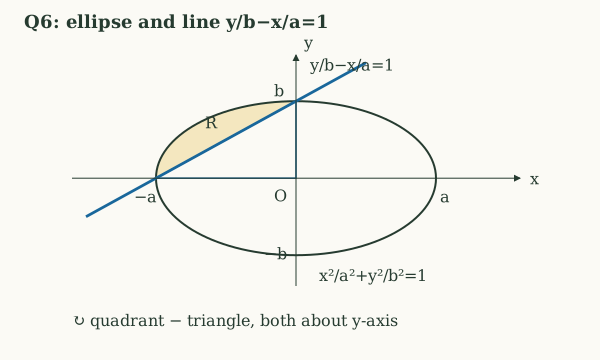
(i) R is bounded by the ellipse x2/a2+y2/b2=1x^2/a^2+y^2/b^2=1 and the line y/b−x/a=1y/b-x/a=1, as shown. Show that its area is

−12ab+∫−a0baa2−x2dx.-\frac12ab+\int_{-a}^0\frac ba\sqrt{a^2-x^2}dx.

Hence, substituting x=asin⁡θx=a\sin\theta, find the exact area in terms of a,ba,b. [8]

(ii) Find the volume when R is rotated completely about the yy-axis, in the form ka2bka^2b with constant kk. [4]

[2010/MJC/Prelim/II/5]

Printed working

(i)

The ellipse gives y=±b1−x2/a2y=\pm b\sqrt{1-x^2/a^2}.

Area R=area of quadrant−area of triangle=∫−a0b1−x2/a2dx−12ab=∫−a0b(a2−x2)/a2dx−12ab=−12ab+∫−a0baa2−x2dx(shown).\text{Area R}=\text{area of quadrant}-\text{area of triangle}=\int_{-a}^0b\sqrt{1-x^2/a^2}dx-\frac12ab=\int_{-a}^0b\sqrt{(a^2-x^2)/a^2}dx-\frac12ab=-\frac12ab+\int_{-a}^0\frac ba\sqrt{a^2-x^2}dx\quad\text{(shown)}.

x=asin⁡θx=a\sin\theta, dx/dθ=acos⁡θdx/d\theta=a\cos\theta; asin⁡θ=0a\sin\theta=0 gives θ=0\theta=0; asin⁡θ=−aa\sin\theta=-a gives θ=−π/2\theta=-\pi/2.

Area R=ba∫−π/20a2−(asin⁡θ)2(acos⁡θ)dθ−12ab=a2ba∫−π/201−sin⁡2θcos⁡θdθ−12ab=ab∫−π/20cos⁡2θdθ−12ab=ab∫−π/201+cos⁡2θ2dθ−12ab=ab[θ/2+sin⁡2θ/4]−π/20−12ab=ab[0+0−((1/2)(−π/2)+sin⁡(−π)/4)]−12ab=abπ4−12ab=ab4(π−2)units2.\begin{aligned}\text{Area R}&=\frac ba\int_{-\pi/2}^0\sqrt{a^2-(a\sin\theta)^2}(a\cos\theta)d\theta-\frac12ab\\&=\frac{a^2b}a\int_{-\pi/2}^0\sqrt{1-\sin^2\theta}\cos\theta d\theta-\frac12ab\\&=ab\int_{-\pi/2}^0\cos^2\theta d\theta-\frac12ab\\&=ab\int_{-\pi/2}^0\frac{1+\cos2\theta}2d\theta-\frac12ab\\&=ab[\theta/2+\sin2\theta/4]_{-\pi/2}^0-\frac12ab\\&=ab[0+0-((1/2)(-\pi/2)+\sin(-\pi)/4)]-\frac12ab\\&=ab\frac\pi4-\frac12ab=\frac{ab}4(\pi-2)\quad\text{units}^2.\end{aligned}

(ii)

x2=a2(1−y2/b2)x^2=a^2(1-y^2/b^2).

V=π∫0bx2dy−13πa2b=π∫0b(a2−a2y2/b2)dy−13πa2b=π[a2y−a2y3/(3b2)]0b−13πa2b=π[a2b−a2b3/(3b2)]−13πa2b=π[a2b−a2b/3]−13πa2b=π(2a2b/3)−13πa2b=13πa2b.\begin{aligned}V&=\pi\int_0^bx^2dy-\frac13\pi a^2b\\&=\pi\int_0^b(a^2-a^2y^2/b^2)dy-\frac13\pi a^2b\\&=\pi[a^2y-a^2y^3/(3b^2)]_0^b-\frac13\pi a^2b\\&=\pi[a^2b-a^2b^3/(3b^2)]-\frac13\pi a^2b\\&=\pi[a^2b-a^2b/3]-\frac13\pi a^2b=\pi(2a^2b/3)-\frac13\pi a^2b=\frac13\pi a^2b.\end{aligned}

Thus k=π/3k=\pi/3.

Teacher notes

Area of quadrant =∫−a0ydx=\int_{-a}^0y dx, with y=b1−x2/a2≥0y=b\sqrt{1-x^2/a^2}\ge0.

Integration by substitution: ∫f(x)dx=∫g(θ)(dx/dθ)dθ\int f(x)dx=\int g(\theta)(dx/d\theta)d\theta; change definite limits from xx to θ\theta.

Volume of quadrant rotated about yy-axis is π∫0bx2dy\pi\int_0^bx^2dy. Volume of triangle rotated about yy-axis is a cone, radius aa units, height bb units.

The solution’s first question line misprints the line as the ellipse equation; the question booklet and diagram correctly state y/b−x/a=1y/b-x/a=1. The solution graph also places an ellipse equation by the straight line. The native article retains the correct question and labels the source misprint here.

Printed answer key

(i) ab(π−2)/4ab(\pi-2)/4 units2^2; (ii) 13πa2b\frac13\pi a^2b units3^3.

Source diagrams in native form

Faithful native source geometry and annotations for question 6.

Mathematical review

Assume positive semi-axes a,b as encoded by the labelled ellipse. The source solution repeats the ellipse equation where it calls the boundary a line; use y/b−x/a=1 from the original question/diagram.