Porisma

Original question & working

Cancel whole periods before integrating · source reference

2025 TJC H2 Maths (9758) JC2 MSM · original exercise attribution retained on source pages · Question pp. 2 · Working pp. 9

Open the interactive lesson

The working and teaching notes are included in the interactive lesson.

This asks for signed integration, not total shaded area. Positive and negative lobes cancel.

View source review notes
Full original question, working & notes

Printed question

It is given that

f(x)={tan⁡(πx/(4a)),−a<x≤a,sin⁡(πx/(2a)),a<x≤3a,f(x)=\begin{cases}\tan(\pi x/(4a)),&-a<x\le a,\\\sin(\pi x/(2a)),&a<x\le3a,\end{cases}

and f(x)=f(x−4a)f(x)=f(x-4a) for all real xx, where aa is a positive real constant.

(a) Sketch y=f(x)y=f(x) for −4a≤x≤7a-4a\le x\le7a. [3]

(b) Using the sketch, write down an equation relating f(x)f(x) and f(−x)f(-x). [1]

(c) Show ∫−2a4af(x)dx=(ka/π)(1+ln⁡m)\int_{-2a}^{4a}f(x)dx=(ka/\pi)(1+\ln m), determining constants k,mk,m. [5]

[2023/HCI/Prelim/I/7]

Printed working

(a)

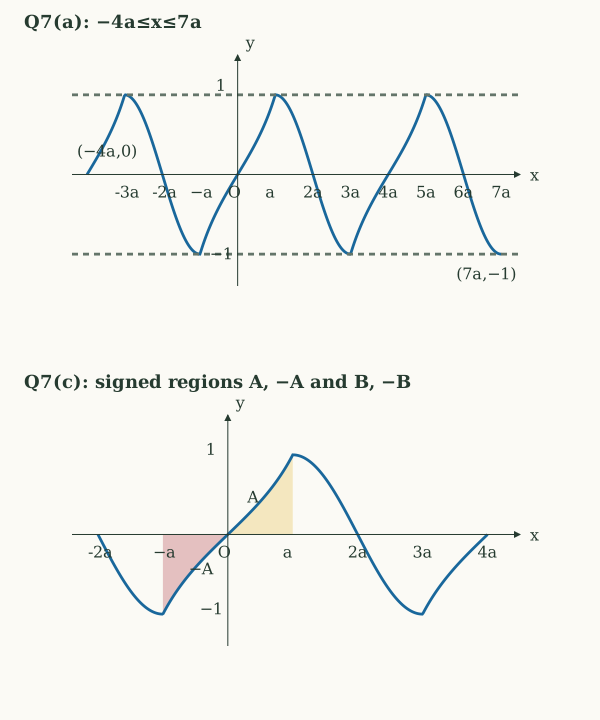
The native graph labels (−4a,0),(7a,−1)(-4a,0),(7a,-1), each multiple −3a,−2a,−a,0,a,2a,3a,4a,5a,6a,7a-3a,-2a,-a,0,a,2a,3a,4a,5a,6a,7a and levels 1,−11,-1.

(b)

From the sketch, f(−x)=−f(x)f(-x)=-f(x).

(c)

∫−2a4af(x)dx=∫−2a−af(x)dx+∫−aaf(x)dx+∫a3af(x)dx+∫3a4af(x)dx=∫2a3af(x)dx+0+0+∫−a0f(x)dx=∫2a3asin⁡(πx/(2a))dx+∫−a0tan⁡(πx/(4a))dx=[−cos⁡(πx/(2a))π/(2a)]2a3a+[ln⁡∣sec⁡(πx/(4a))∣π/(4a)]−a0=2aπ[−cos⁡(3π/2)+cos⁡π]+4aπ[ln⁡∣sec⁡0∣−ln⁡∣sec⁡(−π/4)∣]=2aπ[−1]+4aπ[−ln⁡2]=−2aπ(1+2ln⁡2)=−2aπ(1+ln⁡2).\begin{aligned}\int_{-2a}^{4a}f(x)dx&=\int_{-2a}^{-a}f(x)dx+\int_{-a}^af(x)dx+\int_a^{3a}f(x)dx+\int_{3a}^{4a}f(x)dx\\&=\int_{2a}^{3a}f(x)dx+0+0+\int_{-a}^0f(x)dx\\&=\int_{2a}^{3a}\sin(\pi x/(2a))dx+\int_{-a}^0\tan(\pi x/(4a))dx\\&=\left[\frac{-\cos(\pi x/(2a))}{\pi/(2a)}\right]_{2a}^{3a}+\left[\frac{\ln|\sec(\pi x/(4a))|}{\pi/(4a)}\right]_{-a}^0\\&=\frac{2a}\pi[-\cos(3\pi/2)+\cos\pi]+\frac{4a}\pi[\ln|\sec0|-\ln|\sec(-\pi/4)|]\\&=\frac{2a}\pi[-1]+\frac{4a}\pi[-\ln\sqrt2]=\frac{-2a}\pi(1+2\ln\sqrt2)\\&=\frac{-2a}\pi(1+\ln2).\end{aligned}

k=−2,m=2k=-2,m=2 (shown).

Teacher notes

The smaller source sketch labels a positive region A on [0,a][0,a] and its negative counterpart on [−a,0][-a,0]. ∫0af(x)dx=A\int_0^af(x)dx=A is the area bounded by curve, xx-axis and x=0,ax=0,a. ∫−a0f(x)dx=−A\int_{-a}^0f(x)dx=-A since the curve lies below the xx-axis. Thus ∫−aaf=−A+A=0\int_{-a}^af=-A+A=0. Similarly ∫a3af=∫a2af+∫2a3af=B−B=0\int_a^{3a}f=\int_a^{2a}f+\int_{2a}^{3a}f=B-B=0.

Printed answer key

(a) labelled native graph below; (b) f(−x)=−f(x)f(-x)=-f(x); (c) k=−2,m=2k=-2,m=2.

Source diagrams in native form

Faithful native source geometry and annotations for question 7.