Original question & working
Keep the parameter branch when eliminating t · source reference
2025 TJC H2 Maths (9758) JC2 MSM · original exercise attribution retained on source pages · Question pp. 3 · Working pp. 10, 11
Open the interactive lessonThe working and teaching notes are included in the interactive lesson.
Confirmed branch qualification: the printed Cartesian expression is valid only for 0≤t≤π/2. Counterexample t=π gives (x,y)=(π,0), while the printed expression gives x=0. Question PDF p.3 (printed 53); solution PDF p.11 explicitly adds the rising-arc restriction.
Full original question, working & notes
Printed question
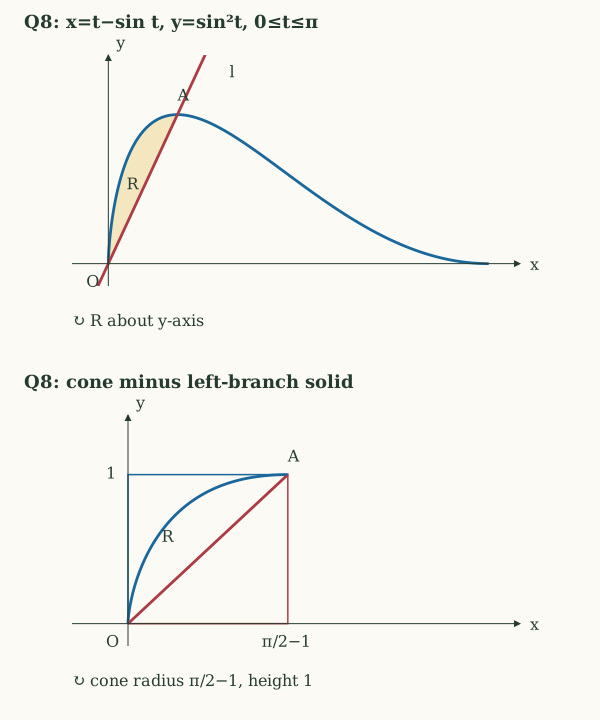
C: , , . A has parameter and is a maximum point. Line l passes through the origin and A. R is bounded by C and l as shown.
(i) Find A. [1]
(ii) Using an algebraic method, find the exact area of R. [5]
(iii) Show the Cartesian equation of C is . [1]
(iv) Find the volume when R is rotated radians about the -axis. [3]
[2023/ACJC/Prelim/I/8]
Printed working
(i)
At , , : .
(ii)
Area .
Therefore area .
(iii)
, ; since . for , hence .
(iv)
Teacher notes
Area of blue region minus area of red triangle. Triangle rotated about -axis gives a cone of radius units and height unit. Native panels retain A,R,O, level 1, , line l and rotation arrows.
Printed answer key
(i) ; (ii) ; the short key labels the volume “(iii) (3 s.f.)”, whereas the question places volume in (iv).
Source diagrams in native form
Mathematical review
The stated Cartesian equation is only the left branch used for R. The full C has a second branch for . The solution correctly states its restricted branch; the question’s global claim is qualified here.