Original question & working
Take the infinite limit and use the bowl radius · source reference
2025 TJC H2 Maths (9758) JC2 MSM · original exercise attribution retained on source pages · Question pp. 6 · Working pp. 18
Open the interactive lessonThe working and teaching notes are included in the interactive lesson.
Notation qualification in (a)(iii): q is defined in the question as a finite-n integral, while R extends to infinity. The printed “2q” is recorded separately from the total area 2ln2. Question PDF p.6 (printed 56), solution p.18.
Full original question, working & notes
Printed question
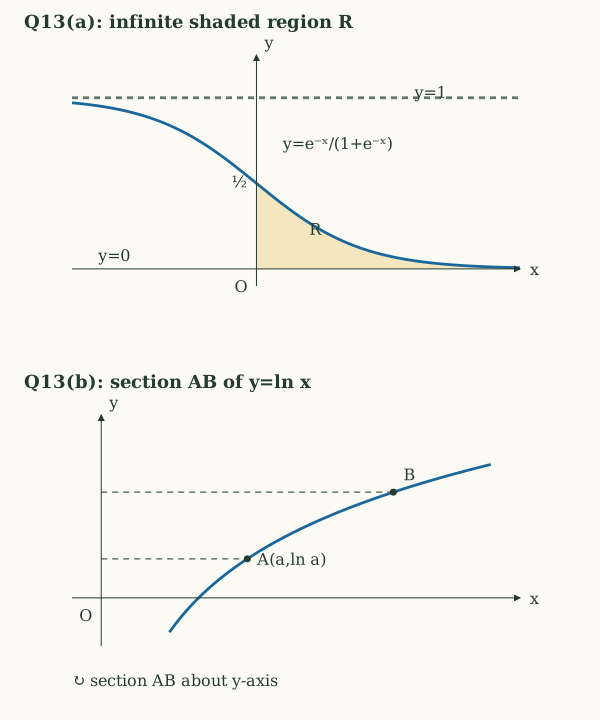
(a) C: . R is bounded by C, positive -axis and positive -axis as shown; graph labels . (i) Obtain a formula in terms of for , . [2] (ii) Hence find R’s exact area. [2] (iii) Denoting the answer obtained in part (i) by , write down in terms of the area of R if C is scaled by factor 2 parallel to -axis. [1]
(b) A girl designs a bowl by rotating section AB of completely about -axis. It must hold . A is ; the rim diameter is twice the base diameter. State B in terms of and find exact . [5]
[2010/VJC/Prelim/I/11 (modified)]
Printed working
(a)(i)
(a)(ii)
since as .
(a)(iii)
When scaled by factor 2 parallel to -axis, . Required area as printed.
(b)
B is .
Teacher notes
, with the modulus sign. when . A scale factor 2 parallel to -axis means replace by .
Printed answer key
(a)(i) ; (ii) ; (iii) . (b) ; .
Source diagrams in native form
Mathematical review
The question defines as the finite- answer in (i), but the printed for the entire region uses from (ii). Correctly, finite- area doubles to , while the full region’s doubled area is . This reference inconsistency is qualified without rewriting the printed question.