Porisma

Original question & working

Sum local area inequalities, then shift the axis · source reference

2025 TJC H2 Maths (9758) JC2 MSM · original exercise attribution retained on source pages · Question pp. 7 · Working pp. 20, 21, 22

Open the interactive lesson

The working and teaching notes are included in the interactive lesson.

View source review notes
Full original question, working & notes

Printed question

(i) Prove ddx(tan⁡−1x)=1/(1+x2)\frac d{dx}(\tan^{-1}x)=1/(1+x^2). [2]

The diagram sketches y=1/(1+x2)y=1/(1+x^2), with a shaded rectangle from n−1n-1 to nn.

(ii) Considering the rectangle and the area between graph and xx-axis on n−1≤x≤nn-1\le x\le n, n≥1n\ge1, show 1/(1+n2)<tan⁡−1n−tan⁡−1(n−1)1/(1+n^2)<\tan^{-1}n-\tan^{-1}(n-1). [2]

(iii) Deduce 1/2+1/5+1/10+⋯+1/(1+n2)<tan⁡−1n1/2+1/5+1/10+\cdots+1/(1+n^2)<\tan^{-1}n. [2]

R is bounded by y=1/(1+x2)y=1/(1+x^2), x=3x=3 and y=1/2y=1/2. Write the equation after translation 3 units in negative xx-direction. Hence or otherwise find its volume rotating completely about x=3x=3. [4]

[2015/NYJC/Prelim/II/4 (modified)]

Printed working

(i)

Let y=tan⁡−1xy=\tan^{-1}x. Then tan⁡y=x\tan y=x. Differentiate:

sec⁡2ydydx=1,(1+tan⁡2y)dydx=1,dydx=11+x2(shown).\sec^2y\frac{dy}{dx}=1,\qquad(1+\tan^2y)\frac{dy}{dx}=1,\qquad\frac{dy}{dx}=\frac1{1+x^2}\quad\text{(shown)}.

(ii)

From graph: area of rectangle << area under curve on [n−1,n][n-1,n].

11+n2[n−(n−1)]<∫n−1n11+x2dx,\frac1{1+n^2}[n-(n-1)]<\int_{n-1}^n\frac1{1+x^2}dx, 11+n2<[tan⁡−1x]n−1n=tan⁡−1n−tan⁡−1(n−1)(shown).\frac1{1+n^2}<[\tan^{-1}x]_{n-1}^n=\tan^{-1}n-\tan^{-1}(n-1)\quad\text{(shown)}.

(iii)

Comparing rectangles with area on 0≤x≤n0\le x\le n,

11+12+11+22+11+32+⋯+11+n2<∫0n11+x2dx,\frac1{1+1^2}+\frac1{1+2^2}+\frac1{1+3^2}+\cdots+\frac1{1+n^2}<\int_0^n\frac1{1+x^2}dx, 12+15+110+⋯+11+n2<[tan⁡−1x]0n=tan⁡−1n(shown).\frac12+\frac15+\frac1{10}+\cdots+\frac1{1+n^2}<[\tan^{-1}x]_0^n=\tan^{-1}n\quad\text{(shown)}.

Alternative solution, using (ii):

11+12<tan⁡−11−tan⁡−10n=1,11+22<tan⁡−12−tan⁡−11n=2,⋮11+(n−1)2<tan⁡−1(n−1)−tan⁡−1(n−2),11+n2<tan⁡−1n−tan⁡−1(n−1).\begin{aligned}\frac1{1+1^2}&<\tan^{-1}1-\tan^{-1}0&&n=1,\\\frac1{1+2^2}&<\tan^{-1}2-\tan^{-1}1&&n=2,\\&\vdots\\\frac1{1+(n-1)^2}&<\tan^{-1}(n-1)-\tan^{-1}(n-2),\\\frac1{1+n^2}&<\tan^{-1}n-\tan^{-1}(n-1).\end{aligned}

Adding cancels all adjacent arctangents, giving the required inequality since tan⁡−10=0\tan^{-1}0=0.

Final rotation task

After translation: y=1/[1+(x+3)2]y=1/[1+(x+3)^2].

(x+3)2=1/y−1⇒x=−3±1/y−1.(x+3)^2=1/y-1\Rightarrow x=-3\pm\sqrt{1/y-1}.

The minus branch is not the curve enclosing R; use x=−3+1/y−1x=-3+\sqrt{1/y-1}. The printed description calls the translated region “enclosed by y=1/[1+(x+3)2]y=1/[1+(x+3)^2], line y=1/2y=1/2 and x-axis”, then rotates it about the yy-axis. The stated x-axis is a printed boundary error: the diagram uses the yy-axis; its region lies between levels 1/101/10 and 1/21/2.

V=π∫1/101/2x2dy=π∫1/101/2(−3+1/y−1)2dy≈2.5998=2.60 or 0.828π(3 s.f.).V=\pi\int_{1/10}^{1/2}x^2dy=\pi\int_{1/10}^{1/2}(-3+\sqrt{1/y-1})^2dy\approx2.5998=2.60\text{ or }0.828\pi\quad(3\text{ s.f.}).

Teacher notes

The unshifted diagram labels y=1/(1+x2)y=1/(1+x^2), 11, x=1x=1, x=3x=3, y=1/2y=1/2, R and rotation arrow at x=3x=3. Shifted diagram labels y=1/[1+(x+3)2]y=1/[1+(x+3)^2], x=−3,−2x=-3,-2, peak 1, y=1/2y=1/2, R and rotation about yy-axis. The repeated telescoping cancellation strokes are represented by the cancellation explanation above.

Printed answer key

The short key labels the final rotation task “15. (iii)”: y=1/[1+(x+3)2]y=1/[1+(x+3)^2]; 2.602.60 units3^3 (3 s.f.). The original question prints no part label for this task; its actual (iii) is the finite-sum inequality.

Source diagrams in native form
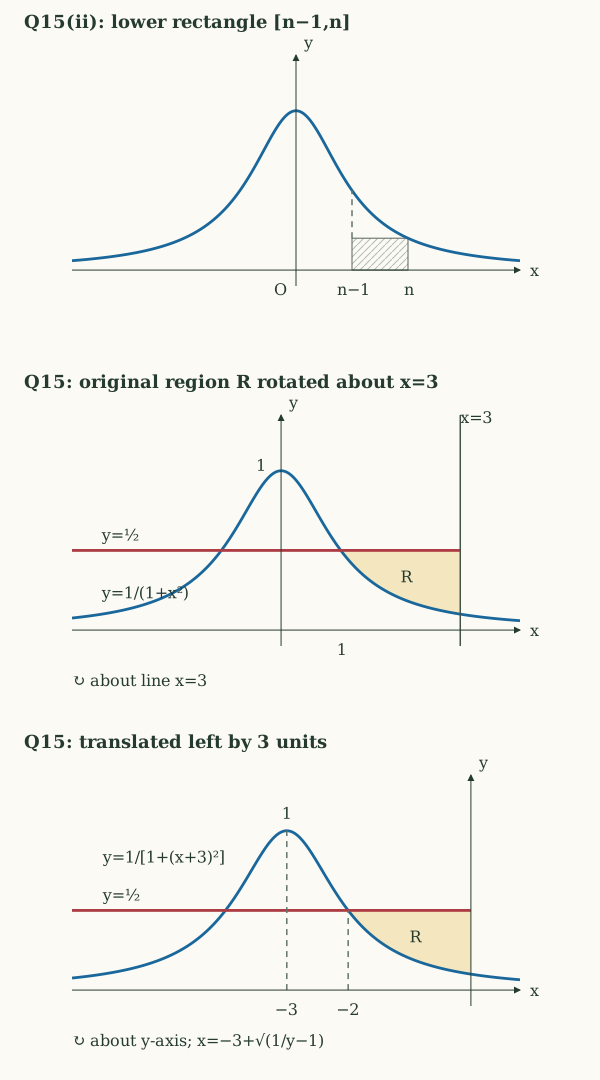
Faithful native source geometry and annotations for question 15.