Original question & working
Multiply two binomial series · source reference
[2009/IJC/Prelim/I/7] · Question pp. 2 · Working pp. 2
Open the interactive lessonThe working and teaching notes are included in the interactive lesson.
Both Topic 09 PDFs are identical and include full solutions beside the questions; opening source pages reveals answers. Source p.2 has a product-line typo (1−2x) in place of (1+2x); the actual binomial expansion and result use the plus sign.
Full original question, working & notes
Printed question
Find the expansion of in ascending powers of , up to and including the term in . State the range of values of for which the expansion is valid. [5]
Without performing any calculations, explain why putting into the result gives a better approximation to than putting . [1]
Hence by putting , find an approximation for , expressing your answer as a fraction in its lowest terms. [2]
[2009/IJC/Prelim/I/7]
Printed working
Printed product-line typo: ; correct denominator sign is .
.
, , .
Both substitutions lie in the validity range. , hence the first is closer to zero. At , and .
Teacher note 1
Since both expansions of and must be valid at the same time, we take the intersection of the 2 regions.
Diagram 09-02-validity
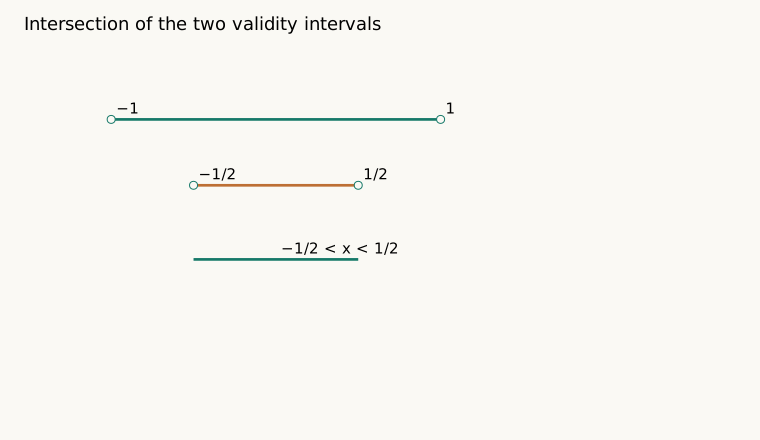
Both source number-line rows have open endpoints. Intersection is open.
Mathematical review
and . Their product is ; both converge for .
Both substitutions lie inside this range, and is closer to zero, so the truncated higher powers are smaller. At , the exact expression is . Thus . At the expression is directly; the printed comparison is a truncation heuristic, not an error bound.
Provenance
TJC JC2 2025 H2 Maths (9758) MSM. Native transcription checked against original visible question, working and sidebars. Question page(s): 2. Working page(s): 2. The two Series source files are byte-identical; their shared visible content is expressed once and mapped to both page sets. Original records remain private for QA; this native article has no PDF or raster worksheet dependency.