Porisma

Original question & working

Repeated poles and general coefficients · source reference

[2009/SAJC/JCT/8] · Question pp. 6 · Working pp. 6

Open the interactive lesson

The working and teaching notes are included in the interactive lesson.

Both Topic 09 PDFs are identical and include full solutions beside the questions; opening source pages reveals answers.

View source review notes
Full original question, working & notes

Printed question

Express 9+4x2(1−2x)2(2+x)\frac{9+4x^2}{(1-2x)^2(2+x)} in partial fractions. [3]

Hence find in its simplest form,

(a) the first four terms in the expansion of 9+4x2(1−2x)2(2+x)\frac{9+4x^2}{(1-2x)^2(2+x)} in ascending powers of xx and state the set of values of xx for which the expansion is valid.

(b) the coefficient of xrx^r in the expansion. [6]

[2009/SAJC/JCT/8]

Printed working

9+4x2(1−2x)2(2+x)=A1−2x+B(1−2x)2+C2+x\frac{9+4x^2}{(1-2x)^2(2+x)}=\frac A{1-2x}+\frac B{(1-2x)^2}+\frac C{2+x}.

9+4x2=A(1−2x)(2+x)+B(2+x)+C(1−2x)29+4x^2=A(1-2x)(2+x)+B(2+x)+C(1-2x)^2. Substitute x=1/2x=1/2: 10=(5/2)B⇒B=410=(5/2)B\Rightarrow B=4. Substitute x=−2x=-2: 25=25C⇒C=125=25C\Rightarrow C=1. Constant 9=2A+2(4)+1⇒A=09=2A+2(4)+1\Rightarrow A=0.

4(1−2x)−2+(2+x)−1=4(1−2x)−2+12(1+x/2)−1=4[1+(−2)(−2x)+(−2)(−3)2!(−2x)2+(−2)(−3)(−4)3!(−2x)3+⋯ ]+12[1+(−1)(x/2)+(−1)(−2)2!(x/2)2+(−1)(−2)(−3)3!(x/2)3+⋯ ]=9/2+63x/4+385x2/8+2047x3/16+⋯ .\begin{aligned}4(1-2x)^{-2}+(2+x)^{-1}&=4(1-2x)^{-2}+\tfrac12(1+x/2)^{-1}\\&=4[1+(-2)(-2x)+\tfrac{(-2)(-3)}{2!}(-2x)^2+\tfrac{(-2)(-3)(-4)}{3!}(-2x)^3+\cdots]\\&\quad+\tfrac12[1+(-1)(x/2)+\tfrac{(-1)(-2)}{2!}(x/2)^2+\tfrac{(-1)(-2)(-3)}{3!}(x/2)^3+\cdots]\\&=9/2+63x/4+385x^2/8+2047x^3/16+\cdots.\end{aligned}

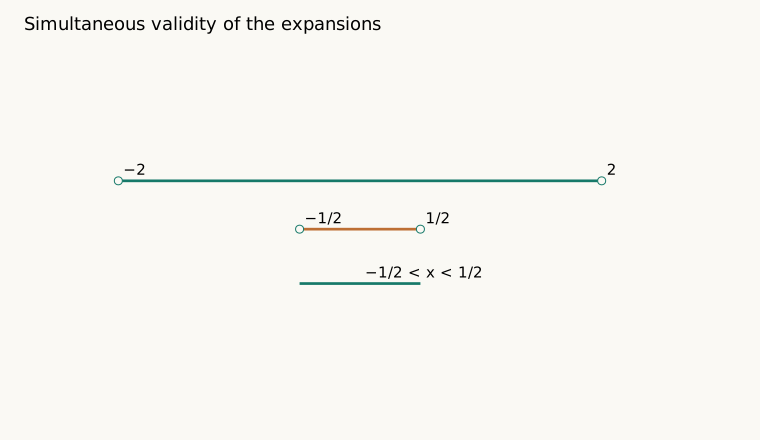
∣x/2∣<1|x/2|<1 and ∣2x∣<1|2x|<1: −1/2<x<1/2-1/2<x<1/2.

[xr]=4(r+1)2r+12(−1)r(1/2)r=(r+1)2r+2+(−1)r(1/2)r+1[x^r]=4(r+1)2^r+\frac12(-1)^r(1/2)^r=(r+1)2^{r+2}+(-1)^r(1/2)^{r+1}.

Teacher note 1

Both (1−2x)−2(1-2x)^{-2} and (1+x/2)−1(1+x/2)^{-1} must be valid at the same time: take the intersection of the 2 regions.

Teacher note 2

(1−x)−2=1+2x+3x2+⋯(1-x)^{-2}=1+2x+3x^2+\cdots; (1+x)−1=1+(−1)x+(−1)2x2+⋯(1+x)^{-1}=1+(-1)x+(-1)^2x^2+\cdots.

Diagram 09-07-validity

Simultaneous validity of the expansions

Mathematical review

The identity gives A=0,B=4,C=1A=0,B=4,C=1, so F=4/(1−2x)2+1/(2+x)F=4/(1-2x)^2+1/(2+x). Using (1−z)−2=∑r≥0(r+1)zr(1-z)^{-2}=\sum_{r\ge0}(r+1)z^r, F=9/2+(63/4)x+(385/8)x2+(2047/16)x3+O(x4)F=9/2+(63/4)x+(385/8)x^2+(2047/16)x^3+O(x^4).

The restrictions are ∣2x∣<1|2x|<1 and ∣x/2∣<1|x/2|<1, hence ∣x∣<1/2|x|<1/2. For r≥0r\ge0, [xr]F=4(r+1)2r+(−1)r/2r+1=(r+1)2r+2+(−1)r/2r+1[x^r]F=4(r+1)2^r+(-1)^r/2^{r+1}=(r+1)2^{r+2}+(-1)^r/2^{r+1}.

Provenance

TJC JC2 2025 H2 Maths (9758) MSM. Native transcription checked against original visible question, working and sidebars. Question page(s): 6. Working page(s): 6. The two Series source files are byte-identical; their shared visible content is expressed once and mapped to both page sets. Original records remain private for QA; this native article has no PDF or raster worksheet dependency.