Original question & working
Check an approximation by its error function · source reference
[2018/DHS/Prelim/I/2] · Question pp. 7 · Working pp. 7
Open the interactive lessonThe working and teaching notes are included in the interactive lesson.
Both Topic 09 PDFs are identical and include full solutions beside the questions; opening source pages reveals answers.
Full original question, working & notes
Printed question
(i) Using appropriate expansions from the List of Formulae (MF26), show that the series expansion of in ascending powers of , up to and including the term in , is . [3]
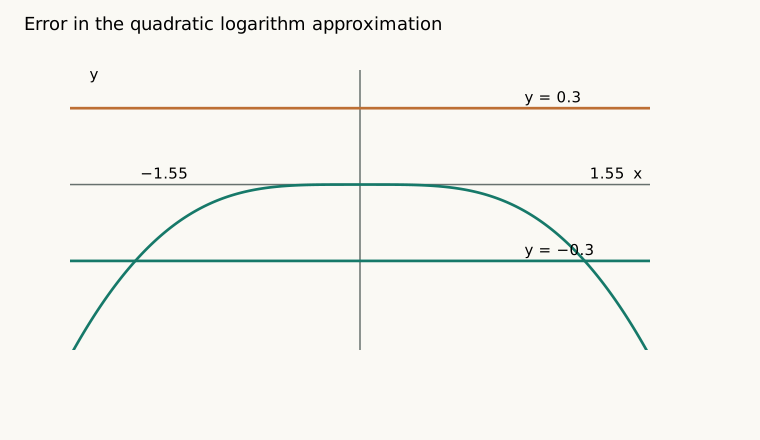
(ii) Find the set of values of such that the value for the above expansion for is within of the value of . [2]
(iii) Deduce an expansion for up to and including the term in . [2]
[2018/DHS/Prelim/I/2]
Printed working
. Printed GC interval (rounded).
Differentiate: . Divide numerator/denominator by : .
Teacher note 1
For , use MF27: , where is replaced by . Do not expand as , as each bracketed term contains a constant and terms in .
Diagram 09-08-error
Mathematical review
, so the log series gives . More precisely, , hence error is even and nonpositive. For , . The unique positive root of is about ; thus (about at 3 s.f.).
Differentiating the analytic series gives , equivalently .
Provenance
TJC JC2 2025 H2 Maths (9758) MSM. Native transcription checked against original visible question, working and sidebars. Question page(s): 7. Working page(s): 7. The two Series source files are byte-identical; their shared visible content is expressed once and mapped to both page sets. Original records remain private for QA; this native article has no PDF or raster worksheet dependency.