Porisma

Original question & working

Small-angle series in a triangle · source reference

[2022/ASRJC/Prelim/I/4] · Question pp. 18 · Working pp. 18, 19

Open the interactive lesson

The working and teaching notes are included in the interactive lesson.

Both Topic 09 PDFs are identical and include full solutions beside the questions; opening source pages reveals answers.

View source review notes
Full original question, working & notes

Printed question

(i) Show that the first two non-zero terms of the Maclaurin series for tan⁡θ\tan\theta is given by θ+13θ3\theta+\frac13\theta^3. You may use the standard results given in the List of Formulae (MF26). [2]

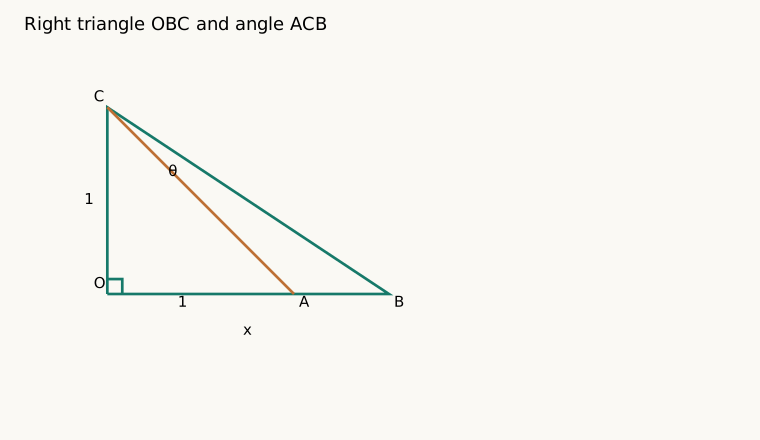
In the right-angled triangle OBC shown above, point A lies on OB such that OA = 1, OB = xx, where x>1x>1 and OC = 1. It is given that angle COB is π2\frac\pi2 radians and that angle ACB is θ\theta radians (see diagram).

(ii) Show that AB=2tan⁡θ1−tan⁡θ\mathrm{AB}=\frac{2\tan\theta}{1-\tan\theta}. [2]

(iii) Given that θ\theta is a sufficiently small angle, show that AB≈aθ+bθ2+cθ3\mathrm{AB}\approx a\theta+b\theta^2+c\theta^3 for exact real constants a,b,ca,b,c to be determined. [3]

[2022/ASRJC/Prelim/I/4]

Printed working

tan⁡θ=sin⁡θ(cos⁡θ)−1≈(θ−θ3/3!)(1−θ2/2!)−1≈(θ−θ3/3!)(1+θ2/2)=θ+θ3/2−θ3/6=θ+θ3/3\tan\theta=\sin\theta(\cos\theta)^{-1}\approx(\theta-\theta^3/3!)(1-\theta^2/2!)^{-1}\approx(\theta-\theta^3/3!)(1+\theta^2/2)=\theta+\theta^3/2-\theta^3/6=\theta+\theta^3/3.

x=tan⁡(π/4+θ)=tan⁡(π/4)+tan⁡θ1−tan⁡(π/4)tan⁡θ=1+tan⁡θ1−tan⁡θx=\tan(\pi/4+\theta)=\frac{\tan(\pi/4)+\tan\theta}{1-\tan(\pi/4)\tan\theta}=\frac{1+\tan\theta}{1-\tan\theta}.

AB=x−1=2tan⁡θ/(1−tan⁡θ)\mathrm{AB}=x-1=2\tan\theta/(1-\tan\theta).

AB≈2(θ+θ3/3)[1−(θ+θ3/3)]−1≈2(θ+θ3/3)[1+(θ+θ3/3)+(θ+θ3/3)2]\mathrm{AB}\approx2(\theta+\theta^3/3)[1-(\theta+\theta^3/3)]^{-1}\approx2(\theta+\theta^3/3)[1+(\theta+\theta^3/3)+(\theta+\theta^3/3)^2].

≈(2θ+2θ3/3)(1+θ+θ2)=2θ+2θ2+8θ3/3\approx(2\theta+2\theta^3/3)(1+\theta+\theta^2)=2\theta+2\theta^2+8\theta^3/3. a=2,b=2,c=8/3a=2,b=2,c=8/3.

Teacher note 1

Maclaurin expansions for sin⁡θ\sin\theta and cos⁡θ\cos\theta can be found in MF27. Apply (1−x)−1=1+x+x2+x3+⋯(1-x)^{-1}=1+x+x^2+x^3+\cdots, replacing xx by θ2/2\theta^2/2.

Teacher note 2

From MF27 under Trigonometry, tan⁡(A+B)=tan⁡A+tan⁡B1−tan⁡Atan⁡B\tan(A+B)=\frac{\tan A+\tan B}{1-\tan A\tan B}. Replace AA by π/4\pi/4 and BB by θ\theta.

Teacher note 3

Use the result of (i) for tan⁡θ\tan\theta, then apply (1−x)−1=1+x+x2+x3+⋯(1-x)^{-1}=1+x+x^2+x^3+\cdots, replacing xx by θ+θ3/3\theta+\theta^3/3.

Diagram 09-17-triangle

Right triangle OBC and angle ACB

OC=OA=1; OB=x>1; θ=angle ACB; right angle COB; example θ=0.2 only.

Mathematical review

(i) Divide sin⁡θ=θ−θ3/6+⋯\sin\theta=\theta-\theta^3/6+\cdots by cos⁡θ=1−θ2/2+⋯\cos\theta=1-\theta^2/2+\cdots: tan⁡θ=θ+θ3/3+O(θ5)\tan\theta=\theta+\theta^3/3+O(\theta^5).

(ii) tan⁡(π/4+θ)=(1+tan⁡θ)/(1−tan⁡θ)=x\tan(\pi/4+\theta)=(1+\tan\theta)/(1-\tan\theta)=x, and AB=x−1=2tan⁡θ/(1−tan⁡θ)AB=x-1=2\tan\theta/(1-\tan\theta).

(iii) Let u=tan⁡θu=\tan\theta. Then 2u/(1−u)=2(u+u2+u3)+O(u4)=2θ+2θ2+8θ3/3+O(θ4)2u/(1-u)=2(u+u^2+u^3)+O(u^4)=2\theta+2\theta^2+8\theta^3/3+O(\theta^4). Thus a=2,b=2,c=8/3a=2,b=2,c=8/3. Geometrically 0<θ<π/40<\theta<\pi/4; the polynomial approximation requires a sufficiently small angle in radians.

Provenance

TJC JC2 2025 H2 Maths (9758) MSM. Native transcription checked against original visible question, working and sidebars. Question page(s): 18. Working page(s): 18, 19. The two Series source files are byte-identical; their shared visible content is expressed once and mapped to both page sets. Original records remain private for QA; this native article has no PDF or raster worksheet dependency.