Porisma

Original question & working

Sine rule and a percentage-error interval · source reference

[2023/SAJC/Prelim/P2/2] · Question pp. 20 · Working pp. 20, 21

Open the interactive lesson

The working and teaching notes are included in the interactive lesson.

Both Topic 09 PDFs are identical and include full solutions beside the questions; opening source pages reveals answers.

View source review notes
Full original question, working & notes

Printed question

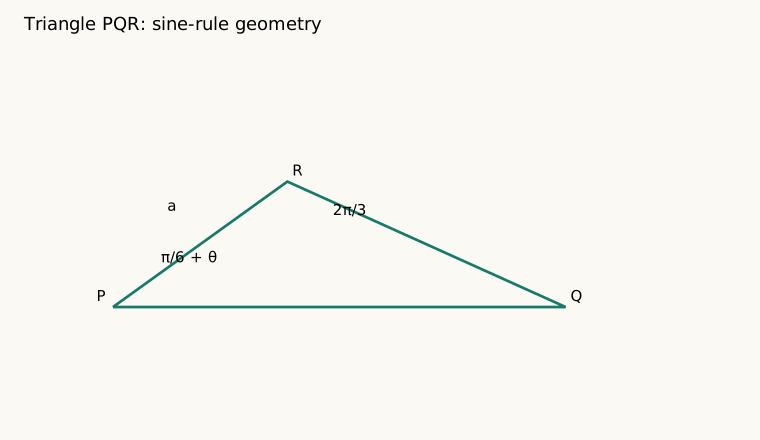
In triangle PQR, ∠PRQ=2π3\angle\mathrm{PRQ}=\frac{2\pi}3, ∠RPQ=π6+θ\angle\mathrm{RPQ}=\frac\pi6+\theta, and PR = aa units, where aa is a positive real constant.

(i) Show that PQ=3acos⁡θ−3sin⁡θ\mathrm{PQ}=\frac{\sqrt3a}{\cos\theta-\sqrt3\sin\theta}. [4]

(ii) Given that θ\theta is sufficiently small, show that PQ≈3a(1+bθ+cθ2)\mathrm{PQ}\approx\sqrt3a(1+b\theta+c\theta^2), where b,cb,c are real constants. [3]

(iii) Given that θ>0\theta>0, find the range of values of θ\theta such that the percentage error of the approximation in (ii) is less than 5%. [2]

[2023/SAJC/Prelim/P2/2]

Printed working

∠PQR=π−2π/3−(π/6+θ)=π/6−θ\angle\mathrm{PQR}=\pi-2\pi/3-(\pi/6+\theta)=\pi/6-\theta.

Sine rule: PQ/sin⁡(2π/3)=a/sin⁡(π/6−θ)\mathrm{PQ}/\sin(2\pi/3)=a/\sin(\pi/6-\theta).

PQ=a(3/2)/[(1/2)cos⁡θ−(3/2)sin⁡θ]=3a/(cos⁡θ−3sin⁡θ)\mathrm{PQ}=a(\sqrt3/2)/[(1/2)\cos\theta-(\sqrt3/2)\sin\theta]=\sqrt3a/(\cos\theta-\sqrt3\sin\theta).

PQ≈3a/[1−θ2/2−3θ]=3a[1−(3θ+θ2/2)]−1\mathrm{PQ}\approx\sqrt3a/[1-\theta^2/2-\sqrt3\theta]=\sqrt3a[1-(\sqrt3\theta+\theta^2/2)]^{-1}.

≈3a[1+(3θ+θ2/2)+(3θ+θ2/2)2+⋯ ]≈3a(1+3θ+7θ2/2)\approx\sqrt3a[1+(\sqrt3\theta+\theta^2/2)+(\sqrt3\theta+\theta^2/2)^2+\cdots]\approx\sqrt3a(1+\sqrt3\theta+7\theta^2/2).

f(θ)=∣approximate PQ−actual PQ∣/∣actual PQ∣f(\theta)=|\text{approximate PQ}-\text{actual PQ}|/|\text{actual PQ}|; after cancelling 3a\sqrt3a, f(θ)=∣(1+3θ+7θ2/2)(cos⁡θ−3sin⁡θ)−1∣f(\theta)=|(1+\sqrt3\theta+7\theta^2/2)(\cos\theta-\sqrt3\sin\theta)-1|.

Solve f(θ)<0.05f(\theta)<0.05 on the physical triangle interval. Printed GC result 0<θ<0.1940<\theta<0.194 (3 s.f.).

Teacher note 1

From MF27 under Trigonometry, sin⁡(A−B)=sin⁡Acos⁡B−cos⁡Asin⁡B\sin(A-B)=\sin A\cos B-\cos A\sin B, replacing AA by π/6\pi/6 and BB by θ\theta.

Teacher note 2

From MF27 use Maclaurin expansion for cos⁡θ\cos\theta and sin⁡θ\sin\theta. Then apply (1−x)−1=1+x+x2+⋯(1-x)^{-1}=1+x+x^2+\cdots, replacing xx by 3θ+θ2/2\sqrt3\theta+\theta^2/2.

Teacher note 3

Percentage error =∣approximate value−actual value∣/∣actual value∣×100=100f(θ)=|\text{approximate value}-\text{actual value}|/|\text{actual value}|\times100=100f(\theta).

Diagram 09-18-triangle

Triangle PQR: sine-rule geometry

Source triangle labels P,Q,R,a,2π/3,π/6+θ retained; schematic a=1.

Diagram 09-18-error
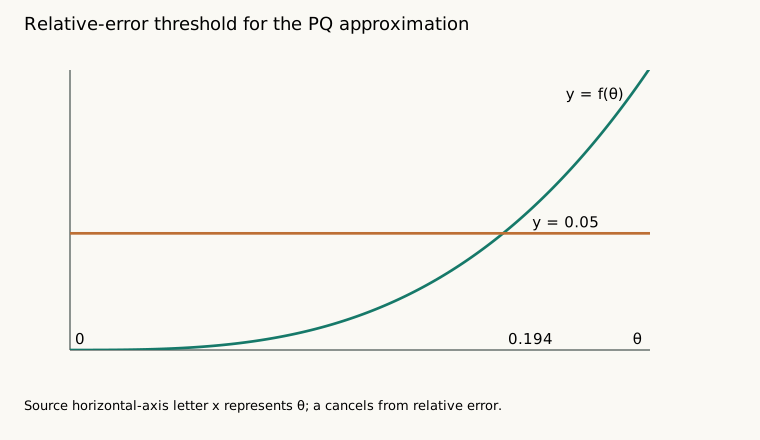
Relative-error threshold for the PQ approximation

Mathematical review

(i) ∠PQR=π/6−θ\angle PQR=\pi/6-\theta. By the sine rule, PQ/a=sin⁡(2π/3)/sin⁡(π/6−θ)PQ/a=\sin(2\pi/3)/\sin(\pi/6-\theta), giving the stated formula.

(ii) The denominator is 1−3θ−θ2/2+O(θ3)1-\sqrt3\theta-\theta^2/2+O(\theta^3). Its reciprocal is 1+3θ+7θ2/2+O(θ3)1+\sqrt3\theta+7\theta^2/2+O(\theta^3); hence b=3,c=7/2b=\sqrt3,c=7/2.

(iii) On the physical interval 0<θ<π/60<\theta<\pi/6, the relative error is ∣(1+3θ+7θ2/2)(cos⁡θ−3sin⁡θ)−1∣|(1+\sqrt3\theta+7\theta^2/2)(\cos\theta-\sqrt3\sin\theta)-1|. To verify a unique accuracy interval, put J=(1+3θ+7θ2/2)(cos⁡θ−3sin⁡θ)J=(1+\sqrt3\theta+7\theta^2/2)(\cos\theta-\sqrt3\sin\theta). On 0<θ<π/60<\theta<\pi/6, J>0J>0 and J′/cos⁡θ=4θ−(73/2)θ2−(4+83θ+7θ2/2)tan⁡θ<0J\prime/\cos\theta=4\theta-(7\sqrt3/2)\theta^2-(4+8\sqrt3\theta+7\theta^2/2)\tan\theta<0, since tan⁡θ>θ\tan\theta>\theta. As J(0)=1J(0)=1, the error 1−J1-J strictly increases. Numerically it reaches 0.050.05 at θ≈0.194141\theta\approx0.194141 radians and increases to that crossing. Thus 0<θ<0.1941410<\theta<0.194141 (approximately 0.1940.194 at 3 s.f.). The factor aa cancels from the percentage error.

Provenance

TJC JC2 2025 H2 Maths (9758) MSM. Native transcription checked against original visible question, working and sidebars. Question page(s): 20. Working page(s): 20, 21. The two Series source files are byte-identical; their shared visible content is expressed once and mapped to both page sets. Original records remain private for QA; this native article has no PDF or raster worksheet dependency.