Original question & working
A removable extension of the differential equation · source reference
[2010/MI/Prelim/I/11(b) (modified)] · Question pp. 1 · Working pp. 1
Open the interactive lessonThe working and teaching notes are included in the interactive lesson.
The original equation is undefined at x=0. The requested initial condition uses the smooth extension y′=2x/(1+x²); this interpretation follows the printed working rather than treating the displayed equation as defined there.
Full original question, working & notes
Printed question
(i) Find the general solution of the differential equation . [2]
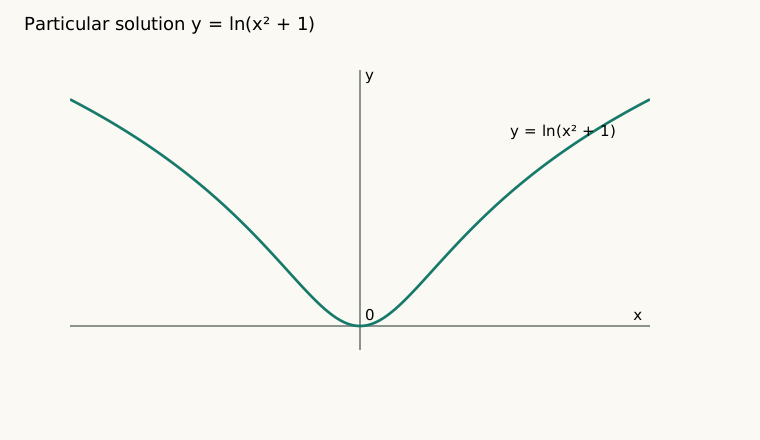
(ii) Sketch the particular solution of the differential equation in (i) for which and . [2]
(iii) Describe the gradient of every solution curve as . [1]
[2010/MI/Prelim/I/11(b) (modified)]
Printed working
.
General solution: . When , . Particular solution: .
As , , i.e. the gradient tends towards zero.
Printed answer key
(i) . (ii) The native sketch is given below. (iii) The gradient tends towards zero as .
Teacher note 1
Given DE of form . Integrate with respect to : .
Teacher note 2
Note: gradient at is .
Diagram 10-01-solution
Mathematical review
(i) For , , so on an interval excluding zero.
(ii) The intended extension through sets . It is even, nonnegative, with a horizontal tangent and minimum at the origin, and increases for positive x. Inflections are at , since .
(iii) Every member has as .
Provenance
TJC JC2 2025 H2 Maths (9758) MSM. Native transcription checked against original visible question, working and sidebars. Question page(s): 1. Working page(s): 1. Original records remain private for QA; this native article has no PDF or raster worksheet dependency.