Original question & working
Cooling toward ambient temperature · source reference
[2023/RI/Prelim/I/6] · Question pp. 2 · Working pp. 9, 10
Open the interactive lessonThe working and teaching notes are included in the interactive lesson.
View source review notesFull original question, working & notes
Printed question
Alice bakes a large pie and removes it from the oven at 1 pm. The temperature reading of the pie using a food thermometer is 200 °C at that instant. She left the pie on the kitchen countertop to cool down. The temperature of the kitchen is kept at a constant 32 °C. The temperature of the pie minutes after it is removed from the oven is °C. This temperature decreases at a rate proportional to the difference between the temperature of the pie and the temperature of the kitchen. At 1.15 pm, Alice checks the temperature of the pie again and it is 180 °C.
(a) Find an exact expression for in terms of , simplifying your answer. [5]
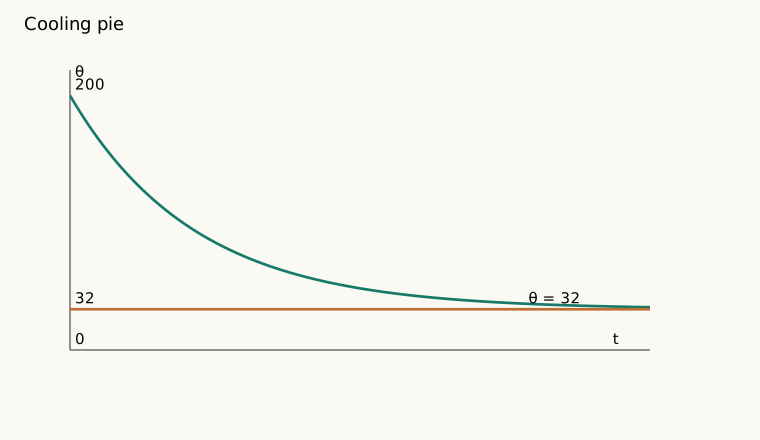
(b) Sketch a graph of against . [2]
(c) Food safety experts caution that bacteria grow fastest in food within the temperature range of 5 °C to 60 °C, known as the temperature danger zone. Find the latest time to the nearest minute to safely store the pie to avoid this danger zone. [2]
[2023/RI/Prelim/I/6]
Printed working
, . .
Since the pie is cooling, , so ; , .
Printed alternative: ; ; , .
At 0, : . At 15, : ; .
.
From GC, solution of is (5 s.f.), or 212 minutes (nearest minute), equivalent to 3 h 32 min.
Printed algebraic alternative: . To safely store the pie, minutes; latest time 4.32 pm.
Printed answer key
(a) . (b) Native sketch below. (c) 4.32 pm.
Teacher note 1
Since pie is cooling, . Also (temperature of kitchen), hence and constant of proportionality is negative.
Teacher note 2
Given , integrate .
Teacher note 3
Note ; do not sketch a curve for . As , , thus . Horizontal asymptote .
Teacher note 4
Since pie is cooling and removed from the oven at 1 pm at 200 °C, it first reaches 60 °C in the danger zone. Pie is removed at 1 pm.
Diagram 10-08-cooling
Mathematical review
(a) gives . Initial data gives A=168; at 15 minutes, . Thus .
(b) For t≥0 the graph starts at (0,200), decreases with positive second derivative, and approaches the horizontal asymptote θ=32.
(c) Solve : minutes. Rounded to the nearest minute, this is 4:32 pm. Under the exercise’s rule storage is before the crossing, not after it; the cited temperature rule belongs to the source exercise.
Provenance
TJC JC2 2025 H2 Maths (9758) MSM. Native transcription checked against original visible question, working and sidebars. Question page(s): 2. Working page(s): 9, 10. Original records remain private for QA; this native article has no PDF or raster worksheet dependency.