Original question & working
Separate the formal model from inconsistent pump directions · source reference
[2022/ASRJC/Prelim/I/11] · Question pp. 6 · Working pp. 27, 28
Open the interactive lessonThe working and teaching notes are included in the interactive lesson.
Question PDF p.6 (printed 73), solution pp.27–28: the printed k=−11/50 is algebraically consistent with the given derivative datum but incompatible with positive inflow ∝h² and positive outflow ∝h. The original wording and solution are preserved; the logistic interpretation is explicitly conditional.
Full original question, working & notes
Printed question
The cylindrical tank in a research laboratory has a cross-sectional area of 4 m². To cool the tank, water is pumped in and out of the tank simultaneously. The volume and height of the water in the tank at any time minutes is given by (m³) and (metres) respectively. Clean water is pumped into the tank at a rate that is proportional to and the water is pumped out from the tank at a rate that is proportional to .
(i) Assume that the water does not overflow and that there is no change to the height of the water when , show that where is a real constant. [4]
The tank was initially filled with clean water to a height of 2 metres. When the height of the water is 5 metres, the volume of water is increasing at a rate of 5.5 m³ per minute.
(ii) Find the exact value of . Hence find in terms of . [5]
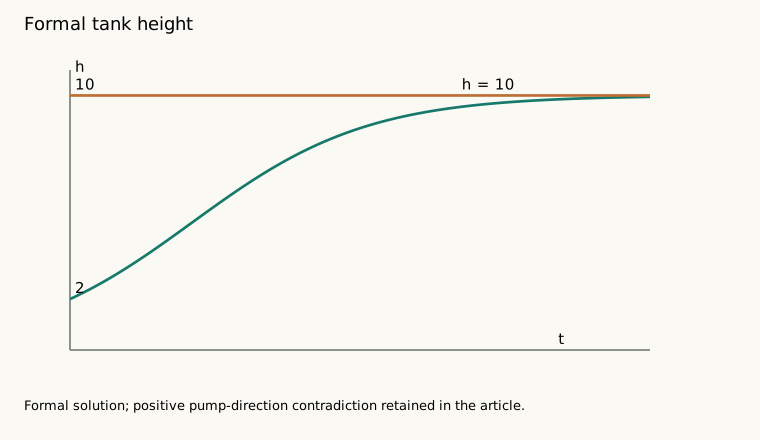
(iii) Sketch a graph of against . Hence write down the minimum height of the cylindrical tank that will not result in the overflow of the water. [3]
[2022/ASRJC/Prelim/I/11]
Printed working
, as printed.
At , . Given base area 4 m², , so (1).
, where (2).
At , : .
; .
Method 1 (MF27): ; .
Method 2 (partial fractions): .
; ; .
, ; .
At 0, : . Thus .
As , , . The source gives minimum tank height 10 metres. This formal solution’s conflict with positive physical pump rates is reviewed separately.
Printed answer key
(ii) ; . (iii) 10 metres; native sketch below.
Teacher note 1
.
- You cannot express both the rate pumped in and rate pumped out as ; the net derivative is neither alone nor alone.
- Constants of proportionality for the two rates need not be the same.
- Avoid using initially, since it represents the final constant in the DE to be shown. Use different letters, e.g. .
- Need to express the DE in terms of one constant: use the given condition to express in terms of or vice versa.
- Need to show clearly how or relates to .
Recall that a “Show” question needs clear explanation. No change in water height when implies there.
Teacher note 2
Given , integrate . Used result: .
Teacher note 3
As , , so . Horizontal asymptote .
Diagram 10-17-height
Mathematical review
(i) Write inflow and outflow . Since V=4h, . Equilibrium at h=10 gives B=10A, hence the stated form with k=A.
(ii) Using the stated datum formally, , so . The formal DE is . Separation gives . Initial h=2 gives odds 1/4, hence . Substitution verifies both the formal DE and V′=5.5 at h=5.
(iii) This formal graph starts at (0,2), rises sigmoidally through inflection h=5 and tends to 10 from below. It suggests a minimum tank height 10 m. However, it requires A=k<0 and B=10A<0 in the original inflow/outflow description: these are negative pumped volumes. No positive physical pump-rate constants satisfy all the supplied statements. Swapping the proportional laws (inflow ∝h, outflow ∝h²) would produce the formal logistic behavior, but that is a proposed repair, not the printed question.
Provenance
TJC JC2 2025 H2 Maths (9758) MSM. Native transcription checked against original visible question, working and sidebars. Question page(s): 6. Working page(s): 27, 28. Original records remain private for QA; this native article has no PDF or raster worksheet dependency.