Porisma

Original question & working

A perpendicular foot organizes four shapes · source reference

[modified 2017/DHS/Promo/6] · Question pp. 1 · Working pp. 1, 2

Open the interactive lesson

The working and teaching notes are included in the interactive lesson.

View source review notes
Full original question, working & notes

Question

The position vectors of A, B and C relative to origin O are −i+5j+k-\mathbf i+5\mathbf j+\mathbf k, i−j+5k\mathbf i-\mathbf j+5\mathbf k and pi−4j+7kp\mathbf i-4\mathbf j+7\mathbf k respectively, where pp is constant. Given A, B and C are collinear, show p=2p=2. [2]

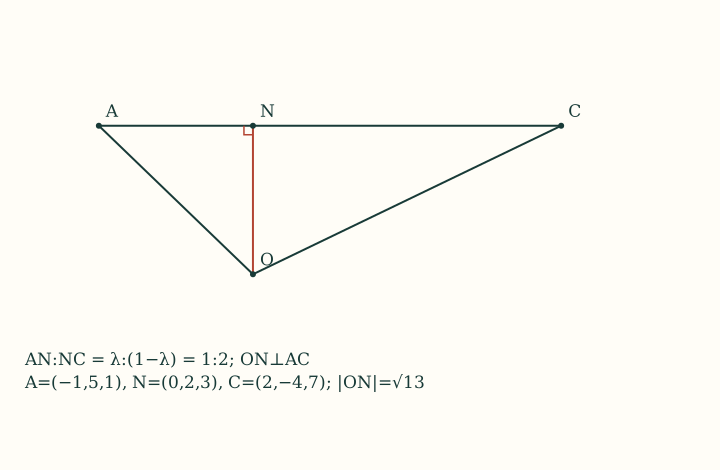
(i) N divides AC in ratio AN:NC=λ:1−λAN:NC=\lambda:1-\lambda. Find λ\lambda given ON is perpendicular to AC. [4]

(ii) Hence find the exact area of triangle OAC. [2]

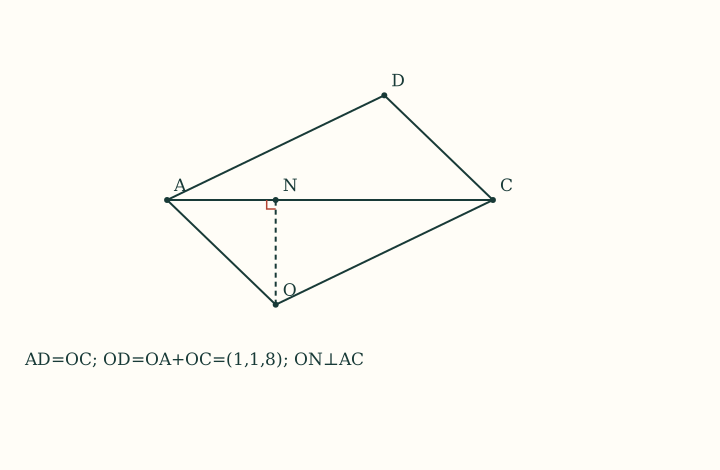
(iii) Find the position vector of D such that OADC is a parallelogram. [2]

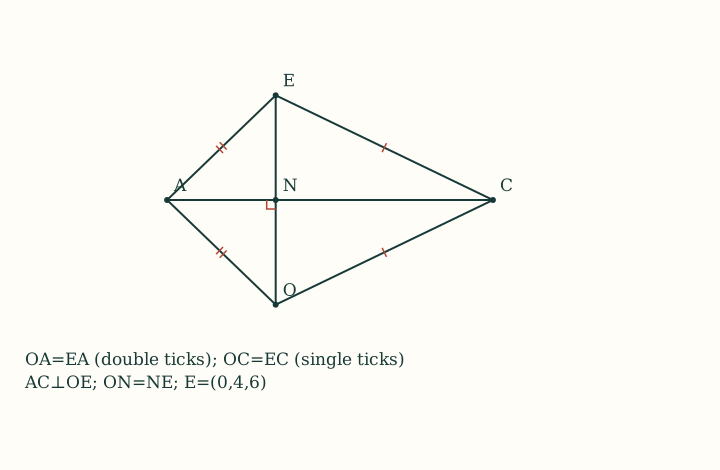
(iv) Find the coordinates of E such that OAEC is a kite. [2]

[modified 2017/DHS/Promo/6]

Source working

Given OA→=(−1,5,1)\overrightarrow{OA}=(-1,5,1), OB→=(1,−1,5)\overrightarrow{OB}=(1,-1,5), OC→=(p,−4,7)\overrightarrow{OC}=(p,-4,7).

Collinearity implies AB→=kAC→\overrightarrow{AB}=k\overrightarrow{AC} for some real kk:

(1,−1,5)−(−1,5,1)=k[(p,−4,7)−(−1,5,1)],(1,-1,5)-(-1,5,1)=k[(p,-4,7)-(-1,5,1)], (2,−6,4)=k(p+1,−9,6).(2,-6,4)=k(p+1,-9,6).

Second coordinate: k=2/3k=2/3. First: 2=(2/3)(p+1)⇒p=3−1=22=(2/3)(p+1)\Rightarrow p=3-1=2 (shown).

(i) Ratio theorem:

ON→=λOC→+(1−λ)OA→=λ(2,−4,7)+(1−λ)(−1,5,1)=(−1,5,1)+λ(3,−9,6).\begin{aligned}\overrightarrow{ON}&=\lambda\overrightarrow{OC}+(1-\lambda)\overrightarrow{OA}\\&=\lambda(2,-4,7)+(1-\lambda)(-1,5,1)\\&=(-1,5,1)+\lambda(3,-9,6).\end{aligned}

ON⊥AC⇒ON→⋅AC→=0ON\perp AC\Rightarrow\overrightarrow{ON}\cdot\overrightarrow{AC}=0:

[(−1,5,1)+λ(3,−9,6)]⋅[(2,−4,7)−(−1,5,1)]=0,[(-1,5,1)+\lambda(3,-9,6)]\cdot[(2,-4,7)-(-1,5,1)]=0, [(−1,5,1)+λ(3,−9,6)]⋅(3,−9,6)=0,[(-1,5,1)+\lambda(3,-9,6)]\cdot(3,-9,6)=0, (−3−45+6)+λ(9+81+36)=0,(-3-45+6)+\lambda(9+81+36)=0, −42+126λ=0⇒λ=1/3.-42+126\lambda=0\Rightarrow\lambda=1/3.

(ii)

ON→=(−1,5,1)+13(3,−9,6)=(0,2,3).\overrightarrow{ON}=(-1,5,1)+\tfrac13(3,-9,6)=(0,2,3). Area(OAC)=12∣AC→∣ ∣ON→∣=12∣(3,−9,6)∣ ∣(0,2,3)∣=32∣(1,−3,2)∣ ∣(0,2,3)∣=321+9+44+9=321413=31822.\begin{aligned}\text{Area}(OAC)&=\tfrac12|\overrightarrow{AC}|\,|\overrightarrow{ON}|\\&=\tfrac12|(3,-9,6)|\,|(0,2,3)|\\&=\tfrac32|(1,-3,2)|\,|(0,2,3)|\\&=\tfrac32\sqrt{1+9+4}\sqrt{4+9}\\&=\tfrac32\sqrt{14}\sqrt{13}=\frac{3\sqrt{182}}2.\end{aligned}

(iii) OADC parallelogram implies AD→=OC→\overrightarrow{AD}=\overrightarrow{OC}, hence OD→−OA→=OC→\overrightarrow{OD}-\overrightarrow{OA}=\overrightarrow{OC}:

OD→=(−1,5,1)+(2,−4,7)=(1,1,8).\overrightarrow{OD}=(-1,5,1)+(2,-4,7)=(1,1,8).

(iv) OAEC kite implies OE→=2ON→\overrightarrow{OE}=2\overrightarrow{ON}:

OE→=2(0,2,3)=(0,4,6).\overrightarrow{OE}=2(0,2,3)=(0,4,6).

Therefore E=(0,4,6)E=(0,4,6).

Teacher notes

A, B and C collinear means they lie on the same straight line. One may instead consider AB→=kBC→\overrightarrow{AB}=k\overrightarrow{BC} or BC→=kAC→\overrightarrow{BC}=k\overrightarrow{AC}, for some k∈Rk\in\mathbb R. “Some” refers to a particular value of k.

N is between A and C. N lies outside the segment if the question says N is on AC produced or CA produced.

ON→⋅AC→=0⇒∣ON∣∣AC∣cos⁡∠ONA=0⇒cos⁡∠ONA=0⇒∠ONA=90∘\overrightarrow{ON}\cdot\overrightarrow{AC}=0\Rightarrow|ON||AC|\cos\angle ONA=0\Rightarrow\cos\angle ONA=0\Rightarrow\angle ONA=90^\circ.

Parallelogram vertices are labelled consecutively OADC, clockwise or anticlockwise.

Kite properties: two pairs of adjacent sides are equal, OA=EAOA=EA and OC=ECOC=EC; diagonals AC and OE meet at right angles; AC bisects OE, so ON=NEON=NE.

Native diagrams

The source contains a collinear A–B–C diagram; the ratio/height triangle A–N–C with O below and AN:NC=λ:1−λAN:NC=\lambda:1-\lambda; its area diagram; parallelogram OADC with N and perpendicular ON; and kite OAEC with equal-side ticks and perpendicular diagonals. These are encoded as verified native geometry.
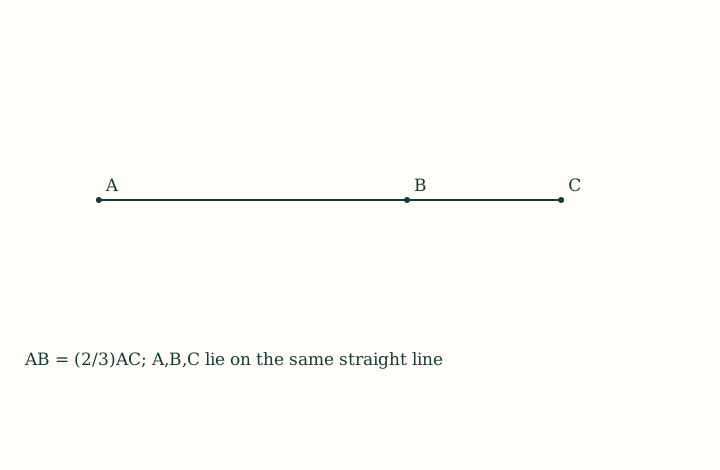
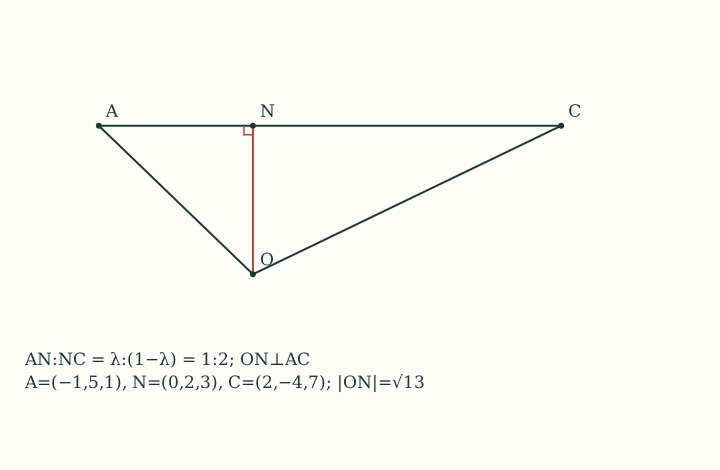
Collinear A,B,C with AB=(2/3)AC Ratio theorem and perpendicular ON Base AC and height ON for the area Parallelogram OADC Kite OAEC with perpendicular diagonals

Printed answer key

(i) λ=1/3\lambda=1/3; (ii) 3182/23\sqrt{182}/2; (iii) (1,1,8)(1,1,8); (iv) (0,4,6)(0,4,6).

Provenance

2025 TJC H2 Math (9758) JC2 MSM: VECTORS. Question document pages 1; solution document pages 1,2. Original page numbers are retained as text metadata.