Porisma

Original question & working

An extended segment and coefficient comparison · source reference

[2018/EJC/Prelim/I/5] · Question pp. 1 · Working pp. 3

Open the interactive lesson

The working and teaching notes are included in the interactive lesson.

View source review notes
Full original question, working & notes

Question

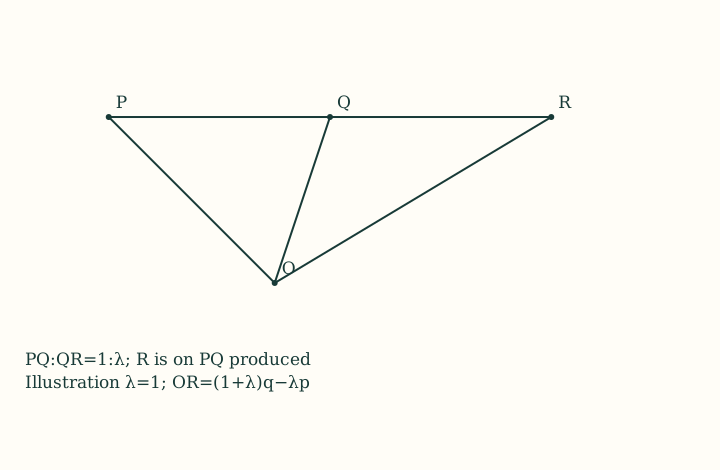
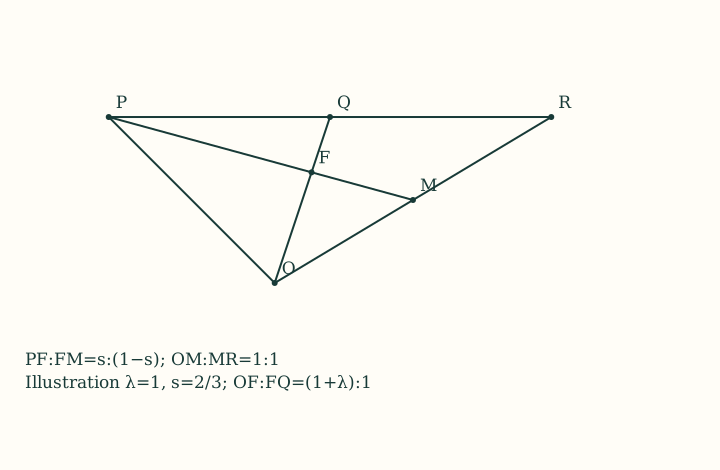
Relative to origin O, P and Q have position vectors p,q\mathbf p,\mathbf q, nonparallel and nonzero. R lies on PQ produced with PQ:QR=1:λPQ:QR=1:\lambda. M is the midpoint of OR.

(i) Find the position vector of R in terms of λ,p,q\lambda,\mathbf p,\mathbf q. [1]

F lies on OQ and F, P, M are collinear.

(ii) Find OF:FQOF:FQ in terms of λ\lambda. [4]

[2018/EJC/Prelim/I/5]

Source working

(i) Ratio theorem:

OQ→=OR→+λOP→1+λ⇒OR→=(1+λ)q−λp.\overrightarrow{OQ}=\frac{\overrightarrow{OR}+\lambda\overrightarrow{OP}}{1+\lambda}\Rightarrow\overrightarrow{OR}=(1+\lambda)\mathbf q-\lambda\mathbf p.

(ii) F on OQ gives OF→=tq\overrightarrow{OF}=t\mathbf q for some t∈Rt\in\mathbb R.

F on PM: let PF:FM=s:1−sPF:FM=s:1-s, s∈Rs\in\mathbb R. Ratio theorem gives

OF→=sOM→+(1−s)OP→=s2OR→+(1−s)p=s2((1+λ)q−λp)+(1−s)p=(1−sλ/2−s)p+s(1+λ)2q.\begin{aligned}\overrightarrow{OF}&=s\overrightarrow{OM}+(1-s)\overrightarrow{OP}\\&=\tfrac s2\overrightarrow{OR}+(1-s)\mathbf p\\&=\tfrac s2((1+\lambda)\mathbf q-\lambda\mathbf p)+(1-s)\mathbf p\\&=(1-s\lambda/2-s)\mathbf p+\tfrac{s(1+\lambda)}2\mathbf q.\end{aligned}

Thus tq=(1−sλ/2−s)p+s(1+λ)q/2t\mathbf q=(1-s\lambda/2-s)\mathbf p+s(1+\lambda)\mathbf q/2.

Nonparallel, nonzero p and q imply

1−sλ/2−s=0⇒s(λ/2+1)=1,1-s\lambda/2-s=0\Rightarrow s(\lambda/2+1)=1, s=1λ/2+1=2λ+2.s=\frac1{\lambda/2+1}=\frac2{\lambda+2}. OF→=0p+s(1+λ)2q=2λ+21+λ2q=1+λ2+λq.\overrightarrow{OF}=0\mathbf p+\tfrac{s(1+\lambda)}2\mathbf q=\frac2{\lambda+2}\frac{1+\lambda}2\mathbf q=\frac{1+\lambda}{2+\lambda}\mathbf q. FQ→=OQ→−OF→=q−1+λ2+λq=12+λq.\overrightarrow{FQ}=\overrightarrow{OQ}-\overrightarrow{OF}=\mathbf q-\frac{1+\lambda}{2+\lambda}\mathbf q=\frac1{2+\lambda}\mathbf q. OF→=1+λ2+λq=(1+λ)12+λq=(1+λ)FQ→.\overrightarrow{OF}=\frac{1+\lambda}{2+\lambda}\mathbf q=(1+\lambda)\frac1{2+\lambda}\mathbf q=(1+\lambda)\overrightarrow{FQ}.

Hence OF:FQ=(1+λ):1OF:FQ=(1+\lambda):1.

Teacher notes

R lies outside segment PQ, nearer Q, because it is on PQ produced.

Form two expressions for OF in terms of p and q, using F on OQ and F on PM. Equate these expressions to find s in terms of λ. Alternatively, consider F as the intersection of lines OQ and PM.

Native diagrams

The first source panel shows P–Q–R with ratios 1,λ1,\lambda and origin O; its ratio-theorem arrows identify the weighted vectors. The second adds midpoint M on OR, F at PM∩OQ, PF:FM=s:1−sPF:FM=s:1-s and the equal lengths OM=MROM=MR marked 1,11,1.

External section P,Q,R F lies on OQ and PM

Printed answer key

(i) OR→=(1+λ)q−λp\overrightarrow{OR}=(1+\lambda)\mathbf q-\lambda\mathbf p; (ii) OF:FQ=(1+λ):1OF:FQ=(1+\lambda):1.

Provenance

2025 TJC H2 Math (9758) JC2 MSM: VECTORS. Question document pages 1; solution document pages 3. Original page numbers are retained as text metadata.