Original question & working
Skew lines and a perpendicular foot · source reference
[modified 2009/NYJC/Prelim/I/3] · Question pp. 1 · Working pp. 4
Open the interactive lessonThe working and teaching notes are included in the interactive lesson.
View source review notesFull original question, working & notes
Question
Lines are and respectively.
(i) Show they are skew lines. [3]
(ii) Find the position vector of the foot of perpendicular from A to . [3]
[modified 2009/NYJC/Prelim/I/3]
Source working
(i) The direction vectors and are not parallel, so the lines may intersect. Equating line coordinates:
Solving (1),(2) using GC gives . Substitute into unused third equation: LHS RHS. The source concludes: “Since there is no unique solution, the lines are skew lines.”
Qualification: The computed inconsistency shows there is no solution, rather than merely “no unique solution”. Nonparallel lines that do not intersect are skew.
(ii) Let N be the foot. N on :
:
Thus .
Teacher notes
In , the first vector is the position vector of a known point on the line; the second is its direction vector; .
Solve for μ, λ using two coordinate equations and substitute into the third to check satisfaction.
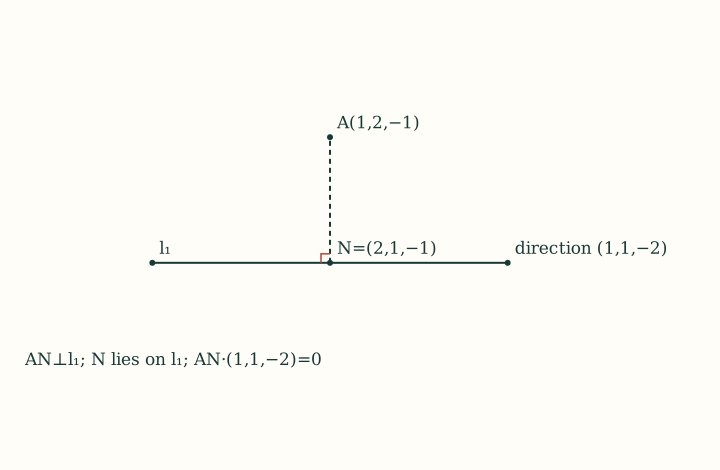
For the perpendicular foot, use two conditions: N lies on so satisfies the line equation; , so , with d its direction vector.
Native diagrams
The source shows a straight through N, a perpendicular AN with A above, a right-angle mark at N and direction arrow along the line.
Printed answer key
(ii) .
Provenance
2025 TJC H2 Math (9758) JC2 MSM: VECTORS. Question document pages 1; solution document pages 4. Original page numbers are retained as text metadata.