Porisma

Original question & working

Projection followed by line reflection · source reference

[2010/ACJC/Prelim/I/9] · Question pp. 1 · Working pp. 5, 6

Open the interactive lesson

The working and teaching notes are included in the interactive lesson.

View source review notes
Full original question, working & notes

Question

Relative to origin O, A and B have position vectors a=3i+j+3k\mathbf a=3\mathbf i+\mathbf j+3\mathbf k and b=5i−4j+3k\mathbf b=5\mathbf i-4\mathbf j+3\mathbf k.

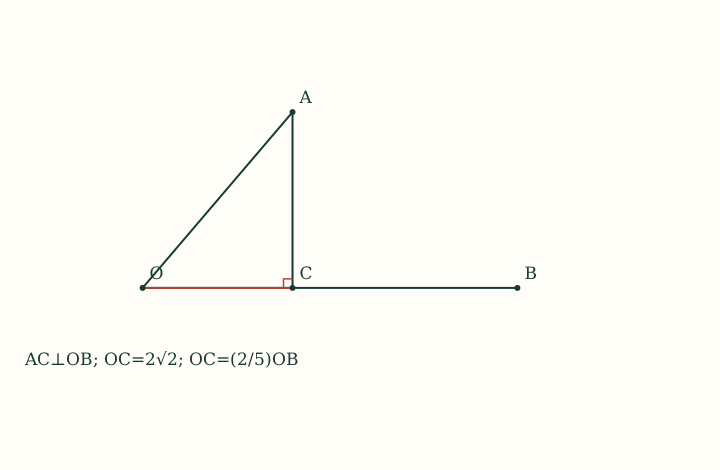
(i) Find the length of the projection of OA on OB. [2]

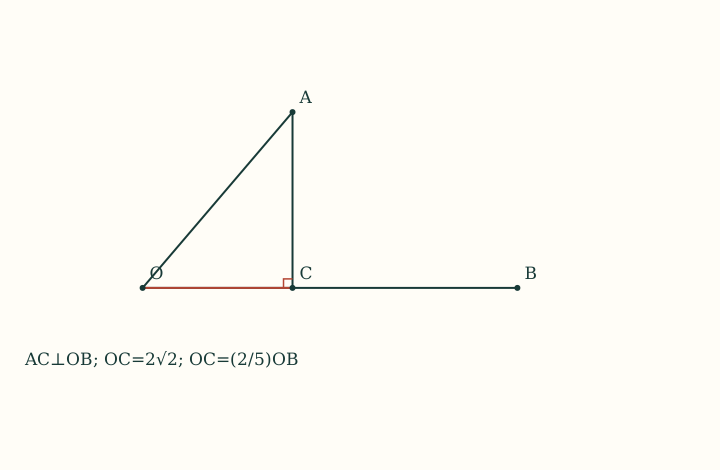
(ii) Hence or otherwise find the position vector of C on OB such that AC is perpendicular to OB. [2]

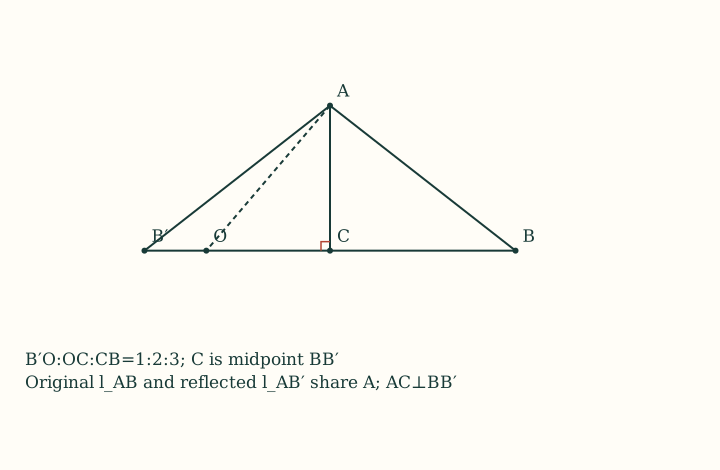
(iii) Find a vector equation of the reflection of line AB in line AC. [3]

[2010/ACJC/Prelim/I/9]

Source working

(i)

∣OA→⋅OB→∣∣OB→∣=150∣(3,1,3)⋅(5,−4,3)∣=2050=22or4/2.\frac{|\overrightarrow{OA}\cdot\overrightarrow{OB}|}{|\overrightarrow{OB}|}=\frac1{\sqrt{50}}|(3,1,3)\cdot(5,-4,3)|=\frac{20}{\sqrt{50}}=2\sqrt2\quad\text{or}\quad4/\sqrt2.

(ii) Line OB: r=(0,0,0)+λ(5,−4,3)\mathbf r=(0,0,0)+\lambda(5,-4,3).

C on OB gives OC→=λ(5,−4,3)\overrightarrow{OC}=\lambda(5,-4,3), λ∈R\lambda\in\mathbb R.

AC→=OC→−OA→=λ(5,−4,3)−(3,1,3).\overrightarrow{AC}=\overrightarrow{OC}-\overrightarrow{OA}=\lambda(5,-4,3)-(3,1,3).

Since AC⊥OBAC\perp OB, AC→⋅OB→=0\overrightarrow{AC}\cdot\overrightarrow{OB}=0:

[λ(5,−4,3)−(3,1,3)]⋅(5,−4,3)=0,[\lambda(5,-4,3)-(3,1,3)]\cdot(5,-4,3)=0, λ(25+16+9)−(15−4+9)=0,\lambda(25+16+9)-(15-4+9)=0, λ=20/50=2/5,OC→=25(5,−4,3).\lambda=20/50=2/5,\qquad\overrightarrow{OC}=\tfrac25(5,-4,3).

Alternative: From (i), ∣OC∣=22|OC|=2\sqrt2.

OC→=22OB→∣OB→∣=22150(5,−4,3)=25(5,−4,3).\overrightarrow{OC}=2\sqrt2\frac{\overrightarrow{OB}}{|\overrightarrow{OB}|}=2\sqrt2\frac1{\sqrt{50}}(5,-4,3)=\tfrac25(5,-4,3).

OC is in the same direction as OB since OA→⋅OB→>0\overrightarrow{OA}\cdot\overrightarrow{OB}>0.

(iii) OC→=25OB→\overrightarrow{OC}=\tfrac25\overrightarrow{OB}, so OC:CB=2:3OC:CB=2:3. Let B′ be the reflection of B in AC.

OB′→=−15OB→=−15(5,−4,3).\overrightarrow{OB'}=-\tfrac15\overrightarrow{OB}=-\tfrac15(5,-4,3). AB′→=OB′→−OA→=−15(5,−4,3)−(3,1,3)=−15(20,1,18).\overrightarrow{AB'}=\overrightarrow{OB'}-\overrightarrow{OA}=-\tfrac15(5,-4,3)-(3,1,3)=-\tfrac15(20,1,18).

The reflected line AB′ is

r=(3,1,3)+α(20,1,18),α∈R.\mathbf r=(3,1,3)+\alpha(20,1,18),\qquad\alpha\in\mathbb R.

Teacher notes

Projection length equals ∣OA→⋅OB→∣/∣OB∣=∣OA∣∣cos⁡∠AOB∣=OC|\overrightarrow{OA}\cdot\overrightarrow{OB}|/|OB|=|OA||\cos\angle AOB|=OC. C is the perpendicular foot from A to OB.

Alternative for (iii): C is the midpoint of B and B′. Ratio theorem about O:

OC→=OB→+OB′→2,\overrightarrow{OC}=\frac{\overrightarrow{OB}+\overrightarrow{OB'}}2, OB′→=2OC→−OB→=45OB→−OB→=−15OB→=−15(5,−4,3).\overrightarrow{OB'}=2\overrightarrow{OC}-\overrightarrow{OB}=\tfrac45\overrightarrow{OB}-\overrightarrow{OB}=-\tfrac15\overrightarrow{OB}=-\tfrac15(5,-4,3).

Native diagrams

Two projection diagrams place O,C,B collinearly with A above C and right angle ACB; the first highlights OC in red. The reflection diagram includes B′,O,C,B in order with consecutive lengths 1,2,3, A over C, original lABl_{AB}, reflected lAB′l_{AB'}, and a perpendicular at C.

Length of the projection of OA on OB C is the perpendicular foot from A to OB Reflection of line AB in AC

Printed answer key

(i) 222\sqrt2; (ii) (2/5)(5,−4,3)(2/5)(5,-4,3); (iii) r=(3,1,3)+α(20,1,18)\mathbf r=(3,1,3)+\alpha(20,1,18), α∈R\alpha\in\mathbb R.

Provenance

2025 TJC H2 Math (9758) JC2 MSM: VECTORS. Question document pages 1; solution document pages 5,6. Original page numbers are retained as text metadata.