Original question & working
Equal radii make a midpoint perpendicular · source reference
[2010/NJC/Prelim/I/3] · Question pp. 1 · Working pp. 6, 7
Open the interactive lessonThe working and teaching notes are included in the interactive lesson.
View source review notesFull original question, working & notes
Question
A and B have position vectors relative to O, with . P with position vector lies on AB such that .
(i) Show AB is perpendicular to OP. [2]
(ii) Determine the position vector of D in terms of a,b, where D is O reflected about AB. [2]
(iii) Give the geometrical meaning of . [1]
[2010/NJC/Prelim/I/3]
Source working
(i)
Hence AB is perpendicular to OP.
Alternative: .
(ii) Since , P is the midpoint of AB. Ratio theorem gives .
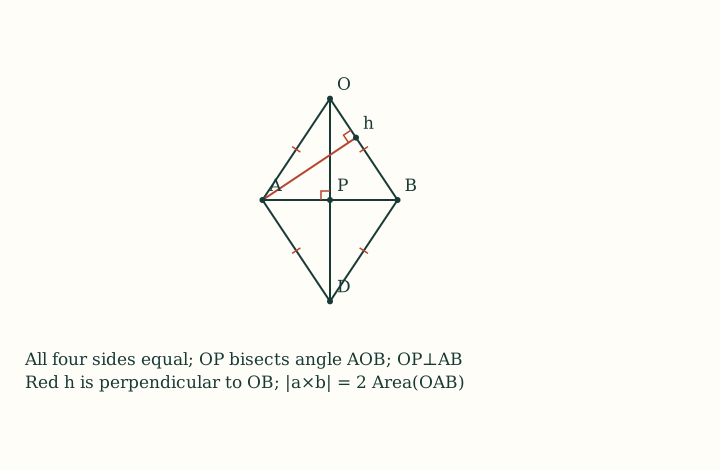
(iii) represents the area of rhombus OADB or OBDA.
Teacher notes
The margin derives
Native diagrams
The rhombus has O above, D below, A left, B right and P at the perpendicular diagonal intersection. All four side-equality ticks, angle bisector at O, right angle at P, altitude h from A to OB and its right-angle mark are retained. Degenerate A=B would not define a unique line AB; the printed geometric construction presumes distinct A,B.
Printed answer key
(ii) ; (iii) area of rhombus OADB or OBDA.
Provenance
2025 TJC H2 Math (9758) JC2 MSM: VECTORS. Question document pages 1; solution document pages 6,7. Original page numbers are retained as text metadata.