Porisma

Original question & working

Orthogonality and an angle maximisation · source reference

[2017/ACJC/Prelim/I/9] · Question pp. 2 · Working pp. 9, 10

Open the interactive lesson

The working and teaching notes are included in the interactive lesson.

The printed motion description names line segments, but the prescribed coordinate paths are circular. This qualification does not alter the computed angle.

View source review notes
Full original question, working & notes

Question

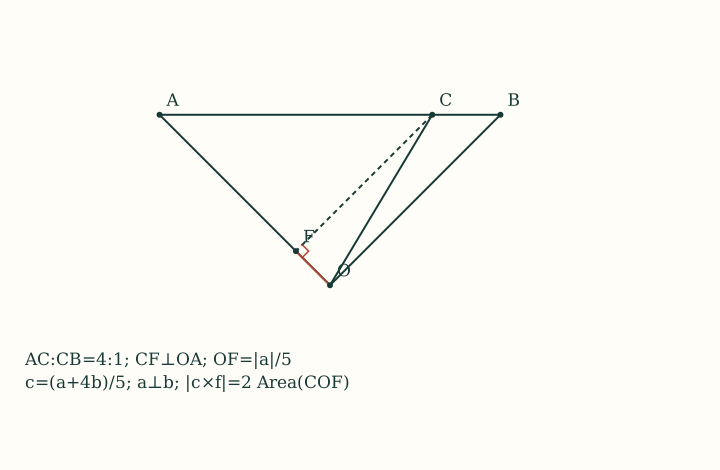
A,B,C have position vectors a,b,c relative to O. AC→=4CB→\overrightarrow{AC}=4\overrightarrow{CB} and ∣a+b∣2=∣a∣2+∣b∣2|\mathbf a+\mathbf b|^2=|\mathbf a|^2+|\mathbf b|^2.

(i) Consider (a+b)⋅(a+b)(\mathbf a+\mathbf b)\cdot(\mathbf a+\mathbf b) to show a and b are perpendicular. [2]

(ii) Find the length of projection of c on a in terms of ∣a∣|\mathbf a|. [3]

(iii) F is the perpendicular foot from C to OA; f is its position vector. State the geometrical meaning of ∣c×f∣|\mathbf c\times\mathbf f|. [1]

(iv) Two points X,Y move along line segments OA,AB respectively such that

OX→=(cos⁡3t)i+(sin⁡3t)j+12k,\overrightarrow{OX}=(\cos3t)\mathbf i+(\sin3t)\mathbf j+\tfrac12\mathbf k, OY→=(sin⁡t)i+(cos⁡t)j−2k,\overrightarrow{OY}=(\sin t)\mathbf i+(\cos t)\mathbf j-2\mathbf k,

where t is real, 0≤t≤2π0\leq t\leq2\pi. Express their scalar product as psin⁡(qt)+rp\sin(qt)+r, with real p,q,r to determine, and find the greatest ∠XOY\angle XOY. [5]

[2017/ACJC/Prelim/I/9]

Source working

(i)

(a+b)⋅(a+b)=a⋅a+2a⋅b+b⋅b.(\mathbf a+\mathbf b)\cdot(\mathbf a+\mathbf b)=\mathbf a\cdot\mathbf a+2\mathbf a\cdot\mathbf b+\mathbf b\cdot\mathbf b.

This equals ∣a+b∣2=∣a∣2+∣b∣2|\mathbf a+\mathbf b|^2=|\mathbf a|^2+|\mathbf b|^2, so

∣a∣2+2a⋅b+∣b∣2=∣a∣2+∣b∣2⇒2a⋅b=0⇒a⋅b=0⇒a⊥b.|\mathbf a|^2+2\mathbf a\cdot\mathbf b+|\mathbf b|^2=|\mathbf a|^2+|\mathbf b|^2\Rightarrow2\mathbf a\cdot\mathbf b=0\Rightarrow\mathbf a\cdot\mathbf b=0\Rightarrow\mathbf a\perp\mathbf b.

(ii) Ratio theorem:

OC→=4b+a5=15a+45b.\overrightarrow{OC}=\frac{4\mathbf b+\mathbf a}5=\tfrac15\mathbf a+\tfrac45\mathbf b.

Projection length:

OF=∣OC→⋅OA→∣∣OA∣=∣(15a+45b)⋅a∣∣a∣=∣15a⋅a+45b⋅a∣∣a∣=∣15∣a∣2+45b⋅a∣∣a∣=15∣a∣.\begin{aligned}OF&=\frac{|\overrightarrow{OC}\cdot\overrightarrow{OA}|}{|OA|}\\&=\frac{|(\tfrac15\mathbf a+\tfrac45\mathbf b)\cdot\mathbf a|}{|\mathbf a|}\\&=\frac{|\tfrac15\mathbf a\cdot\mathbf a+\tfrac45\mathbf b\cdot\mathbf a|}{|\mathbf a|}\\&=\frac{|\tfrac15|\mathbf a|^2+\tfrac45\mathbf b\cdot\mathbf a|}{|\mathbf a|}=\tfrac15|\mathbf a|.\end{aligned}

(iii) ∣c×f∣|\mathbf c\times\mathbf f| is twice the area of triangle COF.

(iv)

OX→⋅OY→=(cos⁡3t,sin⁡3t,1/2)⋅(sin⁡t,cos⁡t,−2)=cos⁡3tsin⁡t+sin⁡3tcos⁡t−1=sin⁡4t−1.\begin{aligned}\overrightarrow{OX}\cdot\overrightarrow{OY}&=(\cos3t,\sin3t,1/2)\cdot(\sin t,\cos t,-2)\\&=\cos3t\sin t+\sin3t\cos t-1=\sin4t-1.\end{aligned} cos⁡∠XOY=sin⁡4t−1cos⁡23t+sin⁡23t+1/4sin⁡2t+cos⁡2t+4=sin⁡4t−15/45=25(sin⁡4t−1).\begin{aligned}\cos\angle XOY&=\frac{\sin4t-1}{\sqrt{\cos^23t+\sin^23t+1/4}\sqrt{\sin^2t+\cos^2t+4}}\\&=\frac{\sin4t-1}{\sqrt{5/4}\sqrt5}=\tfrac25(\sin4t-1).\end{aligned}

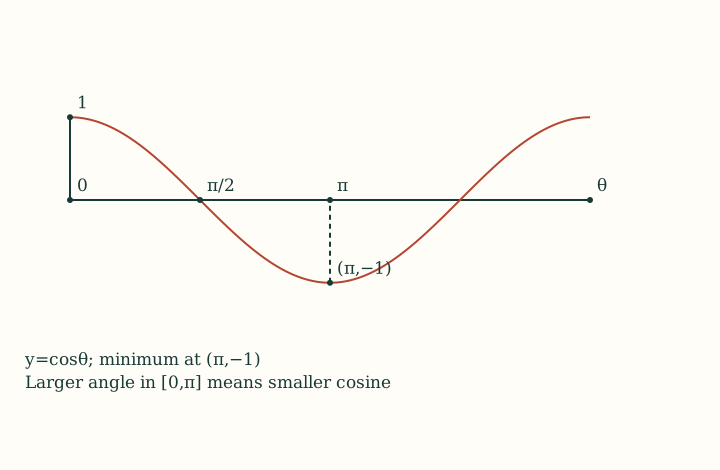
Maximum angle occurs when its cosine is most negative, when sin⁡4t=−1\sin4t=-1. Cosine decreases as θ increases from 0 to π: larger angle, smaller cosine. Then cos⁡∠XOY=25(−1−1)=−4/5\cos\angle XOY=\tfrac25(-1-1)=-4/5, so ∠XOY=cos⁡−1(−4/5)=143.1∘\angle XOY=\cos^{-1}(-4/5)=143.1^\circ.

Qualification

The printed assertion that X,Y move along fixed line segments contradicts the supplied trigonometric positions: those describe horizontal circles. The stated angle result follows the formulas; the line-segment narrative cannot simultaneously hold for the entire t interval.

Native diagrams

The projection triangle labels A,C,B collinearly, AC:CB=4:1AC:CB=4:1, O, perpendicular F on OA, red OF and dashed CF. The cosine graph labels y=cos⁡θy=\cos\theta, θ-axis, y-axis, 0, π/2,π,1,−1\pi/2,\pi,1,-1, with projection guides at the minimum (π,−1)(\pi,-1).

Projection of OC onto OA Cosine decreases on 0≤θ≤π

Printed answer key

(ii) ∣a∣/5|\mathbf a|/5; (iii) twice the area of triangle COF; (iv) sin⁡4t−1\sin4t-1, 143.1∘143.1^\circ.

Provenance

2025 TJC H2 Math (9758) JC2 MSM: VECTORS. Question document pages 2; solution document pages 9,10. Original page numbers are retained as text metadata.