Porisma

Original question & working

Affine collinearity and a triangle area · source reference

[2017/VJC/Prelim/II/2] · Question pp. 2 · Working pp. 11

Open the interactive lesson

The working and teaching notes are included in the interactive lesson.

View source review notes
Full original question, working & notes

Question

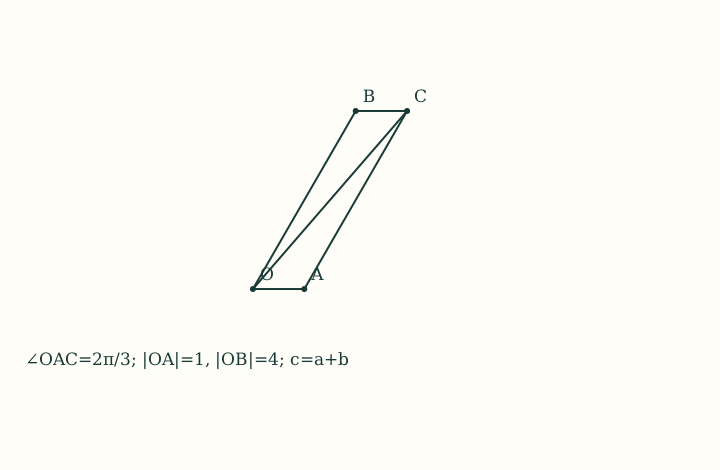
Relative to O, A,B,D have position vectors a,b,d. OACB is a parallelogram and ∠OAC=2π/3\angle OAC=2\pi/3 radians.

(i) Given a is a unit vector and ∣b∣=4|\mathbf b|=4, find the length of projection of OC onto OA. [3]

(ii) Given λa+μb+d=0\lambda\mathbf a+\mu\mathbf b+\mathbf d=\mathbf0 and λ+μ+1=0\lambda+\mu+1=0, show A,B,D are collinear. [3] If μ=4\mu=4, find area OBD as k∣a×b∣k|\mathbf a\times\mathbf b|, determining k. [3]

[2017/VJC/Prelim/II/2]

Source working

(i)

projection length=∣c⋅a^∣=∣(a+b)⋅a^∣=∣a⋅a^+b⋅a^∣=∣a⋅a+b⋅a∣=∣∣a∣2+∣b∣∣a∣cos⁡(π−2π/3)∣=∣1+4(1/2)∣=3.\begin{aligned}\text{projection length}&=|\mathbf c\cdot\hat{\mathbf a}|=|(\mathbf a+\mathbf b)\cdot\hat{\mathbf a}|\\&=|\mathbf a\cdot\hat{\mathbf a}+\mathbf b\cdot\hat{\mathbf a}|=|\mathbf a\cdot\mathbf a+\mathbf b\cdot\mathbf a|\\&=\left||\mathbf a|^2+|\mathbf b||\mathbf a|\cos(\pi-2\pi/3)\right|\\&=|1+4(1/2)|=3.\end{aligned}

(ii) Substitute λ=−1−μ\lambda=-1-\mu into the vector equation:

(−1−μ)a+μb+d=0⇒μ(b−a)=a−d,(-1-\mu)\mathbf a+\mu\mathbf b+\mathbf d=\mathbf0\Rightarrow\mu(\mathbf b-\mathbf a)=\mathbf a-\mathbf d, μAB→=DA→.\mu\overrightarrow{AB}=\overrightarrow{DA}.

AB and DA are parallel and share A, hence A,B,D collinear. At μ=4\mu=4, d=5a−4b\mathbf d=5\mathbf a-4\mathbf b.

Area(OBD)=12∣b×d∣=12∣b×(5a−4b)∣=12∣5b×a−4b×b∣=52∣b×a∣=52∣a×b∣.\begin{aligned}\text{Area}(OBD)&=\tfrac12|\mathbf b\times\mathbf d|\\&=\tfrac12|\mathbf b\times(5\mathbf a-4\mathbf b)|\\&=\tfrac12|5\mathbf b\times\mathbf a-4\mathbf b\times\mathbf b|\\&=\tfrac52|\mathbf b\times\mathbf a|=\tfrac52|\mathbf a\times\mathbf b|.\end{aligned}

Thus k=5/2k=5/2.

Teacher notes

b⋅a=∣b∣∣a∣cos⁡∠AOB\mathbf b\cdot\mathbf a=|\mathbf b||\mathbf a|\cos\angle AOB.

b×a=−a×b\mathbf b\times\mathbf a=-\mathbf a\times\mathbf b, but ∣b×a∣=∣a×b∣|\mathbf b\times\mathbf a|=|\mathbf a\times\mathbf b|. Also b×b=0\mathbf b\times\mathbf b=\mathbf0.

Native diagrams

Parallelogram O,A,C,B in consecutive order, with diagonal OC and interior angle 2π/32\pi/3 at A.

Parallelogram OACB

Printed answer key

(i) 33; (ii) k=5/2k=5/2.

Provenance

2025 TJC H2 Math (9758) JC2 MSM: VECTORS. Question document pages 2; solution document pages 11. Original page numbers are retained as text metadata.