Original question & working
A parallel line and a perpendicular plane · source reference
[2010/JJC/Prelim/I/7] · Question pp. 3 · Working pp. 13, 14
Open the interactive lessonThe working and teaching notes are included in the interactive lesson.
View source review notesFull original question, working & notes
Question
Line l passes through A and B. Plane p is .
(i) Show l is parallel to p but not contained in it. [3]
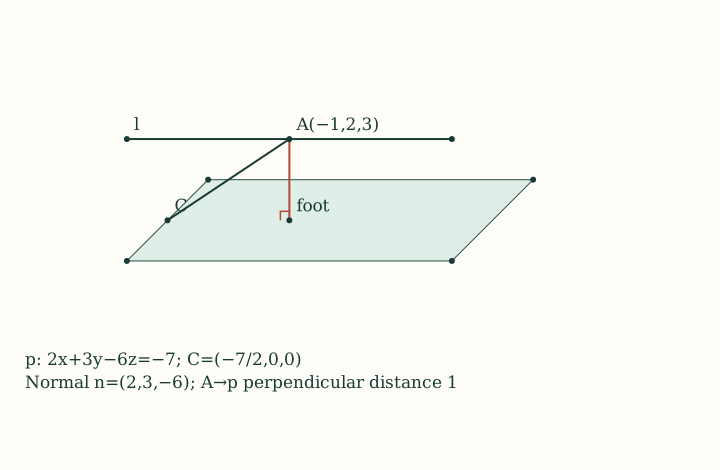
(ii) Find the distance from l to p. [3]
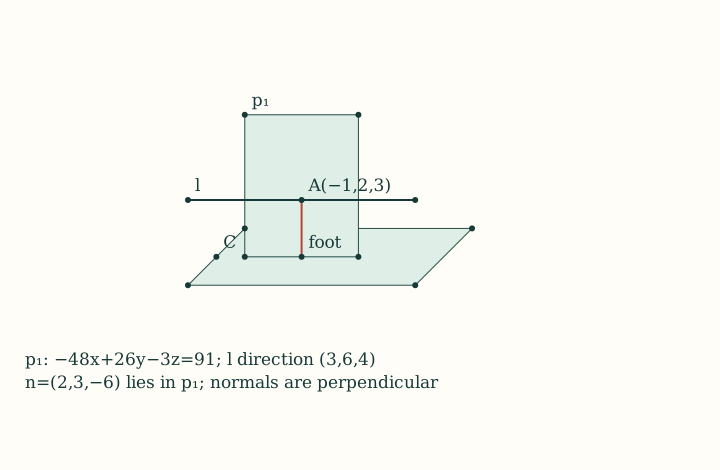
(iii) Find a Cartesian equation of the plane containing l and perpendicular to p. [2]
[2010/JJC/Prelim/I/7]
Source working
(i) Direction .
Plane p: .
so l is parallel to p.
A lies on l but not p, so l is parallel to but not contained in p.
(ii) C lies on p since .
(iii) Let required plane be . A normal is .
A lies on , so
Teacher notes
means the line direction is perpendicular to the plane normal: .
To show A does not lie on p, show its coordinates fail p’s equation. Pick any point C satisfying p’s equation to calculate distance.
A normal of is , where u,v are parallel to : choose the normal of p and direction of l.
Native diagrams
Distance panel: plane p, C in it, l through A above, a red perpendicular distance and normal . Perpendicular-plane panel: p and intersect, l lies in , A on l, direction and normal lie in , with their right-angle relations.
Printed answer key
(ii) unit; (iii) .
Provenance
2025 TJC H2 Math (9758) JC2 MSM: VECTORS. Question document pages 3; solution document pages 13,14. Original page numbers are retained as text metadata.