Porisma

Original question & working

Projection onto a plane and a reflected triangle · source reference

[2010/AJC/Prelim/I/13] · Question pp. 3 · Working pp. 15, 16

Open the interactive lesson

The working and teaching notes are included in the interactive lesson.

View source review notes
Full original question, working & notes

Question

Plane π1\pi_1 and line l are r⋅(2,1,−2)=6\mathbf r\cdot(2,1,-2)=6 and (x−1)/3=(y+4)/2=z−5(x-1)/3=(y+4)/2=z-5 respectively. A has position vector 3i−j+4k3\mathbf i-\mathbf j+4\mathbf k.

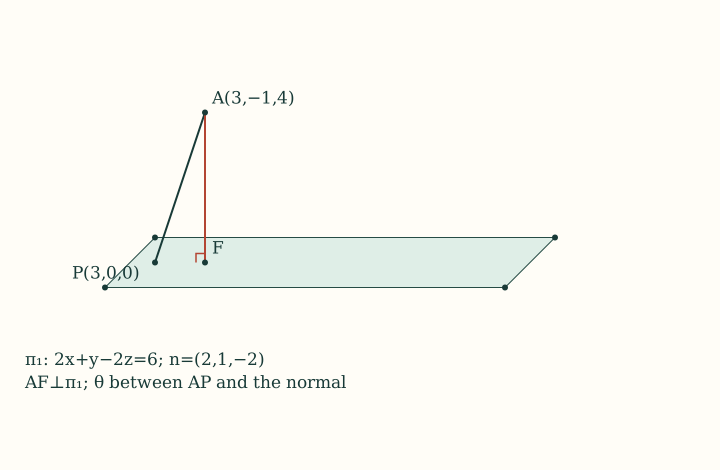
(i) Find the shortest distance from A to π1\pi_1. [2]

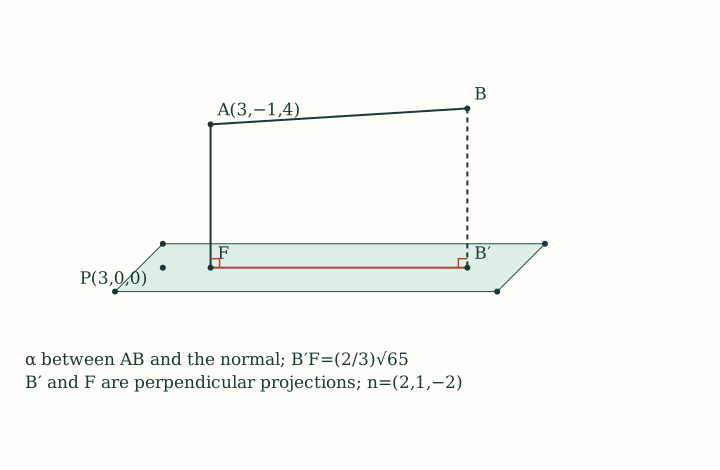
(ii) B satisfies AB→=−5j−2k\overrightarrow{AB}=-5\mathbf j-2\mathbf k. Find the length of projection of AB onto π1\pi_1. [2]

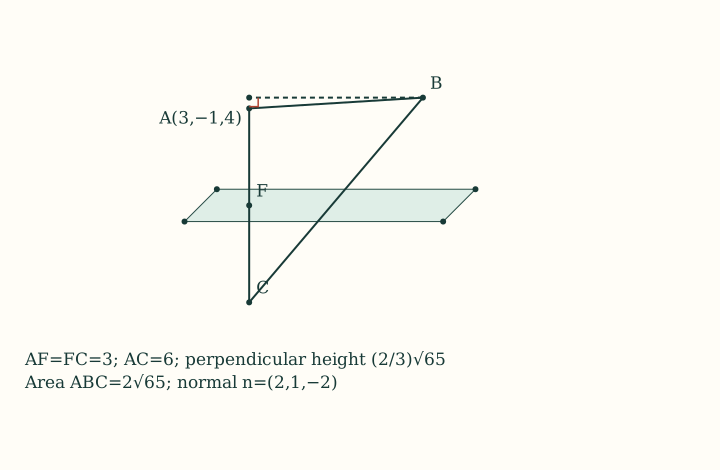
(iii) Use (i),(ii) to find area ABC, where C is A reflected in π1\pi_1. [2]

(iv) Find the Cartesian equation of π2\pi_2 containing l and O. Hence find the intersection of π1,π2\pi_1,\pi_2. [4]

[2010/AJC/Prelim/I/13]

Source working

(i) P(3,0,0)(3,0,0) lies on π1\pi_1 since (3,0,0)⋅(2,1,−2)=6(3,0,0)\cdot(2,1,-2)=6.

AP→=(3,0,0)−(3,−1,4)=(0,1,−4).\overrightarrow{AP}=(3,0,0)-(3,-1,4)=(0,1,-4). distance=∣AP→⋅(2,1,−2)∣∣(2,1,−2)∣=19∣(0,1,−4)⋅(2,1,−2)∣=∣1+8∣3=9/3=3.\text{distance}=\frac{|\overrightarrow{AP}\cdot(2,1,-2)|}{|(2,1,-2)|}=\frac1{\sqrt9}|(0,1,-4)\cdot(2,1,-2)|=\frac{|1+8|}3=9/3=3.

(ii)

projection length=∣AB→×(2,1,−2)∣∣(2,1,−2)∣=13∣(0,−5,−2)×(2,1,−2)∣=13∣(12,−4,10)∣=23∣(6,−2,5)∣=2362+22+52=2365.\begin{aligned}\text{projection length}&=\frac{|\overrightarrow{AB}\times(2,1,-2)|}{|(2,1,-2)|}\\&=\tfrac13|(0,-5,-2)\times(2,1,-2)|\\&=\tfrac13|(12,-4,10)|=\tfrac23|(6,-2,5)|\\&=\tfrac23\sqrt{6^2+2^2+5^2}=\tfrac23\sqrt{65}.\end{aligned}

(iii)

Area(ABC)=12AC⋅2365=12(3×2)(2365)=265 units2.\text{Area}(ABC)=\tfrac12 AC\cdot\tfrac23\sqrt{65}=\tfrac12(3\times2)(\tfrac23\sqrt{65})=2\sqrt{65}\text{ units}^2.

(iv) l:r=(1,−4,5)+λ(3,2,1)l:\mathbf r=(1,-4,5)+\lambda(3,2,1), λ∈R\lambda\in\mathbb R.

Two vectors parallel to π2\pi_2 are (1,−4,5)(1,-4,5) and (3,2,1)(3,2,1); their product

(1,−4,5)×(3,2,1)=(−14,14,14)=14(−1,1,1).(1,-4,5)\times(3,2,1)=(-14,14,14)=14(-1,1,1).

Plane through O: r⋅(−1,1,1)=0\mathbf r\cdot(-1,1,1)=0, or −x+y+z=0-x+y+z=0.

Solve −x+y+z=0-x+y+z=0 and 2x+y−2z=62x+y-2z=6. GC gives x=2+t,y=2,z=tx=2+t,y=2,z=t.

r=(2,2,0)+μ(1,0,1),μ∈R.\mathbf r=(2,2,0)+\mu(1,0,1),\quad\mu\in\mathbb R.

Teacher notes

Point-to-plane distance: ∣AP→⋅n∣/∣n∣=APcos⁡θ=AF|\overrightarrow{AP}\cdot\mathbf n|/|\mathbf n|=AP\cos\theta=AF, n normal to π1\pi_1.

Length of projection of AB onto plane: ∣AB→×n∣/∣n∣=ABsin⁡α=B′F|\overrightarrow{AB}\times\mathbf n|/|\mathbf n|=AB\sin\alpha=B'F, n normal.

GC steps: apps, 9↓PlySmlt2, 2: Simultaneous Eqn Solver, Eqns: 2, Unknowns: 3, NEXT, enter equations, SOLVE. x1=x,x2=y,x3=zx_1=x,x_2=y,x_3=z.

For a vector line equation, write r=⋯\mathbf r=\cdots and state the parameter belongs to R\mathbb R.

Native diagrams

(i) P,F on plane, A above F, AP oblique, red AF with right angle, θ at A, normal (2,1,−2)(2,1,-2). (ii) A(3,−1,4)(3,-1,4), B, their projections F,B′, dashed perpendicular from B, angle α at A, red B′F and normal. (iii) A,C on opposite sides of plane, F midpoint with AF=FC=3, B, dashed perpendicular height to AC labelled 265/32\sqrt{65}/3, and normal.

Point-to-plane distance AF=3 Projection B′F of AB onto π₁ Triangle ABC where C reflects A in π₁

Printed answer key

(i) 33 units; (ii) 265/32\sqrt{65}/3; (iii) 2652\sqrt{65} units squared; (iv) −x+y+z=0-x+y+z=0; intersection r=(2,2,0)+μ(1,0,1)\mathbf r=(2,2,0)+\mu(1,0,1), μ∈R\mu\in\mathbb R.

Provenance

2025 TJC H2 Math (9758) JC2 MSM: VECTORS. Question document pages 3; solution document pages 15,16. Original page numbers are retained as text metadata.