Porisma

Original question & working

Distinguish no intersection from containment · source reference

[modified 2010/IJC/Prelim/I/12] · Question pp. 4 · Working pp. 17, 18, 19

Open the interactive lesson

The working and teaching notes are included in the interactive lesson.

View source review notes
Full original question, working & notes

Printed question

A plane π1\pi_1 has equation r⋅(2,−1,3)=9\mathbf r\cdot(2,-1,3)=9 and a line l1l_1 has equation r=(3,0,0)+λ(4,1,−2)\mathbf r=(3,0,0)+\lambda(4,1,-2).

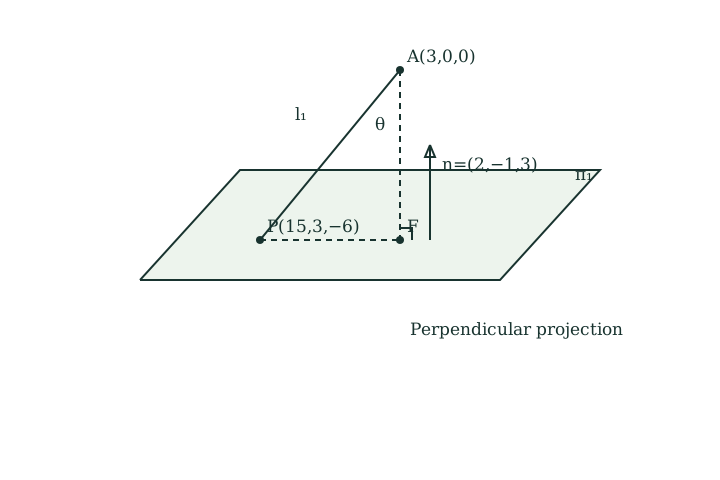
(i) Find the coordinates of PP, the point of intersection of l1l_1 and π1\pi_1. [4]

Hence, or otherwise, find the shortest distance from point A(3,0,0)A(3,0,0) to π1\pi_1. [2]

The equations of planes π2,π3\pi_2,\pi_3 are given as π2:r=(1,1,1)+s(2,0,−3)+t(2,2,1)\pi_2:\mathbf r=(1,1,1)+s(2,0,-3)+t(2,2,1), and π3:αx+y−z=β\pi_3:\alpha x+y-z=\beta, where α,β∈R\alpha,\beta\in\mathbb R.

(ii) Find an equation of plane π2\pi_2 in the form r⋅n=d\mathbf r\cdot\mathbf n=d. Explain why the planes π1,π2\pi_1,\pi_2 intersect. [4]

(iii) The line of intersection of planes π1,π2\pi_1,\pi_2 is l2l_2. The line l2l_2 has equation r=(3,3,2)+μ(2,1,−1)\mathbf r=(3,3,2)+\mu(2,1,-1). Given that l2,π3l_2,\pi_3 do not have any points in common, find the conditions satisfied by α,β\alpha,\beta. [3]

[modified 2010/IJC/Prelim/I/12]

Printed working

(i) π1:r⋅(2,−1,3)=9\pi_1:\mathbf r\cdot(2,-1,3)=9, l1:r=(3,0,0)+λ(4,1,−2)l_1:\mathbf r=(3,0,0)+\lambda(4,1,-2), λ∈R\lambda\in\mathbb R.

For point of intersection, [(3,0,0)+λ(4,1,−2)]⋅(2,−1,3)=9[(3,0,0)+\lambda(4,1,-2)]\cdot(2,-1,3)=9.

⇒(3+4λ)2−λ−6λ=9⇒λ=3\Rightarrow(3+4\lambda)2-\lambda-6\lambda=9\Rightarrow\lambda=3.

⇒OP→=(3,0,0)+3(4,1,−2)=(15,3,−6)\Rightarrow\overrightarrow{OP}=(3,0,0)+3(4,1,-2)=(15,3,-6).

Thus, coordinates of PP are (15,3,−6)(15,3,-6).

AP→=(15,3,−6)−(3,0,0)=(12,3,−6)\overrightarrow{AP}=(15,3,-6)-(3,0,0)=(12,3,-6).

Shortest distance from AA to π1\pi_1

=∣AP→⋅(2,−1,3)∣∣(2,−1,3)∣=14+1+9∣(12,3,−6)⋅(2,−1,3)∣=∣24−3−18∣14=314=31414=\frac{|\overrightarrow{AP}\cdot(2,-1,3)|}{|(2,-1,3)|}=\frac1{\sqrt{4+1+9}}|(12,3,-6)\cdot(2,-1,3)|=\frac{|24-3-18|}{\sqrt{14}}=\frac3{\sqrt{14}}=\frac{3\sqrt{14}}{14}.

Printed alternative solution (otherwise method)

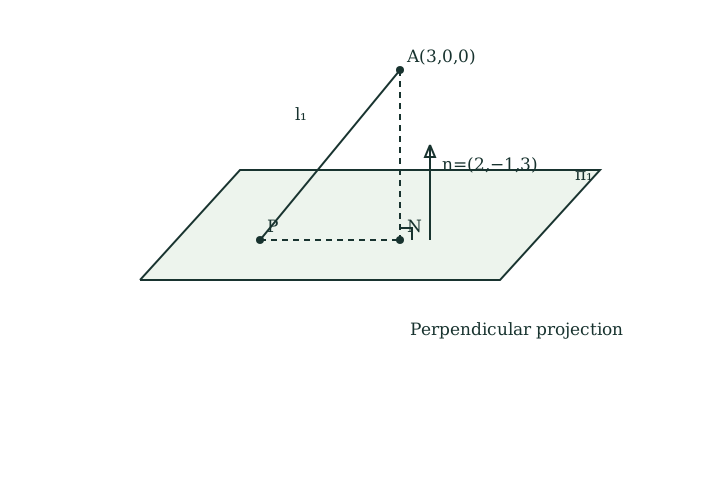
Let NN be the foot of perpendicular from point AA to the plane π1\pi_1.

Equation of line AN:r=(3,0,0)+λ(2,−1,3)AN:\mathbf r=(3,0,0)+\lambda(2,-1,3), λ∈R\lambda\in\mathbb R.

At the point of intersection between line ANAN and the plane,

[(3,0,0)+λ(2,−1,3)]⋅(2,−1,3)=9[(3,0,0)+\lambda(2,-1,3)]\cdot(2,-1,3)=9.

⇒(3+2λ)2+λ+9λ=9⇒λ=314\Rightarrow(3+2\lambda)2+\lambda+9\lambda=9\Rightarrow\lambda=\frac3{14}.

AN→=ON→−OA→=(3,0,0)+314(2,−1,3)−(3,0,0)=314(2,−1,3)\overrightarrow{AN}=\overrightarrow{ON}-\overrightarrow{OA}=(3,0,0)+\frac3{14}(2,-1,3)-(3,0,0)=\frac3{14}(2,-1,3).

Thus, the shortest distance AN=∣AN→∣=3144+1+9=31414AN=|\overrightarrow{AN}|=\frac3{14}\sqrt{4+1+9}=\frac{3\sqrt{14}}{14}.

(ii) π1:r⋅(2,−1,3)=9\pi_1:\mathbf r\cdot(2,-1,3)=9, π2:r=(1,1,1)+s(2,0,−3)+t(2,2,1)\pi_2:\mathbf r=(1,1,1)+s(2,0,-3)+t(2,2,1).

A normal to plane π2=(2,0,−3)×(2,2,1)=(6,−8,4)=2(3,−4,2)\pi_2=(2,0,-3)\times(2,2,1)=(6,-8,4)=2(3,-4,2).

π2:r⋅(3,−4,2)=(1,1,1)⋅(3,−4,2)=3−4+2=1\pi_2:\mathbf r\cdot(3,-4,2)=(1,1,1)\cdot(3,-4,2)=3-4+2=1, i.e. r⋅(3,−4,2)=1\mathbf r\cdot(3,-4,2)=1.

Since (3,−4,2)≠k(2,−1,3)(3,-4,2)\ne k(2,-1,3) for any k∈Rk\in\mathbb R, the normal of planes π1,π2\pi_1,\pi_2 are not parallel to each other. Since the planes are not parallel to each other, they will intersect in a line.

(iii) l2:r=(3,3,2)+μ(2,1,−1)l_2:\mathbf r=(3,3,2)+\mu(2,1,-1) and π3:αx+y−z=β\pi_3:\alpha x+y-z=\beta, i.e. r⋅(α,1,−1)=β\mathbf r\cdot(\alpha,1,-1)=\beta.

Since l2,π3l_2,\pi_3 do not have any points in common, l2l_2 is parallel to π3\pi_3 and does not lie on π3\pi_3.

So l2l_2 is perpendicular to (α,1,−1)(\alpha,1,-1) and point (3,3,2)(3,3,2) does not lie on π3\pi_3.

Thus (2,1,−1)⋅(α,1,−1)=0⇒2α+1+1=0⇒α=−1(2,1,-1)\cdot(\alpha,1,-1)=0\Rightarrow2\alpha+1+1=0\Rightarrow\alpha=-1.

and (3,3,2)⋅(α,1,−1)≠β⇒3(−1)+3−2≠β⇒β≠−2(3,3,2)\cdot(\alpha,1,-1)\ne\beta\Rightarrow3(-1)+3-2\ne\beta\Rightarrow\beta\ne-2.

Native source teaching diagram, Q13 projection Native source teaching diagram, Q13 foot

Teacher notes

Shortest distance from AA to π1=∣AP→⋅n∣∣n∣=APcos⁡θ=AF\pi_1=\frac{|\overrightarrow{AP}\cdot\mathbf n|}{|\mathbf n|}=AP\cos\theta=AF.

For the parametric plane, (1,1,1)(1,1,1) is the position vector of a known point on the plane; (2,0,−3)(2,0,-3) and (2,2,1)(2,2,1) are two vectors parallel to the plane.

l2∥π3⇒l2l_2\parallel\pi_3\Rightarrow l_2 is perpendicular to normal to π3\pi_3.

Printed answer key

(i) (15,3,−6)(15,3,-6); 314\frac3{\sqrt{14}}. (ii) r⋅(3,−4,2)=1\mathbf r\cdot(3,-4,2)=1; normal of π1,π2\pi_1,\pi_2 not parallel → planes not parallel. (iii) α=−1,β≠−2\alpha=-1,\beta\ne-2.

Source provenance

2025 TJC H2 Math (9758) JC2 MSM: VECTORS. Question booklet PDF pages 4–12 (printed 80–88); solution booklet PDF pages 17–44. Column vectors are typeset as ordered coordinate triples here; the entries, products, intermediate equations and original parameter/domain restrictions are retained.