Porisma

Original question & working

Build coordinates from a cuboid · source reference

[2009/IJC/Prelim/I/13] · Question pp. 4 · Working pp. 19, 20

Open the interactive lesson

The working and teaching notes are included in the interactive lesson.

View source review notes
Full original question, working & notes

Printed question
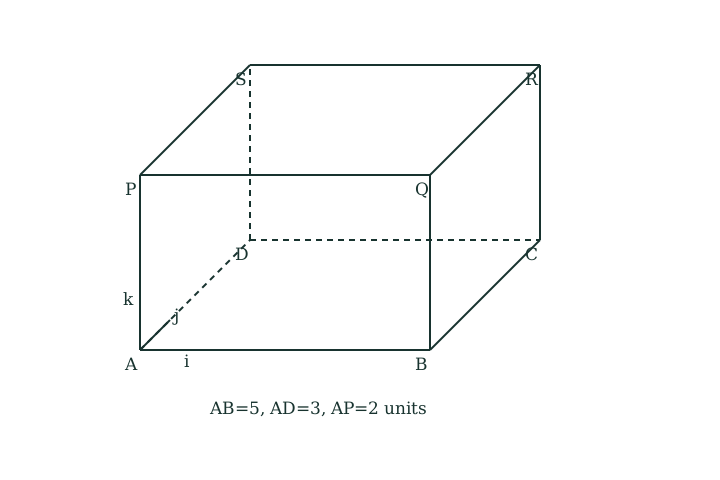
Native cuboid ABCD PQRS with basis i,j,k

The diagram above shows a cuboid with horizontal rectangular base ABCDABCD, where AB=5AB=5 units, AD=3AD=3 units and AP=2AP=2 units. The edges AP,BQ,CR,DSAP,BQ,CR,DS are vertical, and PQRSPQRS is the top of the cuboid. The point AA is taken as the origin and vectors i,j,k\mathbf i,\mathbf j,\mathbf k, each of length 1 unit, are taken along AB,AD,APAB,AD,AP respectively.

(i) Show that the line DQDQ has equation r=3j+λ(5i−3j+2k)\mathbf r=3\mathbf j+\lambda(5\mathbf i-3\mathbf j+2\mathbf k), where λ\lambda is a parameter. Find an equation of the line BSBS. [4]

(ii) Hence calculate the acute angle between the lines DQ,BSDQ,BS, giving your answer to the nearest 0.1∘0.1^\circ. [3]

The point XX lies on RCRC such that RX=23RCRX=\frac23RC, and the point MM is the midpoint of BDBD. The plane pp contains the points R,B,MR,B,M.

(iii) Find, in scalar product form, an equation of the plane pp. [3]

(iv) Find the exact value of the shortest distance from XX to the plane pp. [3]

[2009/IJC/Prelim/I/13]

Printed working

(i) DQ→=5i−3j+2k\overrightarrow{DQ}=5\mathbf i-3\mathbf j+2\mathbf k.

Vector equation of line DQ:r=OD→+λDQ→DQ:\mathbf r=\overrightarrow{OD}+\lambda\overrightarrow{DQ}, λ∈R\lambda\in\mathbb R, i.e. r=(0,3,0)+λ(5,−3,2)\mathbf r=(0,3,0)+\lambda(5,-3,2), λ∈R\lambda\in\mathbb R (Shown).

BS→=−5i+3j+2k\overrightarrow{BS}=-5\mathbf i+3\mathbf j+2\mathbf k.

Vector equation of line BS:r=(5,0,0)+μ(−5,3,2)BS:\mathbf r=(5,0,0)+\mu(-5,3,2), μ∈R\mu\in\mathbb R.

(ii) Let the acute angle between the lines DQ,BSDQ,BS be θ\theta.

cos⁡θ=∣DQ→⋅BS→∣∣DQ→∣∣BS→∣=∣(5,−3,2)⋅(−5,3,2)∣3838=1519\cos\theta=\frac{|\overrightarrow{DQ}\cdot\overrightarrow{BS}|}{|\overrightarrow{DQ}||\overrightarrow{BS}|}=\frac{|(5,-3,2)\cdot(-5,3,2)|}{\sqrt{38}\sqrt{38}}=\frac{15}{19}.

∴θ=37.9∘\therefore\theta=37.9^\circ (correct to 1 d.p.).

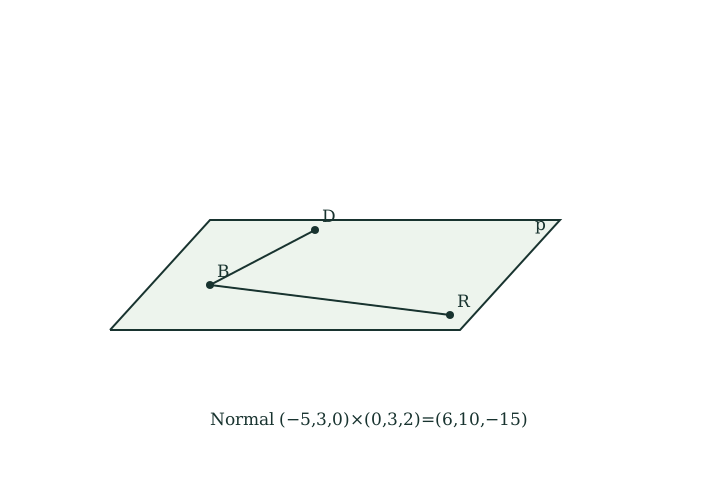
(iii) BD→=BA→+AD→=−5i+3j\overrightarrow{BD}=\overrightarrow{BA}+\overrightarrow{AD}=-5\mathbf i+3\mathbf j.

BR→=BC→+CR→=3j+2k\overrightarrow{BR}=\overrightarrow{BC}+\overrightarrow{CR}=3\mathbf j+2\mathbf k.

A normal is (−5,3,0)×(0,3,2)=(6,10,−15)(-5,3,0)\times(0,3,2)=(6,10,-15).

Equation of plane π:r⋅(6,10,−15)=(5,0,0)⋅(6,10,−15)=30\pi:\mathbf r\cdot(6,10,-15)=(5,0,0)\cdot(6,10,-15)=30.

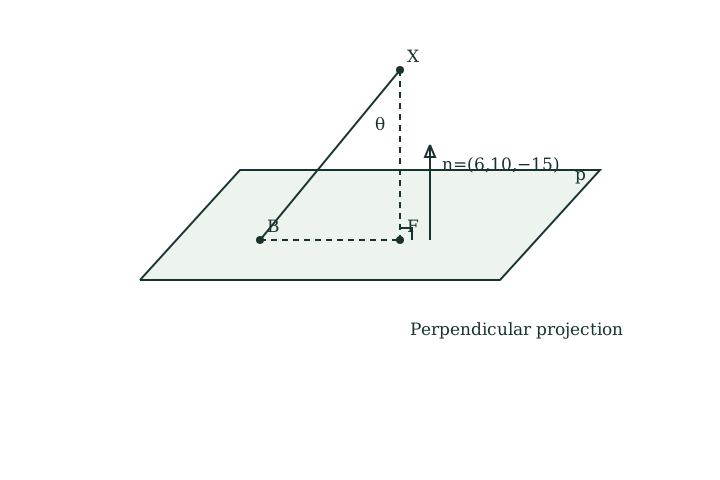
(iv) BX→=BC→+CX→=3j+23k\overrightarrow{BX}=\overrightarrow{BC}+\overrightarrow{CX}=3\mathbf j+\frac23\mathbf k (from diagram).

Shortest distance from XX to plane pp

=∣BX→⋅(6,10,−15)∣∣(6,10,−15)∣=∣(0,3,2/3)⋅(6,10,−15)∣36+100+225=2019=\frac{|\overrightarrow{BX}\cdot(6,10,-15)|}{|(6,10,-15)|}=\frac{|(0,3,2/3)\cdot(6,10,-15)|}{\sqrt{36+100+225}}=\frac{20}{19} units.

Native source teaching diagram, Q14 plane Native source teaching diagram, Q14 distance

Teacher notes

For vector equation of line, must write “r=…,λ∈R\mathbf r=\ldots,\lambda\in\mathbb R”.

Angle between 2 lines is angle between the direction vectors of the 2 lines. For acute angle, put in the modulus sign for DQ→⋅BS→\overrightarrow{DQ}\cdot\overrightarrow{BS}.

Shortest distance from XX to p=∣BX→⋅n∣∣n∣=BXcos⁡θ=XFp=\frac{|\overrightarrow{BX}\cdot\mathbf n|}{|\mathbf n|}=BX\cos\theta=XF.

Printed answer key

(i) r=(5,0,0)+μ(−5,3,2)\mathbf r=(5,0,0)+\mu(-5,3,2), μ∈R\mu\in\mathbb R. (ii) 37.9∘37.9^\circ. (iii) r⋅(6,10,−15)=30\mathbf r\cdot(6,10,-15)=30. (iv) 2019\frac{20}{19} units.

Source provenance

2025 TJC H2 Math (9758) JC2 MSM: VECTORS. Question booklet PDF pages 4–12 (printed 80–88); solution booklet PDF pages 17–44. Column vectors are typeset as ordered coordinate triples here; the entries, products, intermediate equations and original parameter/domain restrictions are retained.