Original question & working
Equal spacing between parallel planes · source reference
[modified 2010/NYJC/Prelim/II/4] · Question pp. 5 · Working pp. 21
Open the interactive lessonThe working and teaching notes are included in the interactive lesson.
View source review notesFull original question, working & notes
Printed question
The plane has equation . A plane with equation (where are constants) is parallel to , find the values of and also the exact distance between . [3]
The plane is parallel to . Find the equation of such that is exactly in between . [2]
[modified 2010/NYJC/Prelim/II/4]
Printed working
.
.
.
Perpendicular distance between .
From diagram, is on the same side of the origin as , and the perpendicular distance from is .
Thus .
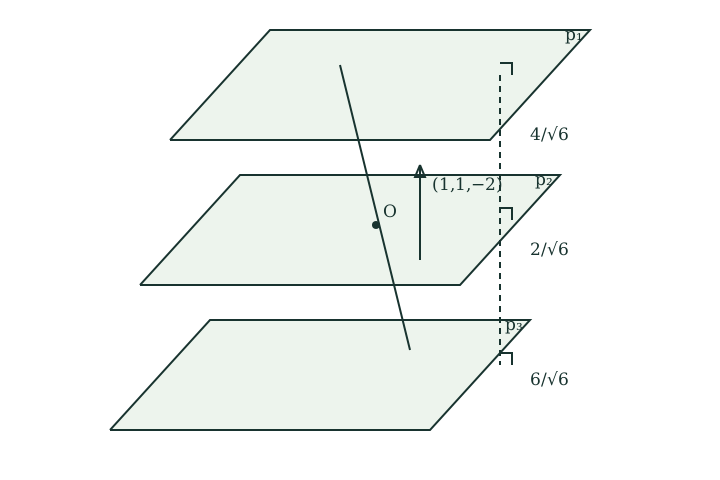
Teacher notes
.
Make the 2 parallel normal vectors of the 2 planes the same and of magnitude 1, i.e. unit vectors.
Printed answer key
; units; .
Source provenance
2025 TJC H2 Math (9758) JC2 MSM: VECTORS. Question booklet PDF pages 4–12 (printed 80–88); solution booklet PDF pages 17–44. Column vectors are typeset as ordered coordinate triples here; the entries, products, intermediate equations and original parameter/domain restrictions are retained.