Porisma

Original question & working

Project a point onto an intersection line · source reference

[2010/NJC/Prelim/I/9] · Question pp. 5 · Working pp. 22, 23, 24

Open the interactive lesson

The working and teaching notes are included in the interactive lesson.

View source review notes
Full original question, working & notes

Printed question

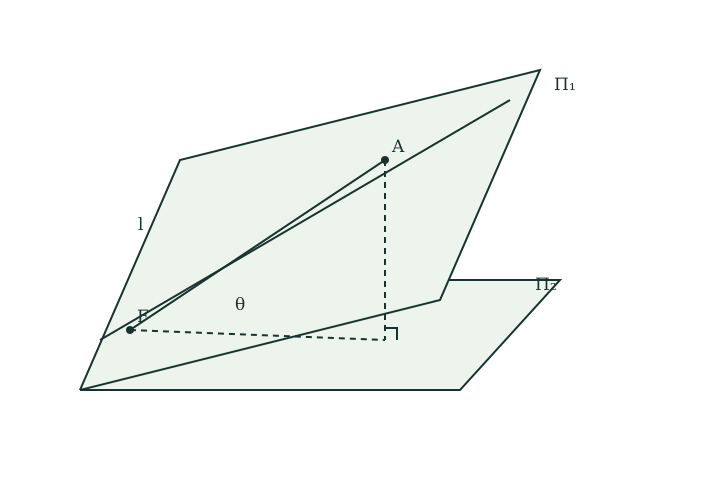
Relative to the origin OO, the point AA has position vector OA→=(0,1,0)\overrightarrow{OA}=(0,1,0) and AA lies on the plane Π1\Pi_1 with equation defined by r⋅(1,3,2)=3\mathbf r\cdot(1,3,2)=3. Another plane Π2\Pi_2 has equation y=xy=x. The planes Π1,Π2\Pi_1,\Pi_2 intersect at line ll.

(i) Find a vector equation of the line ll. [1]

(ii) Show that the cosine of the acute angle between the planes Π1,Π2\Pi_1,\Pi_2 is 77\frac{\sqrt7}{7}. [2]

(iii) Find the position vector of the foot of perpendicular, OF→\overrightarrow{OF}, from point AA to the line ll. Hence, find the exact length of projection of AFAF onto the plane Π2\Pi_2. [5]

(iv) Another plane Π3\Pi_3 has equation px+qy=1px+qy=1, where p,qp,q are real constants. Find the condition which p,qp,q must satisfy such that ll intersects Π3\Pi_3 at exactly one point. [2]

[2010/NJC/Prelim/I/9]

Printed working

(i) Π1:r⋅(1,3,2)=3⇒x+3y+2z=3\Pi_1:\mathbf r\cdot(1,3,2)=3\Rightarrow x+3y+2z=3; Π2:−x+y+0z=0\Pi_2:-x+y+0z=0.

Using GC, x=34−12tx=\frac34-\frac12t, y=34−12ty=\frac34-\frac12t, z=tz=t.

l:r=(3/4,3/4,0)+λ(−1/2,−1/2,1)l:\mathbf r=(3/4,3/4,0)+\lambda(-1/2,-1/2,1), λ∈R\lambda\in\mathbb R or r=(3/4,3/4,0)+λ(1,1,−2)\mathbf r=(3/4,3/4,0)+\lambda(1,1,-2), λ∈R\lambda\in\mathbb R.

(ii) Π2:−x+y+0z=0⇒r⋅(−1,1,0)=0\Pi_2:-x+y+0z=0\Rightarrow\mathbf r\cdot(-1,1,0)=0.

Let θ\theta be acute angle between the planes Π1,Π2\Pi_1,\Pi_2.

Then cos⁡θ=∣(1,3,2)⋅(−1,1,0)∣142=∣−1+3∣28=227=77\cos\theta=\frac{|(1,3,2)\cdot(-1,1,0)|}{\sqrt{14}\sqrt2}=\frac{|-1+3|}{\sqrt{28}}=\frac2{2\sqrt7}=\frac{\sqrt7}{7} (Shown).

(iii) Since point FF lies on line ll, OF→=(3/4,3/4,0)+λ(1,1,−2)\overrightarrow{OF}=(3/4,3/4,0)+\lambda(1,1,-2) for some real λ\lambda.

AF→=(3/4,3/4,0)+λ(1,1,−2)−(0,1,0)=(3/4,−1/4,0)+λ(1,1,−2)\overrightarrow{AF}=(3/4,3/4,0)+\lambda(1,1,-2)-(0,1,0)=(3/4,-1/4,0)+\lambda(1,1,-2).

AF⊥l⇒[(3/4,−1/4,0)+λ(1,1,−2)]⋅(1,1,−2)=0AF\perp l\Rightarrow[(3/4,-1/4,0)+\lambda(1,1,-2)]\cdot(1,1,-2)=0.

⇒(34−14)+(1+1+4)λ=0⇒λ=−24(6)=−112\Rightarrow(\frac34-\frac14)+(1+1+4)\lambda=0\Rightarrow\lambda=-\frac2{4(6)}=-\frac1{12}.

∴OF→=(3/4,3/4,0)−112(1,1,−2)=112(9−1,9−1,0+2)=112(8,8,2)=(2/3,2/3,1/6)\therefore\overrightarrow{OF}=(3/4,3/4,0)-\frac1{12}(1,1,-2)=\frac1{12}(9-1,9-1,0+2)=\frac1{12}(8,8,2)=(2/3,2/3,1/6).

AF→=(3/4,−1/4,0)−112(1,1,−2)=112(9−1,−3−1,0+2)=16(4,−2,1)\overrightarrow{AF}=(3/4,-1/4,0)-\frac1{12}(1,1,-2)=\frac1{12}(9-1,-3-1,0+2)=\frac16(4,-2,1).

and ∣AF→∣=1616+4+1=216|\overrightarrow{AF}|=\frac16\sqrt{16+4+1}=\frac{\sqrt{21}}6.

Hence, exact length of projection of AF→\overrightarrow{AF} onto the plane Π2\Pi_2

=∣AF→∣cos⁡θ=216(77)=736(7)=36=|\overrightarrow{AF}|\cos\theta=\frac{\sqrt{21}}6(\frac{\sqrt7}{7})=\frac{7\sqrt3}{6(7)}=\frac{\sqrt3}6.

(iv) l:r=(3/4,3/4,0)+λ(1,1,−2)l:\mathbf r=(3/4,3/4,0)+\lambda(1,1,-2) and Π3:px+qy=1\Pi_3:px+qy=1, i.e. r⋅(p,q,0)=1\mathbf r\cdot(p,q,0)=1.

ll intersects Π3\Pi_3 at exactly one point ⇒l\Rightarrow l is not perpendicular to normal of Π3\Pi_3.

⇒(1,1,−2)⋅(p,q,0)≠0⇒p+q≠0∴p≠−q\Rightarrow(1,1,-2)\cdot(p,q,0)\ne0\Rightarrow p+q\ne0\therefore p\ne-q.

Native source teaching diagram, Q16 projection

Teacher notes

Using GC: 1) press apps; 2) → 9:PlySmlt2; 3) → 2:Simultaneous Eqn Solver; 4) Put Eqns:2, Unknowns:3; 5) Press “NEXT”; 6) Key in the eqns; 7) Press “SOLVE”. Note: x1=x,x2=y,x3=zx_1=x,x_2=y,x_3=z.

For vector equation of line, must write “r=…,λ∈R\mathbf r=\ldots,\lambda\in\mathbb R”.

Angle between the 2 planes is angle between their normals. For acute angle, put in the modulus sign for the dot product of the 2 vectors in the formula for cos⁡θ\cos\theta.

ll intersects Π3\Pi_3 at exactly one pt ⇒l\Rightarrow l is not parallel or lies on Π3\Pi_3 ⇒l\Rightarrow l is not perpendicular to normal of Π3\Pi_3.

Printed answer key

(i) r=(3/4,3/4,0)+λ(1,1,−2)\mathbf r=(3/4,3/4,0)+\lambda(1,1,-2), λ∈R\lambda\in\mathbb R. (iii) (2/3,2/3,1/6)(2/3,2/3,1/6); 36\frac{\sqrt3}6. (iv) p≠−qp\ne-q. Short key omits (ii).

Source provenance

2025 TJC H2 Math (9758) JC2 MSM: VECTORS. Question booklet PDF pages 4–12 (printed 80–88); solution booklet PDF pages 17–44. Column vectors are typeset as ordered coordinate triples here; the entries, products, intermediate equations and original parameter/domain restrictions are retained.