Porisma

Original question & working

Parallel lines, a parallelogram and a midplane · source reference

2025 TJC H2 Maths (9758) JC2 MSM · original exercise attribution retained on source pages · Question pp. 6 · Working pp. 26, 27, 28, 29

Open the interactive lesson

The working and teaching notes are included in the interactive lesson.

View source review notes
Full original question, working & notes

Printed question

The points A,BA,B have position vectors 3i+j3\mathbf i+\mathbf j and 3i+3j3\mathbf i+3\mathbf j respectively. The line l1l_1 and the planes Π1,Π2\Pi_1,\Pi_2 have equations as follows:

l1:r=OA→+α(2,1,−1)l_1:\mathbf r=\overrightarrow{OA}+\alpha(2,1,-1), Π1:x+2z=3\Pi_1:x+2z=3, Π2:r=λ(1,1,0)+μ(0,1,1)\Pi_2:\mathbf r=\lambda(1,1,0)+\mu(0,1,1), where α,λ,μ∈R\alpha,\lambda,\mu\in\mathbb R.

It is given that the planes Π1,Π2\Pi_1,\Pi_2 intersect in the line l2l_2.

(i) Find a vector equation of the line l2l_2 and show that the line l2l_2 is parallel to the line l1l_1. Hence find the shortest distance between the lines l1,l2l_1,l_2.

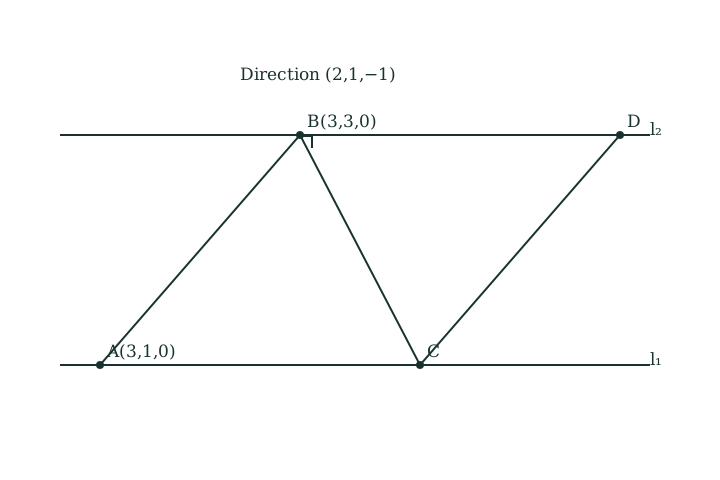
(ii) The points C,DC,D are on the lines l1,l2l_1,l_2 respectively such that ∠ABC=90∘\angle ABC=90^\circ and ABDCABDC is a parallelogram. Find the position vectors of C,DC,D. Hence find the area of the parallelogram ABDCABDC.

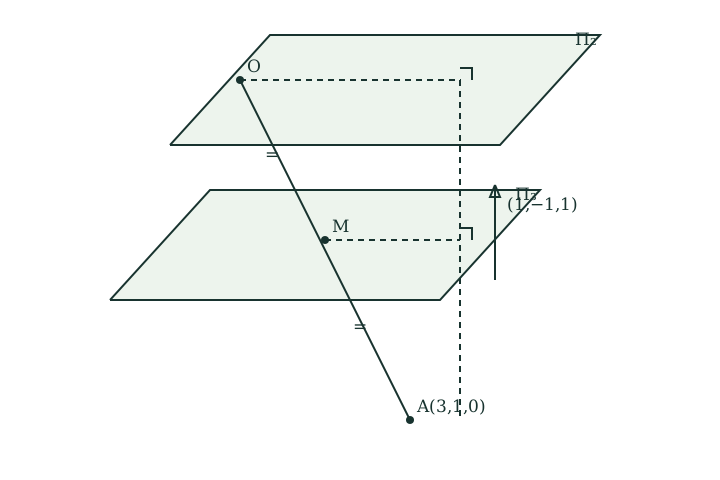
(iii) The plane Π3\Pi_3 is parallel to the plane Π2\Pi_2 and is equidistant to both point AA and the plane Π2\Pi_2. Show that the equation of the plane Π3\Pi_3 is given by r⋅(i−j+k)=1\mathbf r\cdot(\mathbf i-\mathbf j+\mathbf k)=1.

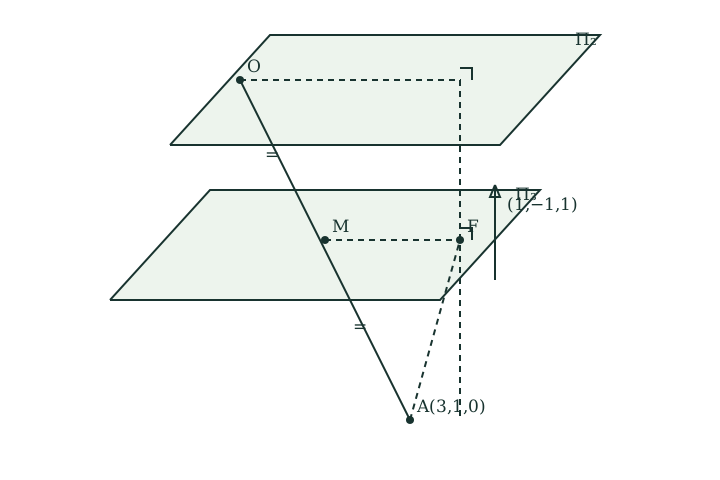
(iv) Find the position vector of the foot of the perpendicular from the point AA to the plane Π3\Pi_3.

Source wording note: In the first sentence of part (iii), the question PDF prints Π2\Pi_2 where the subsequent reference to Π3\Pi_3 identifies the intended plane. This transcription uses Π3\Pi_3 there; the original wording is recorded as a source typo.

Printed working

(i) Π1:x+2z=3⇒r⋅(1,0,2)=3\Pi_1:x+2z=3\Rightarrow\mathbf r\cdot(1,0,2)=3; Π2:r=λ(1,1,0)+μ(0,1,1)\Pi_2:\mathbf r=\lambda(1,1,0)+\mu(0,1,1), λ,μ∈R\lambda,\mu\in\mathbb R.

To find l2l_2, the line of intersection of Π1,Π2\Pi_1,\Pi_2, consider

[λ(1,1,0)+μ(0,1,1)]⋅(1,0,2)=3⇒λ+2μ=3⇒λ=3−2μ[\lambda(1,1,0)+\mu(0,1,1)]\cdot(1,0,2)=3\Rightarrow\lambda+2\mu=3\Rightarrow\lambda=3-2\mu.

Equation of line l2:r=(3−2μ)(1,1,0)+μ(0,1,1)l_2:\mathbf r=(3-2\mu)(1,1,0)+\mu(0,1,1), i.e. r=(3,3,0)+μ(−2,−1,1)\mathbf r=(3,3,0)+\mu(-2,-1,1), μ∈R\mu\in\mathbb R.

Since the direction vector of l1=(2,1,−1)=−l_1=(2,1,-1)=- direction vector of l2l_2, l2∥l1l_2\parallel l_1 (Shown).

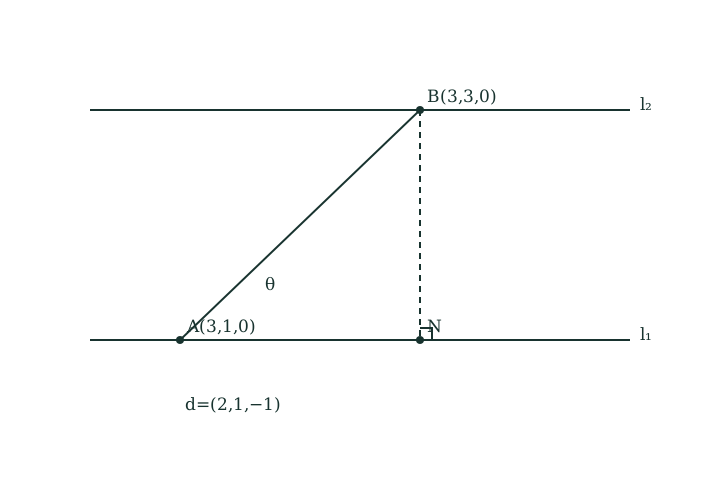
Since point AA lies on l1l_1, point BB lies on l2l_2, shortest distance

=∣AB→×(2,1,−1)∣∣(2,1,−1)∣=16∣(0,2,0)×(2,1,−1)∣=16∣(−2,0,−4)∣=303=\frac{|\overrightarrow{AB}\times(2,1,-1)|}{|(2,1,-1)|}=\frac1{\sqrt6}|(0,2,0)\times(2,1,-1)|=\frac1{\sqrt6}|(-2,0,-4)|=\frac{\sqrt{30}}3.

(ii) l1:r=(3,1,0)+α(2,1,−1)l_1:\mathbf r=(3,1,0)+\alpha(2,1,-1).

Since CC lies on l1l_1, OC→=(3,1,0)+α(2,1,−1)\overrightarrow{OC}=(3,1,0)+\alpha(2,1,-1) for some α∈R\alpha\in\mathbb R.

BA→=(0,−2,0)\overrightarrow{BA}=(0,-2,0) and BC→=(3,1,0)+α(2,1,−1)−(3,3,0)=(0,−2,0)+α(2,1,−1)\overrightarrow{BC}=(3,1,0)+\alpha(2,1,-1)-(3,3,0)=(0,-2,0)+\alpha(2,1,-1).

Since BA⊥BCBA\perp BC, BA→⋅BC→=0\overrightarrow{BA}\cdot\overrightarrow{BC}=0.

⇒[(0,−2,0)+α(2,1,−1)]⋅(0,−2,0)=0⇒4−2α=0⇒α=2\Rightarrow[(0,-2,0)+\alpha(2,1,-1)]\cdot(0,-2,0)=0\Rightarrow4-2\alpha=0\Rightarrow\alpha=2.

∴OC→=(3,1,0)+2(2,1,−1)=(7,3,−2)\therefore\overrightarrow{OC}=(3,1,0)+2(2,1,-1)=(7,3,-2).

Since ABCDABCD is a parallelogram, CD→=AB→\overrightarrow{CD}=\overrightarrow{AB}.

⇒OD→−(7,3,−2)=(0,2,0)⇒OD→=(7,5,−2)\Rightarrow\overrightarrow{OD}-(7,3,-2)=(0,2,0)\Rightarrow\overrightarrow{OD}=(7,5,-2).

Area of parallelogram ABDC=∣BA→×BC→∣ABDC=|\overrightarrow{BA}\times\overrightarrow{BC}|

=∣(0,−2,0)×(4,0,−2)∣=4∣(0,−1,0)×(2,0,−1)∣=4∣(1,0,2)∣=45=|(0,-2,0)\times(4,0,-2)|=4|(0,-1,0)\times(2,0,-1)|=4|(1,0,2)|=4\sqrt5.

(iii) Π2:r=λ(1,1,0)+μ(0,1,1)\Pi_2:\mathbf r=\lambda(1,1,0)+\mu(0,1,1).

A normal to Π2=(1,1,0)×(0,1,1)=(1,−1,1)\Pi_2=(1,1,0)\times(0,1,1)=(1,-1,1).

Note that origin OO lies on Π2\Pi_2. Let MM be the mid-point of OAOA.

Then OM→=12OA→=12(3,1,0)\overrightarrow{OM}=\frac12\overrightarrow{OA}=\frac12(3,1,0).

Since Π3\Pi_3 is parallel to Π2\Pi_2 and is equidistant to both point AA and plane Π2\Pi_2, MM lies on Π3\Pi_3, and (1,−1,1)(1,-1,1) is a normal of Π3\Pi_3.

Thus, equation of Π3\Pi_3 is r⋅(1,−1,1)=12(3,1,0)⋅(1,−1,1)⇒r⋅(1,−1,1)=1\mathbf r\cdot(1,-1,1)=\frac12(3,1,0)\cdot(1,-1,1)\Rightarrow\mathbf r\cdot(1,-1,1)=1.

(iv) Let FF be foot of perpendicular from AA to Π3\Pi_3.

Line AF:r=(3,1,0)+δ(1,−1,1)AF:\mathbf r=(3,1,0)+\delta(1,-1,1), δ∈R\delta\in\mathbb R.

Π3:r⋅(1,−1,1)=1\Pi_3:\mathbf r\cdot(1,-1,1)=1.

To find point of intersection between line AFAF and plane Π3\Pi_3, consider

[(3,1,0)+δ(1,−1,1)]⋅(1,−1,1)=1[(3,1,0)+\delta(1,-1,1)]\cdot(1,-1,1)=1.

⇒(3−1)+δ(1+1+1)=1⇒δ=−13\Rightarrow(3-1)+\delta(1+1+1)=1\Rightarrow\delta=-\frac13.

Hence, OF→=(3,1,0)−13(1,−1,1)=13(9−1,3+1,0−1)=13(8,4,−1)\overrightarrow{OF}=(3,1,0)-\frac13(1,-1,1)=\frac13(9-1,3+1,0-1)=\frac13(8,4,-1).

Native source teaching diagram, Q18 parallel Native source teaching diagram, Q18 parallelogram Native source teaching diagram, Q18 planes Native source teaching diagram, Q18 foot

Teacher notes

Shortest distance =BN=ABsin⁡θ=∣AB→×d^∣=BN=AB\sin\theta=|\overrightarrow{AB}\times\hat{\mathbf d}|, where d=(2,1,−1)\mathbf d=(2,1,-1).

Printed answer key

(i) r=(3,3,0)+μ(−2,−1,1)\mathbf r=(3,3,0)+\mu(-2,-1,1), μ∈R\mu\in\mathbb R; 303\frac{\sqrt{30}}3. (ii) OC→=(7,3,−2)\overrightarrow{OC}=(7,3,-2); OD→=(7,5,−2)\overrightarrow{OD}=(7,5,-2); 454\sqrt5 units2^2. (iv) 13(8,4,−1)\frac13(8,4,-1). Short key omits (iii).

Editorial qualification

The printed continuation says “ABCD is a parallelogram”, whereas the question specifies ABDC. The used equation CD=AB and computed D=(7,5,−2) belong to ABDC. The source lettering typo is retained. The area formula uses BA×BC: this equals the area of ABDC because BD=BA+AC and BA×BC differs only by sign from AB×AC.

Source provenance

2025 TJC H2 Math (9758) JC2 MSM: VECTORS. Question booklet PDF pages 4–12 (printed 80–88); solution booklet PDF pages 17–44. Column vectors are typeset as ordered coordinate triples here; the entries, products, intermediate equations and original parameter/domain restrictions are retained.