Original question & working
A reflected laser and a sensor-distance check · source reference
[2017/YJC/Prelim/I/12] · Question pp. 7 · Working pp. 34, 35, 36
Open the interactive lessonThe working and teaching notes are included in the interactive lesson.
For beam distances, check the foot lies on the actual ray or incident segment; an infinite-line distance alone may be insufficient.
Full original question, working & notes
Printed question
Laser (Light Amplification by Stimulated Emission of Radiation) has many applications including medicine, data storage, military and industrial uses. It has the property of spatial coherence, which allows the laser beam to stay narrow over long distances. When a laser beam is projected onto a mirror at an angle, it reflects off the mirror at the same angle.
An engineer is designing a device that does industrial cutting using a laser beam. To make the device compact, the device has a mirror to reflect the beam before it leaves the device. The laser beam source is located at the origin . It projects an incident beam with direction vector . The beam hits the mirror at the point with angle . The mirror has an equation .
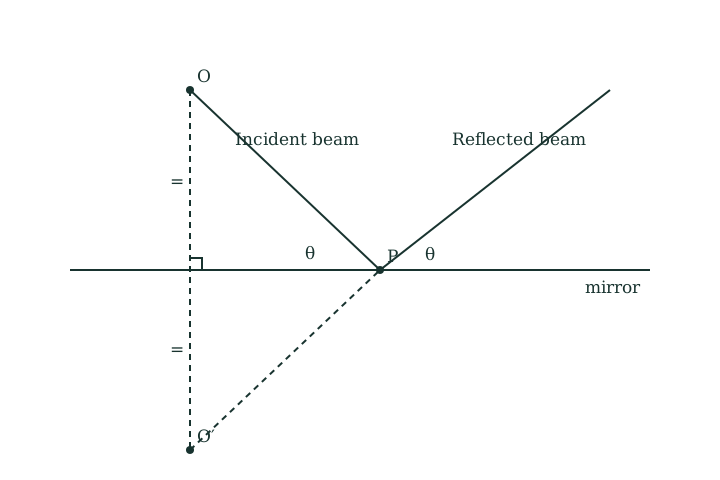
(i) Find the acute angle that the beam makes with the mirror. [2]
(ii) By finding , the image of in the mirror, find a vector equation of the line that the reflected beam is on. [7]
The engineer plans to install a sensor at to monitor the heat produced by the laser. For the sensor to work properly, the sensor must be less than 2 units away from either the incident or the reflected beam. Determine if the sensor will work properly. [4]
[2017/YJC/Prelim/I/12]
Printed working
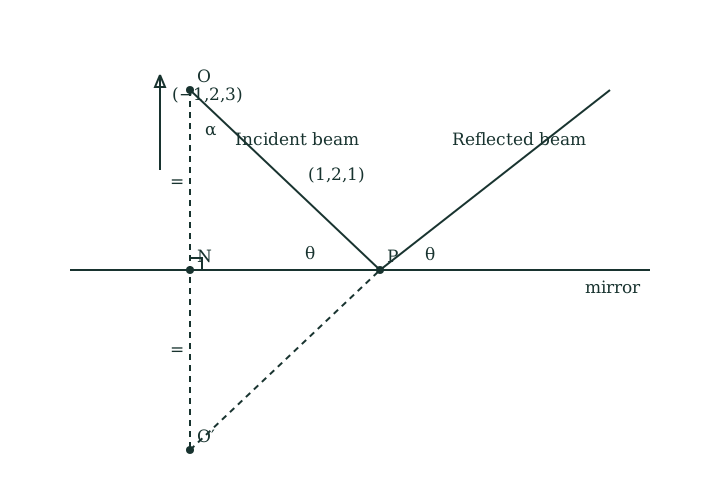
(i) Let . (Note that is also an acute angle).
Then .
.
Thus, (correct to 1 d.p.).
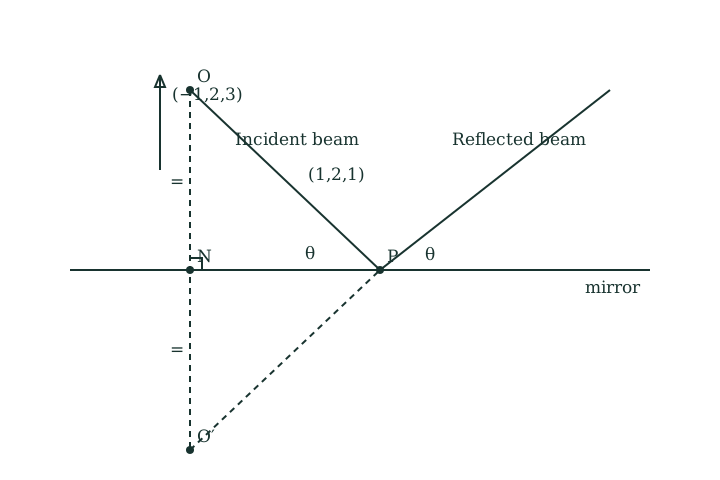
(ii) Let be the foot of perpendicular from to mirror plane.
Then for some .
Since lies on the plane, .
Thus .
Therefore, .
Since is the reflection of in the plane, .
for some .
Since lies on the plane, .
Thus .
Therefore, .
A direction vector of reflected beam is
.
Thus equation of reflected beam is , .
Sensor distances
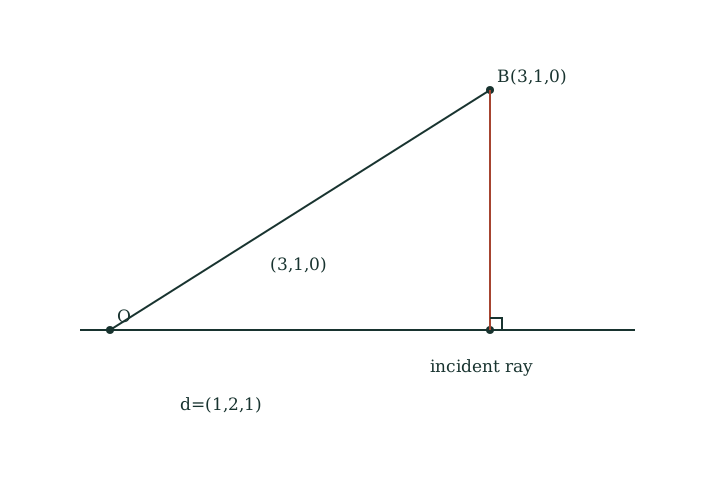
Let be the point .
Shortest distance of from incident beam
.
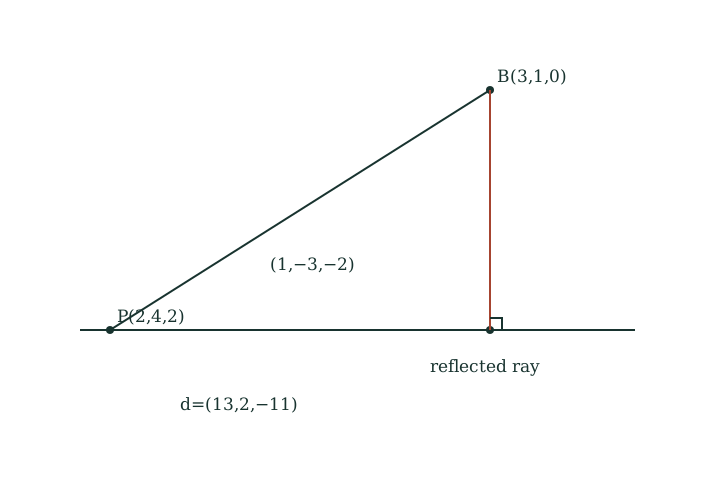
Shortest distance of from reflected beam
.
Since the shortest distance from to both beams are greater than 2, the sensor will not work.
Printed answer key
(i) . (ii) ; , . Short key omits the sensor verdict.
Editorial qualification
The printed vector equation uses a full supporting line with parameter in . The physical reflected beam is the outgoing ray , . For the sensor , , so the reflected perpendicular foot has parameter and lies on the actual ray. The incident foot has parameter , within the segment from to (parameters ). Thus both supporting-line distances apply to the actual beams: and , both greater than 2. The sensor will not work. This corrects an earlier native editorial claim that the reflected parameter was negative; the printed source working is retained.
Source provenance
2025 TJC H2 Math (9758) JC2 MSM: VECTORS. Question booklet PDF pages 4–12 (printed 80–88); solution booklet PDF pages 17–44. Column vectors are typeset as ordered coordinate triples here; the entries, products, intermediate equations and original parameter/domain restrictions are retained.